This article is from the winter 2025 edition of Mobile Baykeeper’s print quarterly, CURRENTS. The magazine is mailed to active members who have given more than $50 in the past year. To get on the magazine’s mailing list, donate here.
By Grant Blackburn
A sign in the parking lot sets the hours for Village Point Park Preserve: dawn to dusk, unless you’re fishing. The park’s waterfront is always open to fishermen. I was there on a mid-September afternoon not to fish, but to clear my mind with a long walk in the woods. A high, clear ceiling hinted at early autumn, but the heat and humidity were intense, broken only by a convective sea breeze from the gentle daily warming of northern Mobile Bay.
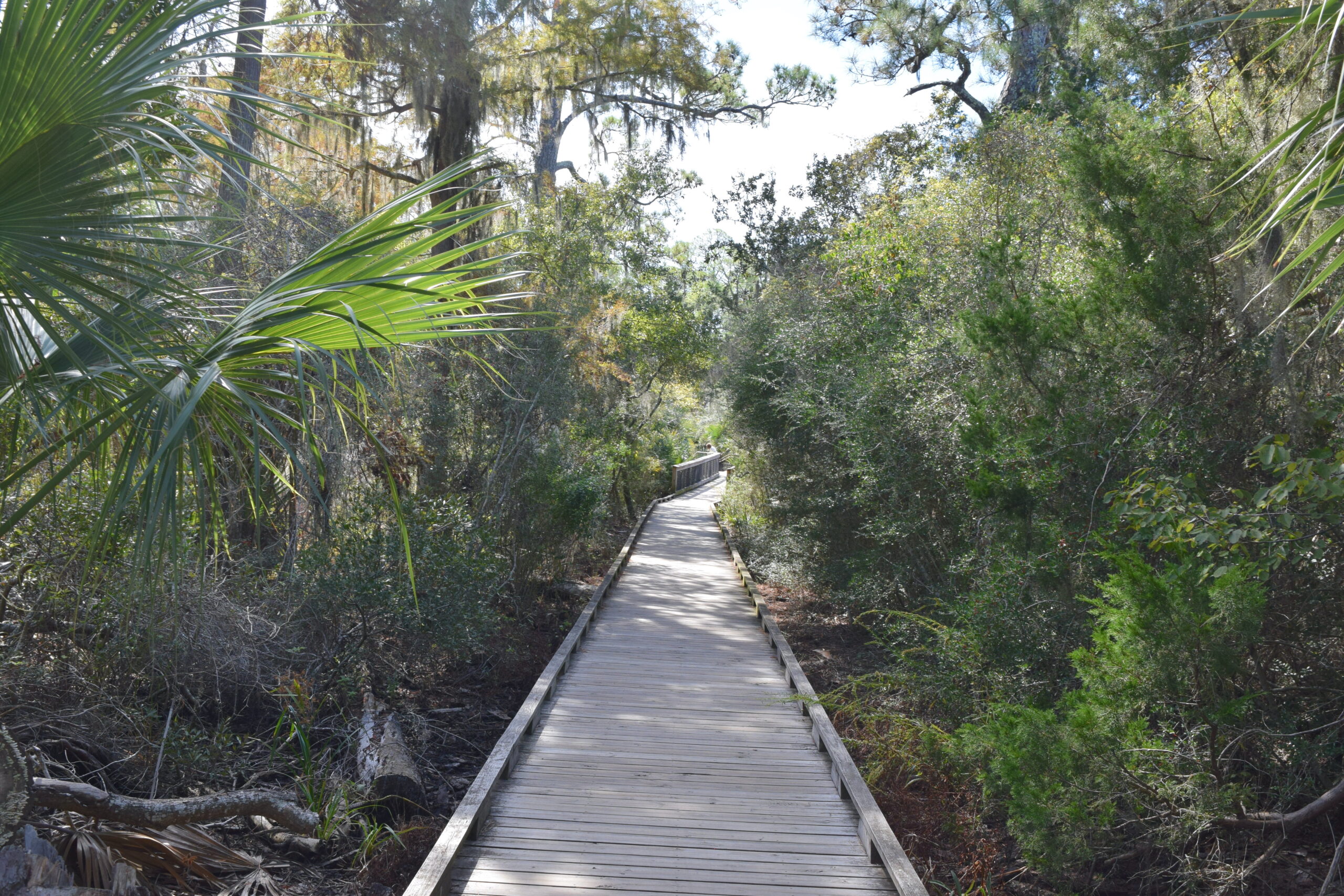
Village Point is an eighty-acre woodland oasis in the heart of the Eastern Shore. The park’s improvements consist primarily of trails built by aspiring Eagle Scouts, some of whom are now scouting out middle-age. The trails go for miles. They are well-worn and narrow, recalling the piney thoroughfares we cut through the woods of North Baldwin County as children. The Village Point trails seem familiar because they always lead to something cool. They wind through mature woods, go by a cemetery older than the State of Alabama, cross a cypress-studded coastal swamp, and end at a large, sandy beach where Yancey Branch feeds Mobile Bay.
The Preserve’s history is rich and novelesque. In 1787, Charles III, King of Spain, conveyed a sprawling tract of land to Dominique D’Olive. The property, then a part of Spanish West Florida, sat on the eastern shore of what the Spanish called la Bahía del Espíritu Santo, covering much of present-day Daphne, including Village Point Park Preserve. By the turn of the 19th century, the D’Olive’s land grant had matured into a sort of outpost. The place was domesticized and held together, but still out on the ragged edge. The D’Olive homestead became known as “D’Olive Plantation,” and by 1830 it reported twenty-five residents, fourteen of whom were enslaved. As D’Olive Plantation aged, lore grew around it like kudzu.
It is legend, but not demonstrable fact, that Aaron Burr came through D’Olive Plantation in 1807, on his way to trial for treason in Richmond. Another story recounts that Andrew Jackson rested troops there during the War of 1812, and inspired them with a rousing speech delivered from the shade of a massive live oak. Solid evidence of Jackson’s stopover is as lacking as the local legend is persistent, but “Jackson’s Oak” still grows in the Village Point woods, marking a place of apocryphal significance. I set off to clear my head with these stories in mind.
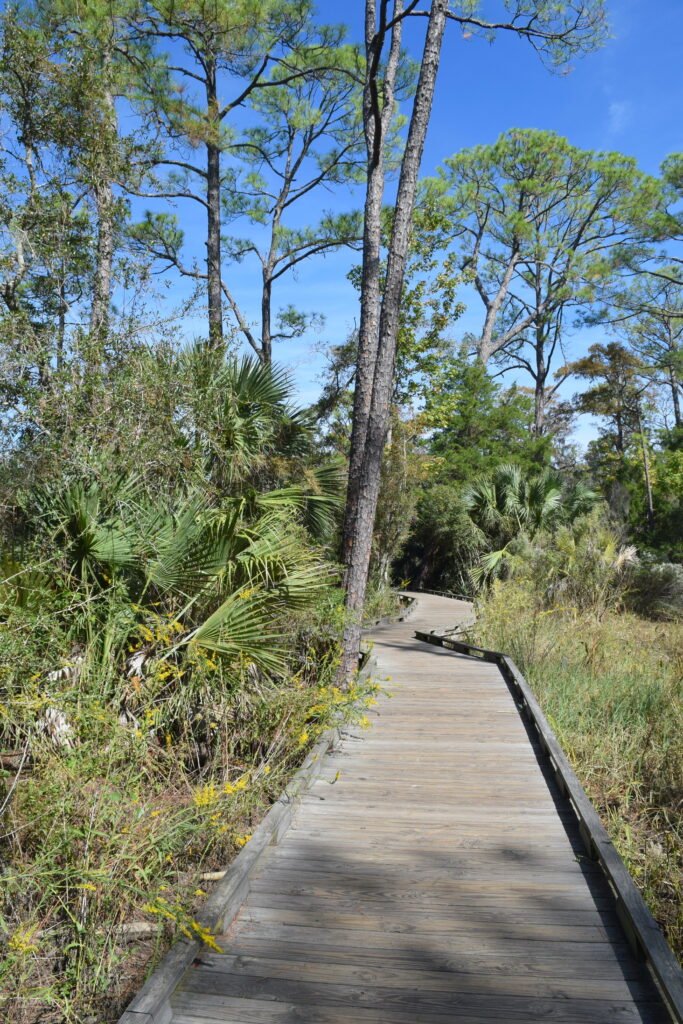
Several trailheads dot the parking lot. Starting down one of them, thick woods and rolling terrain muffled the Eastern Shore’s hum almost immediately. An unbroken canopy of coastal pine forest deflected light and heat, and at ground level it was pleasant. The woods smelled rich and earthy. It was quiet. Road noise gave way to birdsong that contended only with the sounds of squirrels navigating the leafy ground. Intermittent signs marked notable flora: Beautyberry, Sparkleberry, Sweetgum, Poison Oak, Black Cherry, Quercus virginiana, Horse Sugar. Behind drooping muscadine vines, a wild persimmon was bearing young, green fruit.
Then the trail dove abruptly, through a roadcut, and down across a bluff. In a county with little topographic excitement, there is a bluff in the woods, far from Mobile Bay, running parallel with its shoreline. My mind’s eye saw an ancient coastline where forgotten people existed beside a bay whose name is lost to time. I was walking down the trail, daydreaming. How long ago? Who were they? What was the Bay like then? Was it even a bay? What kind of wildlife did those people have to deal with? I snapped back to the present. A very kind lady in an oversized T-shirt had stopped walking Rhett Butler, her Pomeranian, and was warning me about the presence of alligators.
A bit farther down the trail, almost to the Bay, I heard voices and stopped. There was movement ahead, but it did not belong to people. It was a white-tailed doe, retreating from a bend in the trail. The deer picked its way silently through the understorey, and no sooner did she disappear than a couple appeared on the trail where she had been. They never saw her.
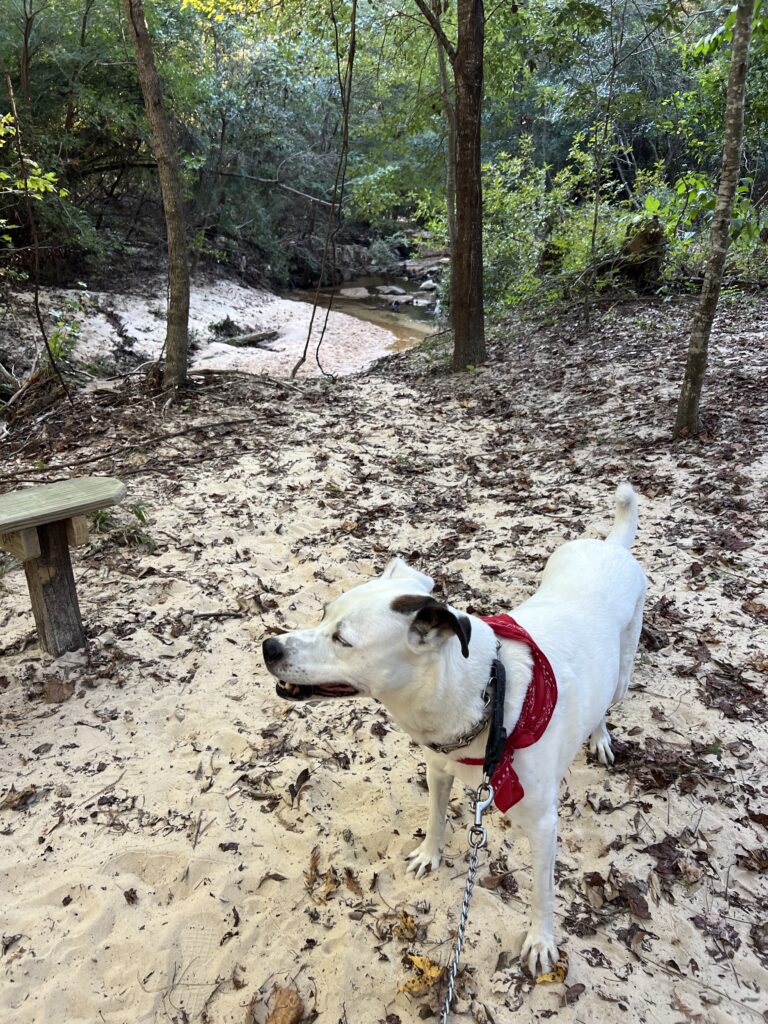
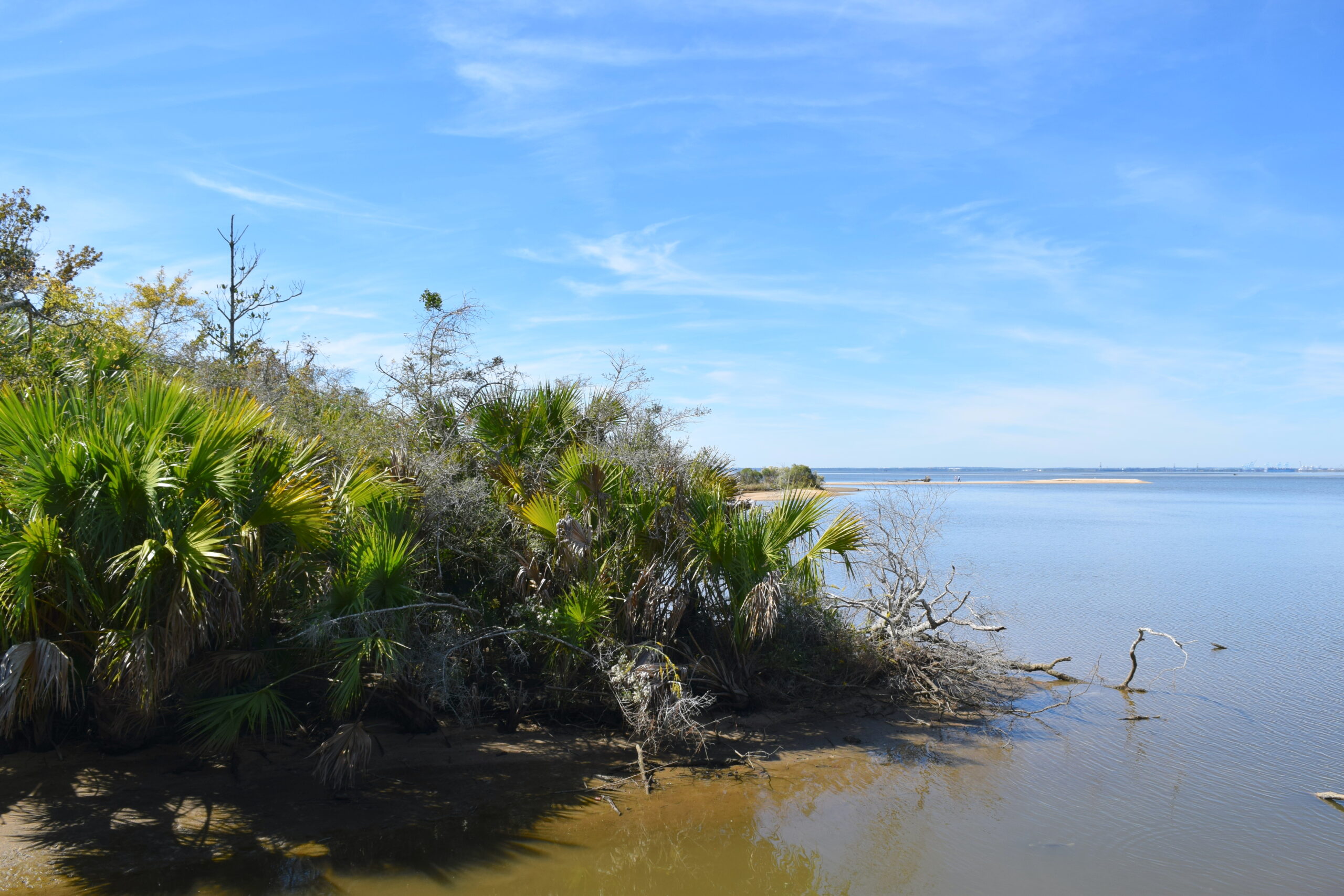
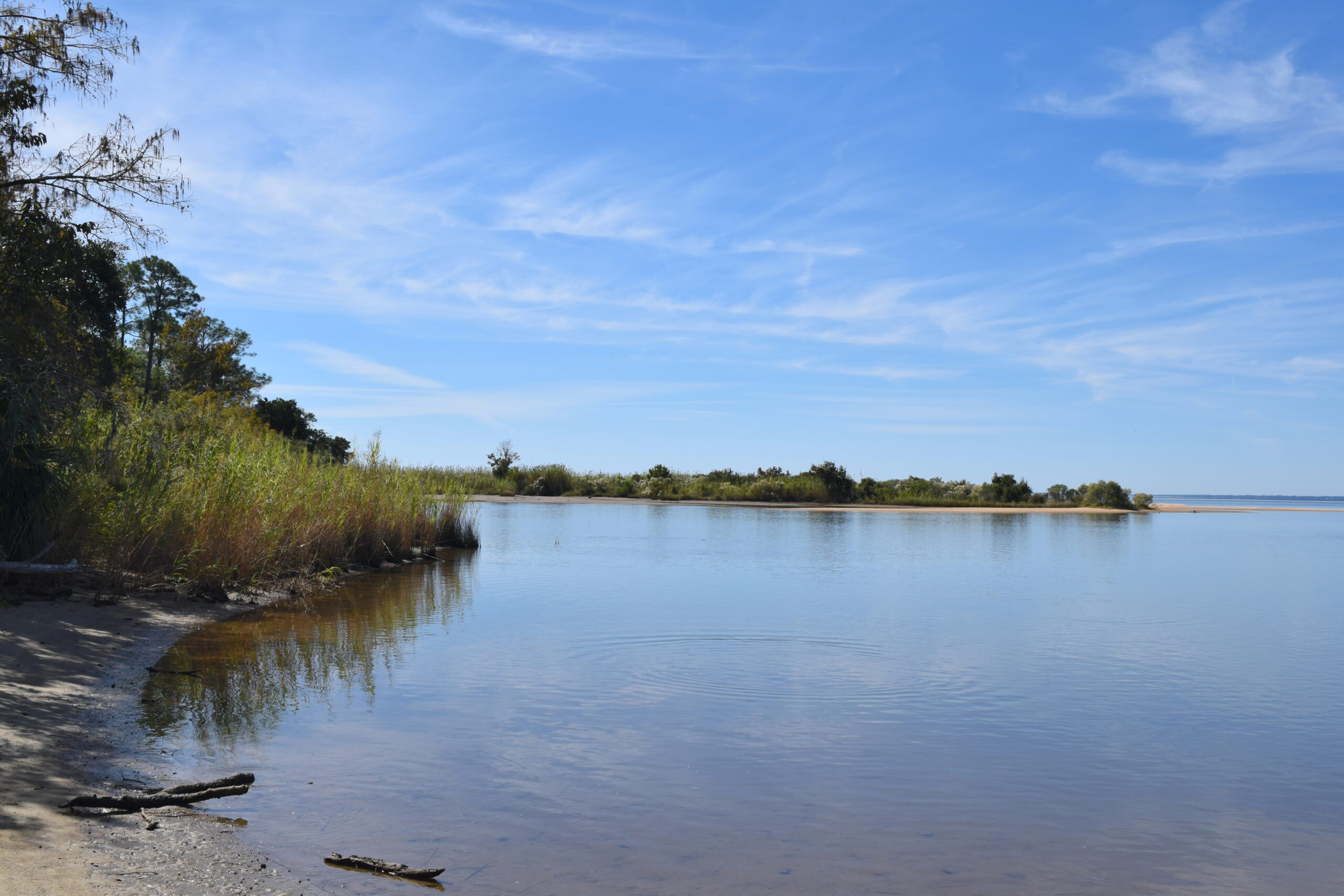
As the trail approached Mobile Bay it crossed Yancey Branch, whose waters were clear and fresh, and whose banks were clad with elephant ears and freshwater vegetation of leafy green. There is a small cove where the branch meets the Bay, and it was teeming with fat, autumnal roe mullet. From overhead came a chorus of seagulls, and the trail opened onto a wide beach. Thousands of gulls and terns mixed on the sand and in the sky. Pelicans fed on mullet. Everything there felt like it was precisely as it should have been.
Turning back, on a different trail leading out of the Preserve, I came to a place where the canopy above was open, and the trail below was blocked by the dismasted crown of a great tree. It had grown to magnificence through multiple wars, countless storms, and the expansion of D’Olive Plantation. Now, with its crown at my feet, reduced to a forgettable obstruction blocking the way to the parking lot, I recalled Shelley’s Ozymandias. “Look on my works, ye mighty, and despair.” A sign at the tree’s base said it was the largest Darlington Oak in Alabama. Beneath those words, someone had written, “Was.”
The Ozymandias oak spoke of the past, but also of the future. A wink to D’Olive Plantation’s former glory, and a nod to the promise of renewal. A reminder about the impermanence of power and the persistence of nature. Not far from the fallen giant, a clearing emerged beside the trail where crumbling brick pillars rose from the undergrowth. They marked the boundaries of D’Olive Cemetery, where generations of people who called this place home lie in permanent rest.
Among those I found resting was “Mary, Wife of Uriah Blue,” who died in 1826, and whose headstone tells us nothing more of herself or her brief marriage. But Uriah Blue served under Andrew Jackson during the War of 1812, and had been ordered to lead Jackson’s rear guard of 1,000 men eastward to the Escambia River, in the winter of 1814-15, while Jackson marched his troops west to the Battle of New Orleans. What to make of the fact that Uriah Blue’s wife was laid to rest on D’Olive Plantation? Mark another point for the legend of Jackson’s Oak.
Village Point reminded me that our actions can affect people we’ll never meet in ways we could never imagine. The park is a monument to the stewards whose decisions preserved the land for more than two centuries. People like Dominique and Louis D’Olive, who chose to leave the Ozymandias oak. People like Al Guarisco, whose passion for Village Point led the City of Daphne to preserve it. And people like my childhood friend, Jay Smith.
Several years ago, Jay and I were talking about his Eagle Scout project. I had no idea what Jay had done. I just knew he was an Eagle Scout, and that he had completed an act of public service to earn the rank. For whatever reason, I expected that Jay’s Eagle project would have been monumental. I am not sure why — I just think that highly of Jay. He surprised me that day by speaking about it almost dismissively. Jay had only cut some trails, he told me, and he was pretty sure they had become overgrown long before anyone used them.
I had just ascended the inland bluff, and was almost looking for the parking lot, when I nearly fell over an old trail marker. It was a large arrowhead, carved from wood, nailed to a derelict 4×4 post. The arrowhead was losing the battles against rot and time, but it still pointed down a well-worn trail to D’Olive Cemetery and Mobile Bay. Carved into it with a narrow blade, barely legible after 22 years of exposure, were the words, “Jay Smith. BSA T-87. Eagle Project. Aug. 15, 2003.” So thank you, Jay, for cutting trails along which you didn’t expect to walk. I suggest you go check them out, and maybe clear your head, the next time you’re in Daphne.
Village Point Park Preserve is located at 27710 Main St in Daphne.