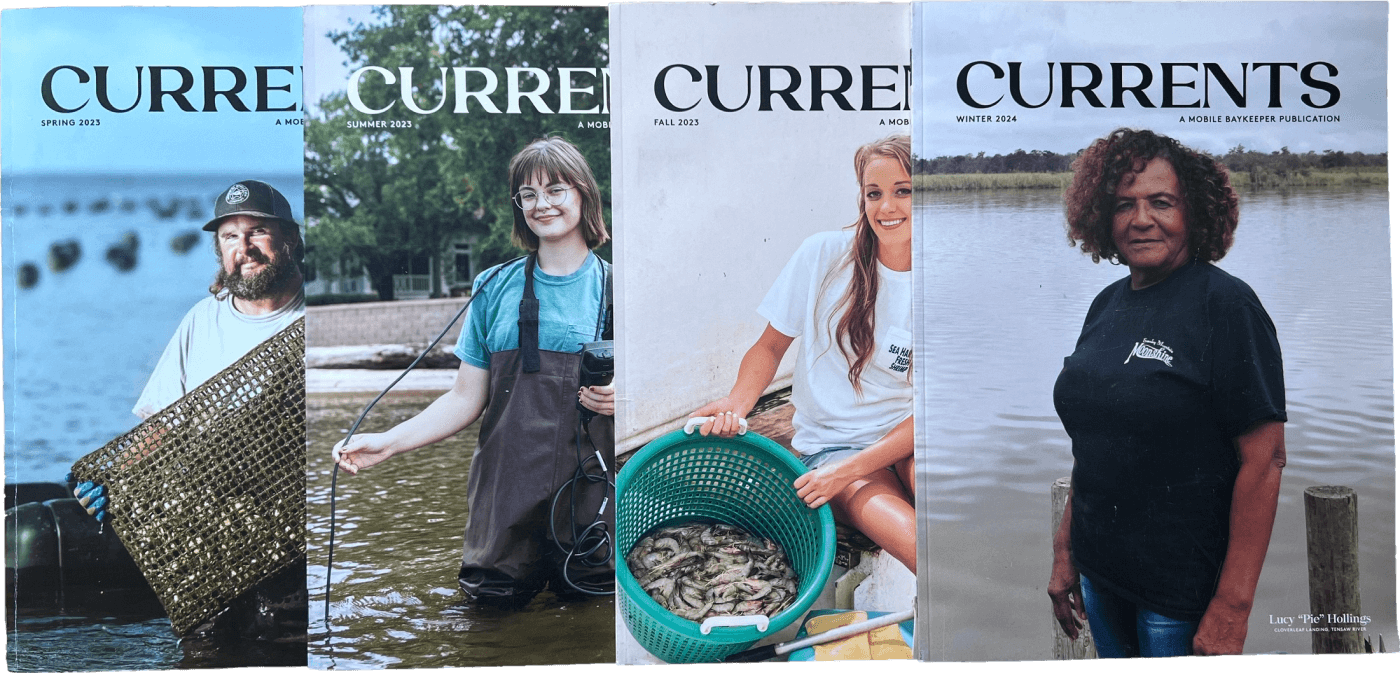
This article is from the 2026 fall issue of Mobile Baykeeper’s print quarterly, CURRENTS. The magazine is mailed to active members who have given more than $50 in the past year. To get on the magazine’s mailing list, donate here.
By Nick Williams | Photos by Courtney Mason
Don Green was maybe five or six years old the first time he watched his father at the kitchen table, hunched over a weathered Farmer’s Almanac. “I asked him one day, ‘Why do you look at that magazine?’” Don tells me. “He showed me the fishing times in there, the moon phases, and the tide charts.”
By the time Don was nine, he was drawing his own solunar charts. It was a precocious start to a lifetime spent as a student of the water. Years later, readers of Great Days Outdoors (originally Gulf Coast Outdoors) magazine would flip straight to the back of the magazine for Don’s solunar charts, seeking a bit of that inherited wisdom. I know, because I was one of them. Long before I worked for the magazine, I read those charts as a kid, right alongside the stories by men who knew our local woods and waters better than I did.
Don was what he called a “plank owner”—an original contributor who helped establish the magazine and wrote for it for roughly 30 years. When the print edition finally ended, people didn’t mourn the editorials as much as they mourned Don’s charts. That simple page of numbers and stars, often torn out and taped to a refrigerator, was the most valuable part of the publication to many.
This made Don a fitting guest for the inaugural episode of the Mobile-Tensaw Delta Fishing Report podcast in early 2026. At Great Days Outdoors, the medium has shifted, but the intent remains: collecting the knowledge of people who have spent their lives on these waters and passing it along to the next person willing to listen.

Steel Rods and Salt Pork
“The first reel I ever used was a straight reel,” Don says when asked about how he got started fishing. “Didn’t even have a gear ratio. You turned it once, the spool turned once.” The rest of his equipment wasn’t much more sophisticated. He describes rods made of solid steel, stiff and heavy, and fishing line that was thick, brightly colored nylon. Boats were scarce because most working families simply couldn’t afford one. In the 1940s, kids didn’t have fiberglass hulls, EFI four-stroke engines, or forward-facing sonar. They had the local creek bank and whatever they could scrounge.
For Don and countless other South Alabama boys, that was plenty. He spent much of his childhood along creeks in Washington County, learning the water by being around (and in) it constantly. There were no tackle aisles full of scented plastics to choose from, so bait was often whatever you could find, dig up, or improvise. Don chuckles as he recounts sneaking a piece of his mother’s salt pork out of the house, cutting off a chunk and jigging it around until something finally bit.
Once he caught that first fish, the day became considerably more self-sustaining. “I’d take the fish out, cut his stomach open, take his stomach out and start using it,” he says. Bass and jackfish became bait for the next fish, and what started with a stolen piece of salt pork could turn into enough fish to help feed the family. “They would wear that thing out,” Don says. “I fed the family many times” that way.
It is the kind of story that may sound foreign to a modern angler surrounded by high-modulus rods, hundred-dollar glide baits, and electronics capable of showing individual fish moving beneath the boat. But Don wasn’t making a case that fishing was better simply because the equipment was worse. What struck me was how much those early years forced him to observe.
Undistracted by relentless algorithms pushing “the next new thing” that would help you catch more fish, your success depended on something that perhaps isn’t common anymore; the capacity to pay attention to what was happening in front of you.
That habit of paying attention would follow Don for the rest of his life, showing up later in the homemade lures he built, the detailed fishing logs he kept and, eventually, the solunar charts that became familiar to generations of Great Days Outdoors readers.

The Cypress Boat
That same resourcefulness shaped the way Don first got out on the water. Sometime around 1963, he and a friend were driving along the west side of Lake Seminole when Don spotted what looked like somebody hunched over in a boat far offshore. He told his friend to pull over, stripped off his shoes, and swam a quarter-mile out to investigate.
“When I got within about 50 yards, I realized it wasn’t somebody humped over,” he says. “It was a tuft of grass.” Committed, Don swam the rest of the way, hauled the derelict vessel to shore, and after failing with the help of local authorities to find its owner, eventually claimed his first boat.
It was 19 feet of cypress, tremendously heavy, and propelled by a single paddle through a sculling notch. “Man, that thing was unbelievable to fish,” he says. Without the drone of an outboard, he could slip through creeks quietly, sneaking right up on bass, crap- pie, and whatever else was hiding in the backwaters.
Eventually, the cypress gave way to aluminum and then fiberglass, and the sculling oar gave way to outboard engines. “I’ve been running up and down the Delta like a chicken with its head chopped off ever since,” he laughs.

Kindness on Mallard Creek
During our interview, Don described a special Christmas morning on Mallard Creek. He had been scheduled to work Christmas Day, so his wife and children had already gone to Florida to spend the holiday with family. Then, on Christmas Eve, Don got word that he wouldn’t be needed after all. With the house empty and nothing much keeping him there, he decided he might as well go fishing.
He launched the next morning from what was then Peterson’s Landing and ran his little boat out into the Delta before daylight. A strong cold spell had pushed birds south, and as the morning began to brighten, Don remembers that the sky and marsh were alive with ducks. “There were thousands of ducks that morning,” he says. “Thousands and thousands.” Even after all his years in the Delta, he still remembers it as the most ducks he ever saw there at one time.
Don worked his way up Mallard Creek, fishing as the first light came up, when he noticed smoke rising from one of the old camps farther ahead. He recognized the place and figured the owners, Miss Mary and Mr. Jim, were there. As he got close, he heard Miss Mary call out through the morning air, “Don, is that you?” When he answered, she invited him over for a cup of coffee.
Don paddled over and joined them. Somewhere in the conversation, Mr. Jim asked why a man with a wife and young children was alone on Christmas morning, and Don explained that he had expected to be working. His family was already in Florida by the time his plans changed, and fishing seemed better than sitting around an empty house wishing he was with them.
Mr. Jim didn’t let him dwell on it long. “Shoot, man, I’ll go fishing with you then,” Don remembers him saying. Miss Mary had only one condition: they needed to bring back enough fish for dinner.
The two men went back out, and according to Don, it didn’t take long. “It wasn’t 45 minutes,” he says, before they returned with a mess of fish. They cleaned the catch, and Miss Mary fried it up with grits and cornbread. What had begun as a Christmas morning Don expected to spend alone became one of the holiday memories that stayed with him longest.
“Man, that was one of the most wonderful Christmases that I ever endured,” he jokes. He was still missing his wife and children, and he made that clear when he told me the story, but there was something about the morning that stuck: the cold air, the thousands of ducks, smoke coming from a camp in the swamp, a cup of coffee offered by people who knew him, and a fresh mess of fish shared at the table.


“Used to be”
Listening to Don, I felt a familiar twinge of sadness—the feeling of fishing the ghost of a place. Don remembers water that was clearer, ducks that were plentiful, and a time when kids could wander freely. “Nobody wants you on their property anymore,” he says. “It used to be, the kids had the run of all the property.”
That loss of habitat and access is part of why Don has spent his life helping younger fishermen. Even now, high-school tournament anglers come by his shop for hand-made baits, which he sells below wholesale. “That’s what I’m all about,” he says. “Trying to help people be better fishermen.”
The Delta is changing beneath them. Don has watched creeks grow shallow and grass beds disappear. Mallard Creek, where he enjoyed that Christmas, once averaged 10 feet deep; today, finding six is a challenge. “If they don’t do something, our Delta is going to be dead,” he warns. “And it’s killing me to see them not doing anything about it.”
Don’t mistake this for the tired gripe that everything was better in the old days. His memories are an important baseline. He remembers what the creeks looked like before they silted in because he ran them for decades.
Don confides to me that he doesn’t get on the water as much as he used to these days, but he’s still trying to hand a lifetime of experience forward. The Delta and the equipment used to fish it have changed. Kids today have carbon-fiber rods and forward-facing sonar, which maybe helps to offset the challenges caused by the Delta’s changes, but nothing replaces what Don values most: someone willing to teach, and a kid willing to listen.
When I ask for his advice for a young angler, he doesn’t talk about sonar. He doesn’t even talk about solunar charts. He tells me to “listen,” to be respectful to my fellow sportsmen, and to learn from those willing to help. Then, once you know enough to get by, use your own mind and form your own theories, and be willing to share them. That is the summary of his life. Don learned from his father, learned from the water, spent decades writing for Great Days Outdoors, and is still, even now, passing it all to the next generation.
*Navy slang for a member of the original crew of a United States Navy ship or unit who was present when it was first placed into active service or commissioned