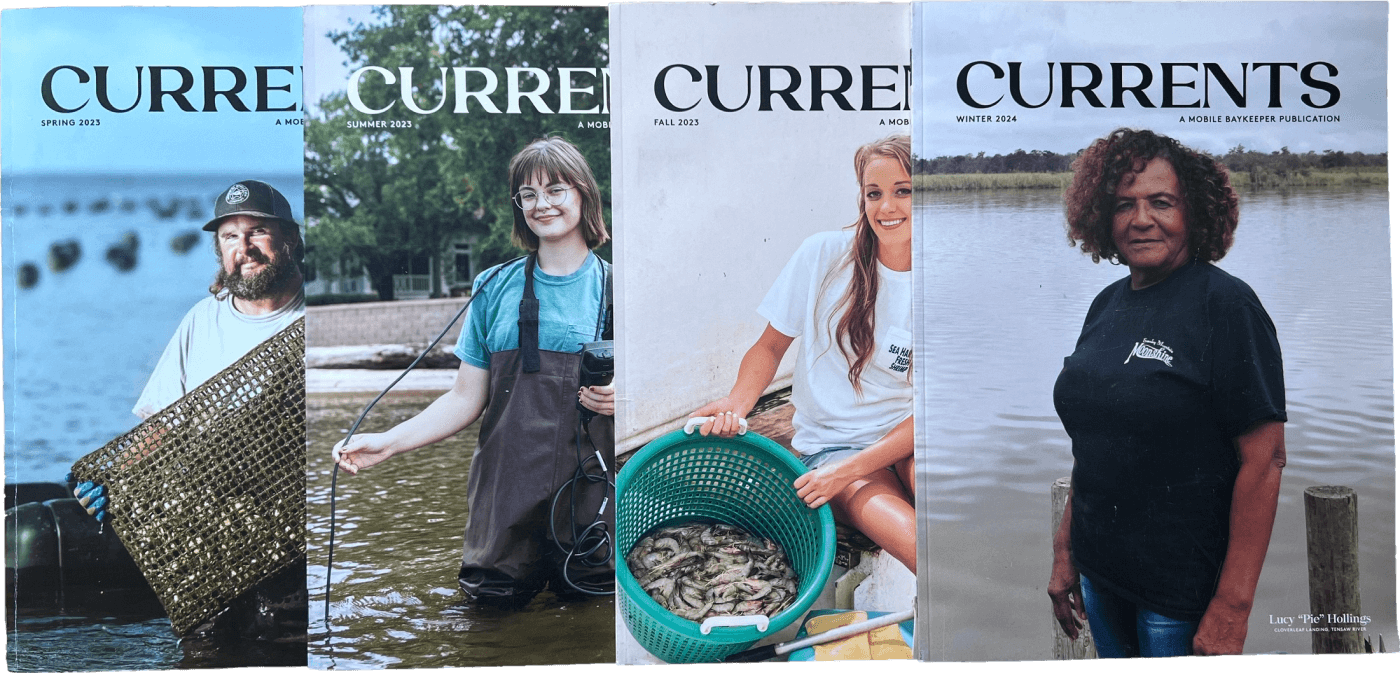
This article is from the spring 2026 edition of Mobile Baykeeper’s print quarterly, CURRENTS. The magazine is mailed to active members who have given more than $50 in the past year. To get on the magazine’s mailing list, donate here.
By Caine O'Rear
An in-shore charter guide who grew up fishing with his dad on the rivers and streams of coastal Alabama, Patric Garmeson knows our local fishery as well as anyone. In January we caught up with the Ugly Fishing captain and angled for specks off of Dog River. We gabbed about this year’s trout bounty, the long-term effects of mud dumping in the Bay, and the future of our fishery.
Why has the fishing been so good this year?
With the hatchery program, we have a lot of things going in the right direction, in conjunction with the tighter restrictions and having to let go of the bigger breeder fish. So now anglers are being forced to do different things and some of the culture around here has changed for the better.
We’re in kind of a good period and people forget about when things were bad. When trout fishing was really bad, I was fishing for redfish and stuff like that. We’re benefiting from good biodiversity, but looking at the decline of trout fishing over the years, we had a really nice peak that happened immediately following the oil spill.
The year 2011 was really good and the waters were closed for most of the year. So after the oil spill happened, they did that full mandatory closure where no fish were allowed to be harvested. The following year we had the best big-trout class that I probably had ever seen.
And then in 2012, it kind of dropped off and then progressively got worse all the way through 2022-23. In 2024 we saw a pretty noticeable increase in speckled trout stocks. But in 2012 we saw it declining for years. There are areas that used to have thick, fat healthy oysters and now they’re totally gone. We’re in a period right now where I think regulations have benefited the culture and the stock. But I think, if we get the habitat back, then we really have a rebound on our hands.
Texas has seen some really drastic, big fish kills and stuff. But because they have so much habitat and they have tight regulations, that fishery is now as good as some people have seen it since the ’80s or ’90s. And they have a lot of habitat to support speckled trout for coming back. So my idea is, we’re doing the right things.
Regulation-wise, we still have to improve the culture more, and by culture I mean respect for regulations. A big portion of the fishermen targeting speckled trout really appreciate bigger fish and return them back to the water, even without having to obey the regulation.
Prior to that everybody just kept them and you looked for getting your limit, and the bigger the fish the more excited you were about keeping that limit. That’s changed a lot. Legally, you’re allowed to keep one fish over 22 inches — but a lot of fishermen don’t. They may catch several over 22 inches and be happy to turn them loose. They may still keep a limit of fish but they’re going to be in that 17-to-19 inch range. They are more abundant in that size and they don’t necessarily provide as much stock, as far as biomass and the amount of eggs that they’re able to produce. Once they get up to 20 inches and bigger, then they exponentially produce more eggs and more offspring. Plus, it’s a good strong genetic indicator for fish to reach that size. So there’s some value in returning that size of fish.
Talk to me about the mud-dumping issue and its effect on the fishery.
The year 2012 is when they started doing the open-water dredge disposal again. There were some areas where I remember seeing the dredge pipe. We had some great fishing even while the dredge pipe was there and there were times when we were catching fish off of the dredge pipe. But then once all of that was over with, we saw where those oysters that were really plentiful started declining to basically non-existent now. And that’s 13 years ago and we are not seeing any kind of rebound. That’s the part of it that concerns me. We had such a lush oyster reef up there on the north end of the Bay that doesn’t exist anymore. It’s 13 years removed from when the fishing was magnificent.
The commercial fishermen used to make half of their winter living up that way, setting gill-nets, catching sheepshead, black drum, and mullet. When those oysters were there, you could look out on a calm day like this and see tails sticking up out of the water where these big black drum were nose-down and feeding around these oysters. I mean it was an incredible sight. You could literally look out there and see hundreds tailing all at one time and that’s definitely a thing of the past. That was one of the premier hot spots, that north part of the Bay prior to 2012.
There were a few of us that would boat race to get to some of those hot spots where the oysters were really thick and you would have this oasis where the big speckled trout lived there in big numbers.
As a fishing guide, you’re looking at migratory patterns.
We see a lot of a lot of fish-tagging happening. We do that on our own voluntarily. So I get to see a lot of speckled trout that are tagged in Dog River and end up towards Dauphin Island or Fort Morgan and the Delta.
It’s pretty exciting to get those reports back. I’m not an expert by any means but I do tag a lot of fish and it is always interesting and intriguing to get the reports back and see what’s happening — where the fish go and their growth rates and stuff. I’m definitely into the science side of things.
Are you surprised the fishing has been so good this year?
I think the surprise is that there’s so little habitat from what we had in the past. I mean, there’s probably fewer oysters on the bottom than possibly ever in my lifetime right now. So there are areas where speckled trout need to be able to live and survive and grow up.
The assessment of the state’s fish-stock program shows that the numbers are good for speckled trout and their assessment is based on a variety of methods of acquiring the data. There probably is a significant increase in biomass. But the part of it that does concern me is that there’s good fishing, but a lot of times it feels like it’s quite isolated. You may find a stretch of river or an area in the Bay where you do have some habitat, whether it’s man-made or natural, and there may be a lot of speckled trout right there in that particular area.
You’re talking about seagrass?
Seagrass, or it could be oyster shell. Like some reef remnants where it’s just hard bottom and the shells are exposed. It may not be living oyster reefs but the fish still return to these kind of areas. My concern is that we maybe have a false sense of rebound because we find these productive areas and the fish become a little bit more concentrated, because we have less habitat.
So then we’re kind of high-fiving over good fishing but it might be a result of the fish being condensed into what little habitat is remaining.
Like those fish are going to the country club and everyone else is kind of dying off?
Yeah, yeah. You’ll find areas in these rivers that have clam beds and stuff. Those are important. You’ll find areas that will have exposed clam shell, and trout really like those areas.
If you’re throwing out and you’re getting stuck in the mud and stuff like that, they usually don’t hang out in really mucky, nasty areas. They generally tend to be around harder bottom with firm structure or grassy bottom, where there’s actually vegetation growing. So I guess what I’m getting at is, yes, speckled trout fishing has been good the last year and a half, probably as good as I’ve seen it in 10 or 15 years.
But I’m also wondering if it’s not a result of having developed some good fishing habits and understanding where they should be and that we may be seeing a tighter isolation of fish.
So we have a lot of fish in smaller areas which make them easier to catch. Optimistically, we do the right things in water quality and water improvement and oyster restoration and we start getting more and more of these areas starting to rebound or regrow themselves. And the speckled trout that we have right now start producing and continue to produce and we have a flourishing upward trend on speckled trout and other inshore species.

When did it start getting good this year?
I really noticed the trout fishing improving in the fall of last year. You get into some of these situations where you’re measuring success based on a previous time that wasn’t very successful. But I track my numbers. I track the fish that we’re catching and I have been doing that for quite a while, as well as the numbers of fish that we’re catching and the quality of the fish we’re catching. I would say it is probably better than what we’ve seen in the last decade, which is very encouraging.
The long-term success of this fishery is going to depend on the habitat. And we just can’t turn a blind eye to it. What’s going to happen if we have another downturn and we don’t have the habitat to support another good rebound?
Essentially, what will happen, is more regulation. The state will reduce the bag limits and they potentially could change the upper size that you can keep, or maybe eliminate that upper-size fish. So if we don’t have the habitat to support a good fishery, then the angler is going to take the brunt of it. A six-fish limit could all of a sudden turn into a three-fish limit. We have more people, so then it’s going to be an easy decision by the state. They’re going to say, "Well, stock assessments are down. If the number of anglers is up, the only direction to go is to reduce the amount of fish that each person’s allowed to keep,” and then you have people saying, “Oh well, they’re just trying to take everything away from me.”
If we put a lot of effort into in a healthy habitat and then we don’t have to have these conversations about “Well, we got too many fishermen and not enough fish.”
How educated is the angler community about habitat restoration?
I don’t think it’s educated enough on the subject. Too many people focus on the fish and not how they got here. We’ve got some areas to improve upon — just getting people educated on the value of the healthy oyster and the healthy seagrass and stuff like that. I mean, when I was a kid (I’m 45 now), I remember seagrass and aquatic vegetation growing up and down the Eastern Shore.
I didn’t even like wading around some of the areas of the Eastern Shore because you had grass growing under your feet full of clams and sharp objects and stuff. A lot of people obviously weren’t around then and don’t really have the point of comparison. If someone moved here 10 years ago, they might think none of this existed. Their basis of comparison is moving forward from whenever they first moved here. My assessment of what was good is based out of the ’80s and ’90s.
I have customers that are 80 and 90 years old that grew up here and the grass and the oysters they say they saw and experienced as kids, it almost brings tears to my eyes thinking about what they saw to where it is now.
When did you start guiding?
I got my captain license in 2010, so the year of the oil spill. I did not start full-time guiding until 2017. I grew up on the Eastern Shore and have been fishing my whole life.
I was born in Pennsylvania and my parents moved down here when I was five. My dad always loved to fish, so it was something that’s been a part of my life since I could walk.
Every time I’m on the water, I want to learn something. I love catching fish, but for me to go and catch 10 fish in a place that I know where they typically hang out, versus catching two in a place that I’ve never fished before — those two are more rewarding to me than the 10 that I kind of expected to be there. So I think it’s that sense of discovery that drives me and motivates me.
What can the average angler do to improve habitat restoration?
He’s got to think habitat first — habitat and water quality are the two driving forces. For instance, I had a gentleman on my boat that had a sport-fish hatchery for raising largemouth bass and striped bass and some other species for freshwater lakes. And we were talking about the importance of managing waters for the big breeder fish. But he said the most important thing for a healthy fishery, regardless of freshwater or saltwater, comes down to water quality and habitat. He said if you don’t have healthy water to be able to have the nutrients in the water for those hatching fish, the fish that are just popping out of the egg — those things have to have an abundance of food within the first 48 hours or they all die.
So you can have all the healthy breeder fish that you want, but if their eggs drift into areas that are low in nutrients and low in value, then it’s all for nothing. So that nursery has to be healthy. It has to have the cover for those fish to hide in once they get big enough. Because they go from hatching into a larval stage, and that larval stage is when they’re feeding on phytoplankton and zooplankton. Those are the nutrients in the water, so that’s the part that is ultimately the end-all, be-all for the health of a spawning cycle.
So you can try to do all the management you want. And if you don’t have that stuff in place, then it’ll never survive long-term, but long-term survival is coming from health of the water and habitat for those fish to live in.
What are you thoughts on the state’s fish consumption advisories?
It’s something I’ve never really paid much attention to. I consume fish personally and take guided trips. We are all over the entire Bay. Most of the fish that we consume (sheepshead, redfish, speckled trout, flounder), most of those have some sort of migratory area, so they’re not necessarily locked into any one particular area, so it’s never been on my radar a whole lot — maybe it should be.
For the freshwater fishery stuff, there are advisories to not eat largemouth bass. And there are a lot of people that do eat largemouth bass in our area. Knowing that those people, who are enjoying largemouth bass for dinner and feeding their family on it, and they’re potentially poisoning their family with fish that are heavy with mercury and they’re doing it on a regular basis — that does make for a sad story in my opinion.
I’m sure there could be some balance where maybe eating largemouth bass a couple times a month isn’t harmful. Maybe it is. I don’t really know what those medical guidelines are, but I know that we do consume a little bit of fresh tuna that’s caught in the Gulf, and I know that’s a fish to keep an eye on with mercury and bioaccumulation and stuff, and the king mackerel.
But I would be curious to know and understand more about some of the fish that we harvest, like the sheepshead, flounder, speckled trout, and making sure those are safe for me and my family.