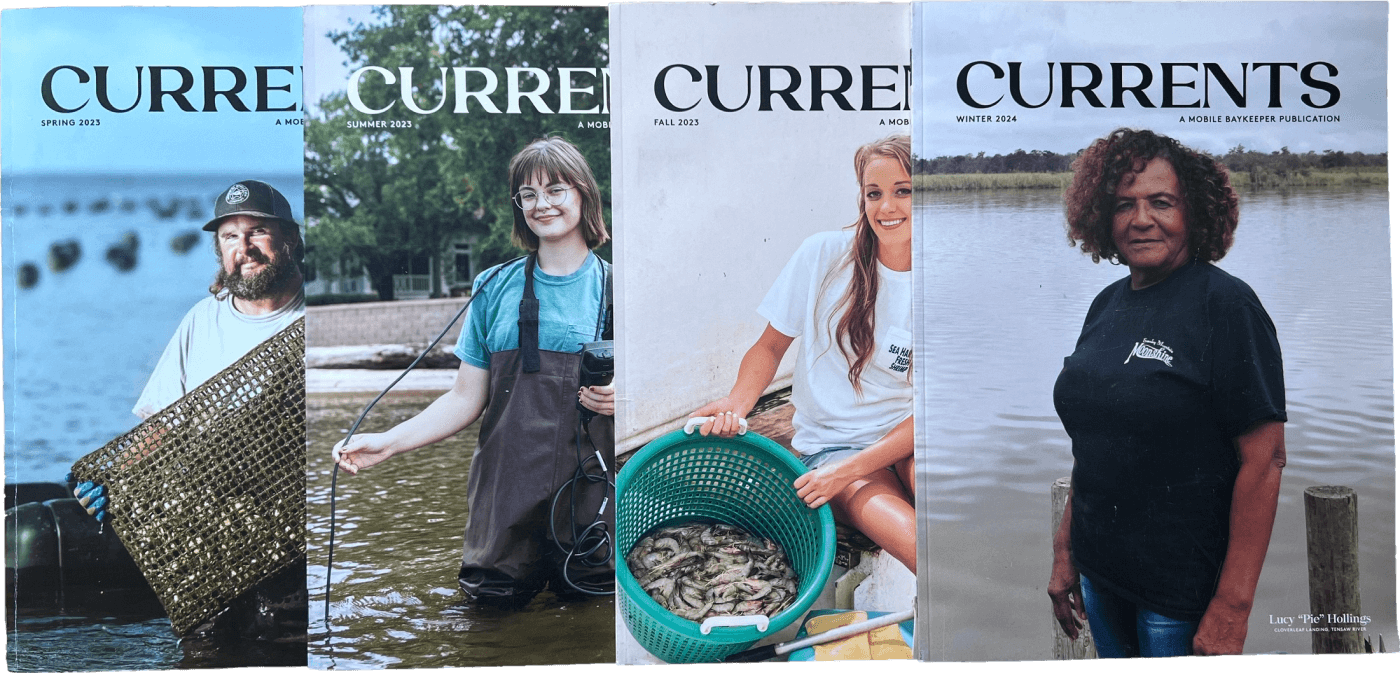
This article is from the winter 2025 edition of Mobile Baykeeper’s print quarterly, CURRENTS. The magazine is mailed to active members who have given more than $50 in the past year. To get on the magazine’s mailing list, donate here.
By Virginia Kinnier | Photos by Courtney Mason
One right turn and 0.1 miles from bustling Highway 98 sits a converted barn that houses Nature Connect Preschool — well, the backpacks at least. In the six acres of dense forests and winding trails surrounding the barn, class is in session. Butterflies and bumblebees accompany children throughout their lessons, the soft mumble of walkie-talkies echo in the woods, and a Nature Shelf overflows with the day’s treasures: clay, sticks, shells, and leaves found in the nearby creek that will go home in backpacks like daily progress reports at the end of the day.
Founded in 2017 by Fairhope native Brinkley Hutchings, Nature Connect began as a one-week kids’ camp at Stedman’s Landing, a short walk down the beach from the house Brinkley grew up in and still lives in today. The original twelve campers brought backpacks filled with supplies to a spot on the Bay where they spent the day playing, exploring, and learning.
That first camp was such a success that the following year Brinkley started the first preschool class, two days a week with eight kids at Village Point Park, doing much of the same thing. Unbeknownst to Brinkley, the congregation at Church of the Apostles where she was a member got wind of what she was doing and offered her the barn on their property, as well as the surrounding acreage, in a 50-year lease agreement.
While it may have started with humble roots, Nature Connect has blossomed into one of the most sought-after early learning programs in the area and beyond. Renovations to the barn allowed for the addition of a screened-in porch with cots for rest time, a kitchen, restrooms, and classrooms with cubbies to accommodate the now 136 students (ages 3-12) enrolled during the school year and the 300 to 400 who come through the 28 summer camp sessions.
“We have children on the waiting list who haven’t even been born yet,” laughs Jennifer Clark-Grainger, the program director at Nature Connect. “We also have some families who moved to this area just to go to school here.”

When her own daughter enrolled, Jennifer had a front row seat to what was happening at Nature Connect and she knew she wanted to be involved. With a degree in archeology and five years of experience in children’s programming with the USA Archaeology Museum, she was a perfect fit and signed up to be a substitute teacher. Within the year she was full time, and now she serves in a leadership capacity.
“It takes really unique educators to choose this path,” Jennifer admits. “We have an all-female staff of twelve with a six-to-one student-teacher ratio, so two teachers in every class who each contribute uniquely to our curriculum.”
Jennifer is also the tour guide on campus today, and she begins by setting off down the hill toward the woods, diagonal beams of sunlight slicing through the openings in the canopy of pines and hickory trees overhead. We pass a chicken coop, a frog pond, and a mud kitchen. At the bottom of the hill, she points out a set of picnic tables grouped together beneath the trees.
“While they do work inside the classroom a little bit, this is where they will do their math, handwriting, journaling,” she explains. “This is also where we do something called a ‘sit spot.’ We ask, ‘What tree do you feel called to today? Come have a seat under it.’ We start out with two-minute increments and work our way up to twenty. The whole purpose of the sit spot is to be still in nature long enough for nature to come to you. You're seeing ants, you're hearing birds, and you're starting to tune in to all your senses and learning how to orient yourself in nature. There are so many natural ways to learn, and all the data proves that children can actually focus better in nature.”
We turn deeper into the forest, and as we begin our descent down a narrow, winding path, the shade of the trees thickens to provide complete coverage from the sun. After a few minutes, we exit the wooded path and step into cool, clear water that flows almost playfully in the direction of Mobile Bay.
“This is Red Gully Creek,” Jennifer announces with a smile.
Further up the creek, a group of twelve four- and five-year-olds, also known as the Raccoons, give us a masterclass in the joys of outdoor learning. We watch from the sandy banks of the creek as some children dig for clay while others fashion bows and arrows out of sticks and string.

“There's always archetypes that rise to the surface, and the kids will learn to identify as something because that's where their interests are,” Jennifer says. “We often have hunters in the group who catch all the salamanders and the frogs and the worms, and we have to make sure they're not in their backpacks when they go home. We have the ones who are super physical — I call them the Bam Bams — who just want to run and jump and splash, and they're given the freedom to do so within safe parameters. And every once in a while, we'll have just a true naturalist come through, like this little boy named Buddy, who I had to constantly learn more about mushrooms for so I could answer his questions.”
In a world where you can Google anything and receive immediate answers, Nature Connect is resuscitating a childlike sense of curiosity, wonder, and discovery.
“We call it the art of questioning, and we are trained in that,” explains Jennifer. “We want to encourage them to become curious enough to ask a question. Say we find an animal track in the forest, a child might notice it and ask a question like, ‘Which animal do you think it is?’ And instead of providing the answer, we will encourage them to use their deductive reasoning skills to try to figure it out themselves, usually by answering their question with a deeper question that will leave them wondering.”
Two boys race by, uninhibited by shouts of “No running” or “Keep your voices down” as their laughter echoes up to the treetops. They head to the splash zone, a dedicated area of the creek for just that: splashing.

“They know that we have to be able to see them to stay safe, but they’re allowed to go exploring up and down the creek within the boundaries we set by tying red flags on tree branches,” Jennifer explains. “It’s not always perfect in the beginning, but we want to allow them risky play; it’s creative and it’s important for their bodies. So, we just set parameters. A lot of people might think we’re a hippie school with no structure, but I beg to differ. I think we need more structure than most to keep them safe.”
Speaking of structure, a concern some applicants have is the incorporation of the academic standards in such a nontraditional, academic setting.
“We meet all state standards and conduct regular academic assessments at the beginning and the end of the year, but we also add nature assessments to our curriculum,” Jennifer explains. “For the nature assessments, we have different levels for different ages. So, for our three year olds, it might be as simple as, ‘Can you name one kind of tree?’ or ‘What are some animals you might see at the creek?’ But as they get older, we have a whole ring of plants that are found in our area that we work with them to identify.”
As we say goodbye to the Raccoons at the creek and begin our ascent back up to the main campus, Jennifer explains the seasonal shifts in daily activities for the students.
“In the winter months, once the rules are established and we can trust them with it, we will start a fire to keep them warm because comfort is everything in nature. We will make hot tea and cook croissants over the fire. In the spring, we will be talking about pollinators, getting our hands in the dirt and gardening, and working on our five senses.”

With the changes in seasons come changes in the students as well. “By the end of the year, you start to see a physical evolution,” Jennifer explains. “During the first couple of days, they're a little timid. They want to hold our hand. They might take a while getting used to walking around in rain boots or wet clothes. They struggle to walk up and down the hill. But by the end of the year, it's nothing. They come in not liking the sensory stuff and then getting over it by the end of the year. Also fear of bugs; they arrive scared of bees and they leave holding out a finger to catch a dragonfly.”
This transformation extends to the students’ overall relationship with nature, as well.
“They develop a sense of respect and responsibility for nature and all of its creatures,” Jennifer explains. “They know if you want to hold a salamander, you have to wash off the bug spray before you handle them and your hand has to be wet, because salamanders breathe through their skin. You have to leave the salamanders at the creek because their families are there. They develop an intolerance for litter — it really makes them mad. They know with trees, you don't pull on the green leaves; you collect the brown. We don't want to climb baby trees, and they'll tell you why. They're accustomed to holding our chickens the right way by getting under their wings, so they won’t hurt them. They also learn about respect for the land itself. They know we have two different trails that lead down to the creek, and when we switch up, it’s intentional. And they know it’s because the other path is worn down, and this land needs to recover. It’s one of the biggest things they learn while they’re students at Nature Connect. That’s the ultimate goal: to make them stewards of the land.”


Nature Connect’s reach goes far beyond the six acres it sits on, offering field trips for students at traditional schools, as well as a home school enrichment program for six to 12 year olds who are given the opportunity to come on campus one day a week to experience outdoor learning. They also partner with Ruff Wilson Youth Organization, a local nonprofit for kids in the Daphmont community, and host them at the creek as well as spend time fishing on the Bay together.
“We want more children to have this experience, wherever they are, even if they’re enrolled in a traditional school, especially if they’re enrolled in a traditional school,” Jennifer says. “We want as many children as possible out in nature.”
Our tour wraps up at the top of the hill, and Jennifer remembers to point out one last thing, the area where each class meets at the start of every school day.
“Each morning at Nature Connect begins with a gratitude circle, when each child will say one thing they are grateful for, and they carry this gratitude with them throughout the day.”
On behalf of the city of Fairhope, as well as the surrounding areas, we are all tremendously grateful that a place like Nature Connect exists for the kids in our neck of the woods.