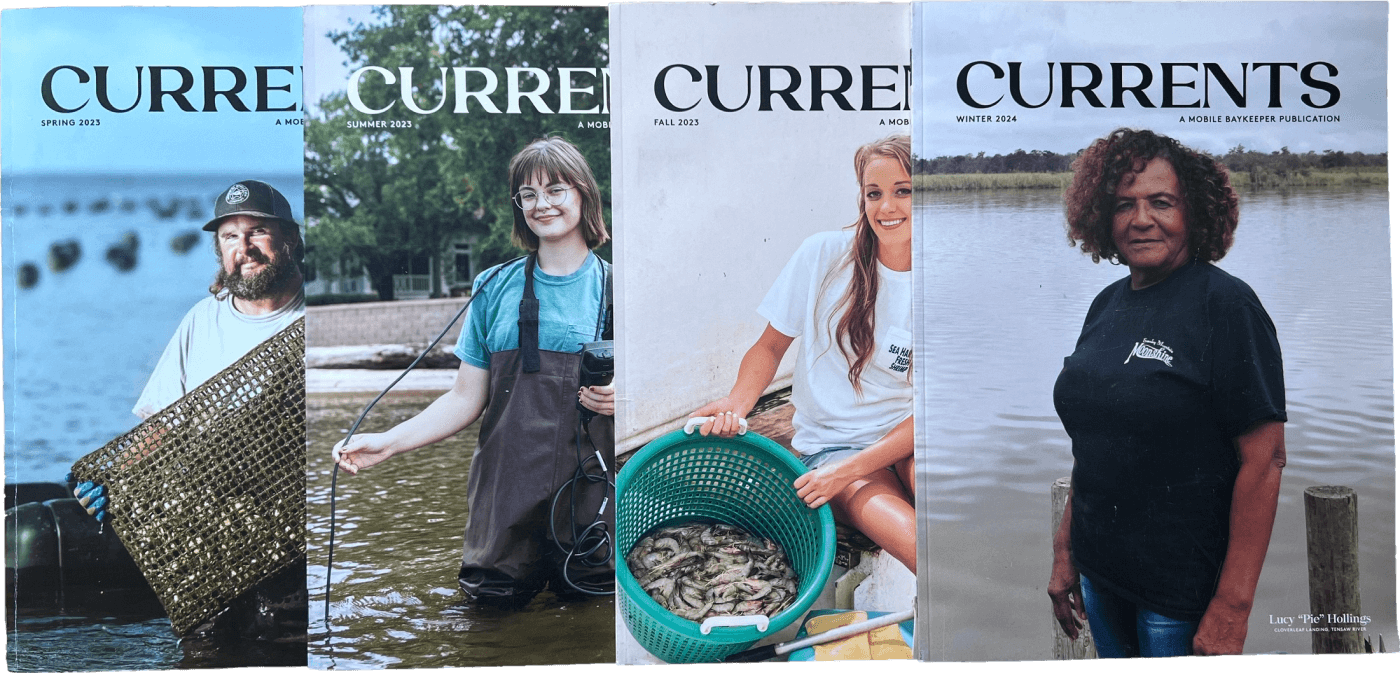
This article is from the 2026 fall issue of Mobile Baykeeper’s print quarterly, CURRENTS. The magazine is mailed to active members who have given more than $50 in the past year. To get on the magazine’s mailing list, donate here.
By Virginia Kinnier | Photos by Courtney Mason
In Theodore, Alabama, in a light green building tucked inland between Mobile Bay and Fowl River, there is treasure hiding in plain sight. A single, three-letter word makes up a metal sign that hangs nonchalantly from the roof of the building, humbly hinting at what you’ll find inside: ART.
Frank Ledbetter’s career as a metal artist is just as surprising as discovering an art gallery off a side road on the way to Dauphin Island. A native of Mobile, Frank served in the Marine Corps before returning home to work at a paper mill, where he met his wife, Terri. In 1976 he opened his own metal fabrication business in Semmes, Alabama, which he owned and operated for twenty-five years while he and Terri raised their two children, Laura and Blake.
In 2001 the Ledbetters’ lives were changed forever when Blake passed away in a tragic accident at the age of fifteen, and in his grief, Frank decided it was time to walk away from the business he built. He had no idea he was walking toward a new career he could have never imagined.
“If Blake had lived, I would not be an artist,” Frank admits. “I mean, there’s no doubt about that. But through that grieving process, I discovered this latent ability I didn’t know I had. I call it the God factor. But whatever you want to call it, art saved me. It gave me a reason to go on. And it gave me a way to carry him with me. On every piece of art that I create, I sign it with ‘BWL’, so his initials are on everything that I do. I’ve even got pieces out there that are like time capsules with some of his stuff in them. I don't really tell a lot of people about that, but there are several sculptures that hold a memento of him.”
One of the very first pieces Frank created in his garage following the death of his son still hangs on the wall in his studio today. It may appear to be a simple, metal fish, but it serves as the cornerstone of his entire art career.
While his son Blake’s legacy lives on through Frank’s art, another legacy is being honed and strengthened within these studio walls. Frank’s daughter, Laura, is following in her dad’s footsteps to become the next Ledbetter metal artist.

“I learned to weld when I was twelve years old,” Laura laughs. “While my dad owned the metalworks company, we grew up at the shop, playing on cranes and running through tanks. I guess you could say it’s in my blood.”
But it wasn’t until four years ago, during the challenging days, weeks, and months following her divorce, that Laura sought out the solace of her dad’s art studio, welding on aluminum scraps from her dad’s projects.
“My two kids and I lived right down the street, and I kept walking over to the studio to weld in my free time,” Laura recalls. “One of my practice pieces ended up looking like a ship, so my dad and I worked together one day to make it into a real ship, Shipwreck Number One. For a while he had it here in the studio, and people kept trying to buy it, so he called me one day and said, ‘You need to come out here and weld another ship. I think I can sell it.’ So, I made Shipwreck Number Two. Three weeks later he called me and said, ‘Guess what? Your ship sold.’ Now I build one every time another one sells or whenever someone asks me to put one in a gallery or show.”
Today three of Laura’s ships sit side by side in the safe harbor of her dad’s studio.
“They’re made completely from scrap metal,” Laura explains. “Everything I make is from something my dad already made, using whatever he didn’t need.”


As Laura shows me around, she walks over to a side of the studio that is dedicated to buckets and buckets of scraps. To anyone else, it looks like a pile of junk. But to Laura, it’s a starting point.
“I usually just come over here, dump out one whole bucket, and something will hit,” she explains. “I’ll work on the hull first, and then I try to make it as symmetrical as possible. But it’s a shipwreck, so it can be a little wonky.”
Ships aren’t all Laura has been experimenting with. Last year she designed 12 metal “evil eye sculptures” for the recipients of the Arty Awards in Mobile. She also creates metal Christmas trees that she sells through her social pages and at Arti Gras, an annual art show in DeTonti Square in Mobile.
We leave the buckets behind and stop underneath an enormous piece of driftwood hanging from cables from the ceiling, a boat motor nearly inconspicuous in the center, and a metal crab peeking out from its perch on one corner of the wood.
“This is my dad’s most recent commission piece,” Laura says. “It’s going to hang above a four-by-ten-foot concrete bar in an outdoor kitchen at someone’s beach house.”


While the studio itself is empty of other visitors today on our tour, we do have an audience. One entire wall of the studio is populated by what Frank fondly refers to as his “Faces of the Discarded.” These pieces are made from a range of cast aluminum pieces, such as boat motors, car rims, diesel engines, car engines, welded together to create wild faces painted in bright colors and whimsical designs.
The Faces of the Discarded showcase Frank’s unique ability to blend materials so seamlessly that it’s impossible to tell where one material ends and another one begins. But where do all these materials come from?
“A lot of people just drop stuff off,” Frank laughs. “They know what I do, and they’ll come by with it and say, ‘You want this?’ And I'm like, yeah, I'll take it. Then one day, I turn it into art.”
I ask when he realized that he was an artist, and his answer is as humble as the sign out front.
“I don’t know that I ever have,” he admits. “It’s still a mystery to me. I know that sounds crazy, but I look back on pieces that I’ve done, and if you asked me to do it again, I don’t know that I could.” This reminds Frank of a piece from his early days as an artist that he says was possible only by what can be described as divine intervention.
“When I used to do art shows, this lady came into my booth at the Shrimp Festival, and she didn’t even talk to me, but she took my card,” he explains. “She called me the next week from her home in Kentucky and said, ‘I love your work. I want to commission something.’ So, I asked her what she had in mind. She said, ‘Well, I'm thinking I want a table. And I like the Roebling Suspension Bridge over the Ohio River. And I like paddlewheel boats. And I have five kids. I also like crucifixes.’ My initial reaction was there is no way this is going to happen, but we ended up signing a contract by the end of the call. I came out to the studio the next morning and freaked out. I set my things down and walked back inside the house.
“My wife knows me really well, and she took one look at me and said, ‘What's the matter?’ I said, ‘I don’t know if I can do this.’ She convinced me to take a break and watch a movie with her instead. So, we sit down and we're watching this movie, and the characters start driving over this bridge. I start yelling, ‘Pause it! Pause it! That's it! That’s the bridge I have to build!’ Can you ima- gine that? We keep watching, and there’s another scene where they are sitting on a park bench, and the Roebling Suspension Bridge is right there in the background. And I said, ‘Okay, God.’ The next day I came out here, and I built it.”
While the materials Frank uses contribute to the one-of-a-kind nature of his pieces, the best marketing he has are the pieces he’s already made. Along with the ten-foot outdoor hanging sculpture we saw earlier, he’s also working on two large sculptures for a children’s learning center in Pennsylvania: a Mama duck and three ducklings to match a sculpture he previously made for the owner, as well as a “Rock, Paper, Scissors” piece to add to the learning center’s sculpture displays.

With close to 50 pieces of public art, including two major projects he recently completed at Lewis Landing and the Africatown Welcome Center, as well as countless private pieces he has created for clients, he’s a busy man. But at 73 years old, the work has started to take its toll.
“I don’t know how much more I got in me,” Frank admits. “I have a lot of ideas, a lot I want to do. But it’s very taxing physically. I keep telling my wife I want to semi-retire or mentally retire, but I don’t know if I can. I love what I do. I love it.”
And with his daughter’s career just getting started, he has the perfect protégé to continue sharing his craft with.
“She has the brain,” Frank says. “I always wanted her to do it, because I knew she had potential. And now everybody’s embracing her as a metal artist, and I’ve told her she needs to embrace it, too. Not only can she do it, but she also has me and I can teach her so much.”
Laura also brings her own creative skills to her art. “I have always been artistic and crafty,” she says. “I learned how to sew at a young age. I hand embroider. I make jewelry.”
And while she says she has her dad to thank for her do-it-yourself mentality, Laura is making a name for herself in the art world, something her dad is especially proud of.
“She’s taking her own path,” Frank says. “I told her, ‘You'll find it, you'll find your path.’ She just has to keep looking for it, but this is a great start.”
As the tour concludes and I say goodbye to the faces lining the wall to the exit, a small brown head darts past me and turns to smile at his mom and granddad.
“This is my son, Jameson,” Laura says. “We want to teach him, and my daughter, Sarah-Blake, my brother’s namesake, how to weld too, but he’s only nine and she’s seven, so I guess we’ll give them a couple years,” she laughs.
And just like that, the Ledbetter legacy ripples out into another generation.