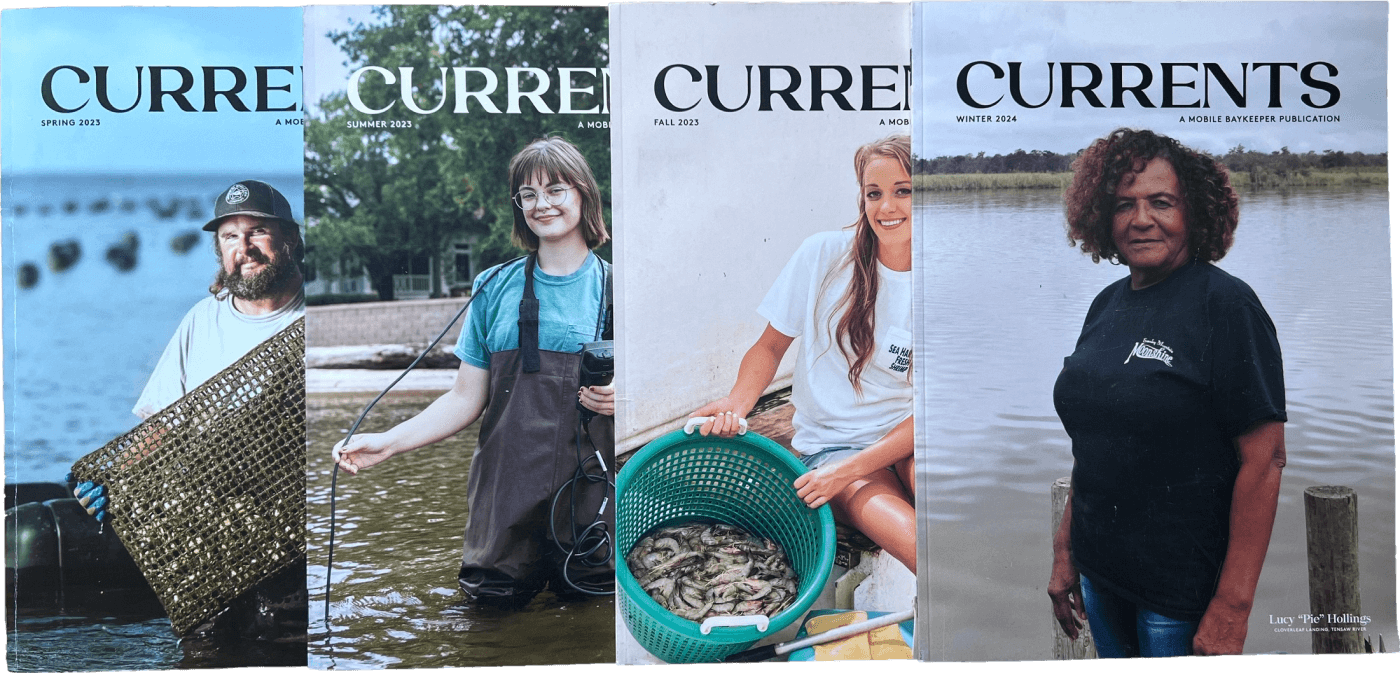
This article is from the 2026 fall issue of Mobile Baykeeper’s print quarterly, CURRENTS. The magazine is mailed to active members who have given more than $50 in the past year. To get on the magazine’s mailing list, donate here.
By Caine O'Rear | Photos by Courtney Mason
The mullet are jumping this summer morning in August. It has not rained in days and the water looks relatively clear, almost green in the early sunlight. I am sitting on a bench under a live oak overlooking Mobile Bay with Jimbo Meador, in front of his house in Point Clear, not far from the hotel. We are drinking coffee and the way these mullet are jumping it’s clear they’ve been drinking it, too.
This is the house where Jimbo has lived most of his adult life with his wife, Lynn, and where he raised his two children, Bo and Carolyn. Prior to that it was the house of his wife’s parents. Built in the 1850s, it typifies other coastal cottages of that time period along the Bay with its long galleries and low-form broad roofs which were designed to enhance ventilation in the long, hot summers. It reminds me of another antebellum house along the boardwalk, where I lived one July without air-conditioning at the age of eight, a time punctuated by the sound of a rickety ceiling fan and a black-and-white television tuned constantly to the videos of MTV.
From the bench to the right stands Jimbo’s wharf, where he has cast his fly rod and bait net over the decades and stood sentinel over one of his greatest loves: the Bay. He has seen it change greatly over time. He remembers the days when the water was always clear and seagrass covered its bottoms and gigging flounder with a spear was a daily pastime.
I don’t think there’s anyone who personifies Mobile Bay more than Jimbo. Like those people who seem to blend into the land from which they come and take on its colors and topographical features, Jimbo almost seems to be a natural extension of the water, as much so as a blue heron that melts into the marshes and muddy bottoms of the Delta.
Save for a stint working for Beretta gun company, every job Jimbo’s held has been water-related: shrimping, tugboat captain, a designer of fishing kayaks, seafood distributor, eco-tour guide in the Delta, the list goes on.
For some time this certified Master Naturalist has been a sort of spiritual godfather to Mobile Baykeeper, having in recent years developed a keen friendship with our director William Strickland. Jimbo knows the watershed as well as anyone and his memories and knowledge of the Bay and Delta are crucial to draw from as we work to build a better future for our waters.
An icon in the world of fly fishing, Jimbo defies any clichés associated with the “sportsman” or “outdoors-type.” He is a true Southern eccentric: a storyteller and natural-born humorist with a deep interest in Eastern spiritual practices. He has counted among his friends such luminaries as Jimmy Buffett, Guy de la Valdène, Tom McGuane, and Jim Harrison.
Winston Groom dedicated the book Forrest Gump to Jimbo, and it seems Groom’s hero shares more than a few characteristics with our interview subject. Jimbo’s voice was somewhat famously the model for Tom Hanks in the film version of the book. And the fact that we’re sitting here, chatting on a bench under an oak tree hung with Spanish moss is, well, a little uncanny.
As the morning unwinds our talk drifts over a continent of subjects, almost all having to do with the water. What shines through in hearing Jimbo’s tales is his deep sense of spirituality, and the life-affirming quality of his time spent in harmony with our natural world. Our talk only scratches the surface, but there is plenty more where this came from. This fall will see the publication of his long-awaited book, Short Stories From a Life Well-Lived: Stories by & about Jimbo Meador. It can be pre-ordered at JimboMeador.com, and is sure to be a must-read for any lover of the water.
Until then, we’ll let Jimbo talk.

Early Lessons
I was into nature probably more than anybody my age. I had a trapline and I wanted to be a mountain man. I sold furs. I took a correspondence course in taxidermy when I was about ten. I found a mail-order catalogue and I ordered everything I could find about trapping and the outdoors. I was just always fascinated with it. I’ve been blessed with all of that. In fact, the Bible tells us to take care of this—that God created this for us and we should take care of it.
Master Naturalist
I took tours up in the Delta for a good while. One time I pulled up in a little bayou, and the lotuses were blooming. I had some women in the boat. We pulled in there and one woman stood up and she said, “There is a God.” I’d take those tours and show people all the vegetation and talk to them about it. I’d show them the invasive species and say, “You know what the worst invasive species is?” And they’d say, “What?” I’d say, “Us.”
The vegetation up there in the Delta is really important. It holds the land, you know. It also supplies a lot of life. People don’t realize how much life there is under the water that they don’t see. I once had some nets made, and I’d take kids up there and let them scoop down in the water and show them all this stuff. I had these little plastic goldfish bowls and we would see all the life that was in there in just one scoop.
And those little bowls I had, I’d let them keep them and watch the stuff and then release it. It said “Catch and Release” on the thing. I’ve forgotten where I got those things. But yeah, kids loved it. And their parents did, too. Parents enjoy seeing their kids enjoy it. But yeah, it’s a pretty unique place.
But this whole Bay—I mean, see how it’s brown? We once had seagrasses all in here. And the seagrass is a habitat for all marine life—crabs and shrimp and all kinds of fish. So we’ve destroyed a whole habitat with muddy water. For example, if I tell people, “If you put a tarpaulin over your grass, without photosynthesis, how’s it going to live?” Well, the Bay’s the same way. Muddy water is a tarpaulin, and as long as the water’s muddy we can’t have vegetation. So it’s like putting a tarpaulin over your garden, you know. You’re not gonna produce much.
Pass It on Down
One thing about conservation—I say we’re stealing from my grandchildren, because I would like for my grandchildren to be able to see the same things in nature that I’ve seen. I’d like to at least leave that to them. I don’t want to destroy it. I said something years ago—I think it was a writer for Mobile Bay Magazine who interviewed me—and he asked me how I felt about the Bay. I said, “Well, if we don’t change something, Mobile Bay is going to become a cesspool for economic growth.” I don’t think I worded it like that. I think I made it a little more severe. But it’s true: we are destroying a lot of our resources. Hell, you know, like I said, the Bible tells you in the very beginning that we’re supposed to take care of what God created. Why don’t they preach that in church?
The dredging, I think, did more to start the whole process. Radcliff Materials was dredging shale out here, and that’s where all the turbidity started. I remember when this Bay was so clear that I could see bottom where that mullet just jumped out there by the wharf house. In fact, I could stand on the end of my wharf and see a school of mullet come by and throw my cast net and catch them.

School's Out
Early on I wanted to be a marine biologist. I took so many biology classes at one point they told me I couldn’t take any more. But, you know, I never actually graduated. It’s like they say, “Never let schooling interfere with your education.” But that was one of the things I wanted to do, was be a marine biologist. And I still got a lot of good friends who do that. Dr. Jim Franks over in Ocean Springs and John Dindo down here, he’s a friend of mine. So I’ve always been fascinated with learning more—everything I can—about the ocean and the water. I guess you could say I was homeschooled.
Baykeeper
I feel we were blessed to get William Strickland as the director because he sees the real picture. You know, back in the 1960s I had a bumper sticker on my car that said, “Save our marshes for fish and other wildlife,” and I got it from the Littoral Society. Littoral is a tide zone. I was a member of that organization and had the bumper sticker before Baykeeper was even here.
Mullet
I love mullet. I grew up on mullet and grits for breakfast. But in Italy, you know, I don’t know what they do to the mullet, but hell, it’s so expensive. They dry the roe and grind it on a salad. I mean, one pair of mullet roe over there is like three hundred dollars.
I spent a lot of time in Italy when I worked for Beretta gun company. It’s an interesting company. It’s one of the oldest family-owned companies in the world [having been founded in 1526]. Maybe the oldest. Over there, real wealthy people get kidnapped. None of them ride in the same car together. And I went on a big boat with them. The family owns an island and they got a huge home out there, and hell, they had machine guns on the damn boat. Ugo [Gussalli Beretta] is the daddy. When Ugo says something, everybody listens.
Infinite Spark
Paramahansa Yogananda was one of my teachers. He’s been dead for years, but I studied a lot of his philosophies. It’s pretty simple, you know, and we’re blessed to live here, to be here.
I’ve had people think I was a Buddhist, but I’m just a student of Buddhism, and I really enjoy that philosophy. Everything in this world is so important—the God, or the Creator, or whoever you want to say, created it. It’s our job to take care of it. Even the Native Americans felt that way. I’ve been really interested in a lot of Native American philosophy. In fact, I got a book—the name of it is Touch the Earth [compiled by T.C. McLuhan] —and it’s got a lot of interesting quotes from Native Americans in there. Because it’s so important. Of course, back then it was a food source and a shelter source, and anything we needed we had right here. We didn’t have to run to the 7-Eleven to get something.
I’ve been doing meditation for a while. Sometime in the ’80s, I was meditating out there one day on the very end of the wharf. I just had a bathing suit on. I was sitting there cross-legged on the very tip end. Of course, I had my eyes closed. Some guys came by throwing cast nets, and I could hear them talking. One of them said, “You think he’s dead?” The other said, “Might be sleeping. I don’t know.”
Then one day I was in the health-food store and I saw where some guy was having a meditation thing or something—anyway, he was having a class. I don’t like classes, so I got his number and called him. I asked him, since I didn’t like to go to classes, was there any way he could come to my house. At the time I had a Catahoula dog named Clyde. Nobody came in this yard when I had Clyde. In fact, he bit a few people.
But anyway, I’d called this guy to come and do some yoga with me because I didn’t like classes. He said yeah. I had an office out back with a glass door, and I was sitting in there. I forgot he was coming. I look out the door and I see this guy—he’s got kind of weird-looking clothes on and long hair—and Clyde is sitting next to him wagging his tail. Clyde never did that. This guy had an aura around him. It was amazing. I mean, it truly amazed me. Blew my mind.
So anyway, I asked him in and got to talking to him and got pretty fascinated with what he was doing. I started doing yoga with him. I even went over to Pensacola where he lived, went to his house, and his mother was up in her 90s. They even had a special diet and everything. One day I’m sitting there with both of them on the floor in a lotus position and they turn out the lights, and I’m thinking, “Man, what have I gotten into here?” But they were really interesting people. They were vegetarians. He’s dead now, but I miss him because I had a lot of interesting conversations with him.
You’ve got chakras in your body from the bottom of your feet to the top of your head, and when we would meditate, we’d focus on each chakra all the way up through your body and back down. It’s a really relaxing sensation. I learned a lot from him. Then I read a lot, especially Paramahansa Yogananda. When he died—you know, they believed you could leave your body and come back—but when he died they had his body on display for 20 days and he never changed. Then they closed the casket and buried him.


Fasting
Way back in the beginning I read a lot about what exercises were good for you and what weren’t. I read a lot by Paul Bragg. When I read his book The Miracle of Fasting is when I started fasting. I’d fast for a week, four times a year.
After about three days, you’re really not hungry. You gotta have water, though. And Bragg suggested drinking pure apple cider vinegar. I got it from the health-food store, about a gallon. But Bragg was an interesting guy.
I’ll tell you what happens with fasting. Your body’s living off the old cells, and when you fast, your body starts producing new cells. So hell yeah, it’s good for you.
Run, Forrest, Run!
Winston [Groom, author of the novel Forrest Gump] was a really good friend of mine. In fact, he dedicated that book to me and Joey Radcliff. He and I used to go to lunch every day—just about every day. So [the running thing] could have [come from me]. I’m not gonna say it did, but I was definitely running back then. I was obsessed with running.
I was managing Bon Secour Fisheries, and I would go down to the Gulf where there was nobody, because back then nobody was running. If you were running, they figured you’d done something wrong. So I’d go run on the beach. It’s a national park now, the park I ran on. But I didn’t see any people, so I ran down there.
If it got late, if I didn’t have time to go down there, I’d go over here on the Lakewood golf course [at the Grand Hotel] and run at night with a bathing suit on. The sprinkler system was on. I could run through that.
One night I was running, and I got back up where I started, and the Fairhope police and the Grand Hotel security were waiting on me. They wanted to know what I was doing. I said, “I’m running.” They said, “Why are you running?” I said, “I like to run.” And they said, “Well, we’ve been getting all these calls from people that live on the golf course.” I had a big beard, too, back then. They said there was a crazy man with a big beard running naked through the golf course at night. I said, “Well, you can see I ain’t naked. I got a bathing suit on. I might be crazy.”

Swimming in the Bay
When I was swimming, I started pulling a kayak behind me on a parachute cord so people wouldn’t run over me in boats, especially those kids on jet skis. Then people were stopping to see if I needed help, so I just started pulling a float behind me, you know.
Actually, once you start something moving, it goes pretty easy. I had a sailboat and the wind quit blowing one time, and I’m sitting out there. One night I was sitting out there and I said, “Hell, I need to get going here.” So I tied a rope around my waist and swam home. Once the boat started moving, it really didn’t seem to be that much of a problem.
Another time, I was on my damn paddleboard up there by the Grand Hotel, and the Marine Patrol came over. He says, “Where’s your life jacket?” I said, “Oh, it’s back at the house. I forgot it.” He said, “Well, you need to pull into the beach.” I said, “Well, I’ll just go home and get it.” He said, “No, you won’t. You ain’t got a life vest. You’re going to the beach.” I said, “Is it against the law to swim without a life vest?” He said, “No.” I said, “Okay, I’m going to get it. I’ll swim home.” I took a stroke like that, and I looked back, and he was just standing in his boat looking at me like, “What the hell did I do now?”
But I loved to swim at night, especially when there’s phosphorescence in the water and there’s not many people out there.
Reading
One of my favorite books is Winds from the Carolinas, by Robert Wilder. Years ago, this girl told me to read it. There was a character in it that reminded her of me. So I got the book and started. His name was Juan Cadiz. When Juan showed up in the book, he was a bum. But if you read the book, you’ll see things change.
He had him a little sailboat with a red sail. In the very beginning, he just sailed around the Bahamas and kind of took it easy and was just happy, you know, doing what he was doing. And there’s this couple who moved to the Bahamas to try to grow cotton during Reconstruction, and they were building this huge mansion. They moved the whole plantation home down there. That actually happened—they tried to grow cotton in the Bahamas.
Anyway, Juan was wondering what was going on. So he sailed his little boat in there one day, and the girl that lived there was on the pier. So he emptied his gourd out so he didn’t have any water. Told her he needed some water. He got to talking to her and told her, “You see that little cove down there?” She said, “Yeah.” He said, “You see this sail?” She said, “Yeah.” He said, “Be looking for it. It’ll be down there.” A long time went by. He was down there. Of course, she came down there. And he ended up marrying her. He doesn’t have a pot to piss in, and here he is now living in this huge mansion, marrying this girl. It’s a great damn book, I’m gonna tell you.
I saw a picture of Jimmy Buffett with a shirt on that said “Juan Cadiz.” I said, “Have you read Winds from the Carolinas?” He said, “Two or three times.”
Now, for a kid growing up, I think every kid ought to read The Old Man and the Boy [by Robert Ruark], because his philosophy is the best there could be about nature. Well, mainly hunting is what it’s about, but it’s about nature, too. And just the old man’s philosophy was great. I made Lynn read it before we got married.


"Good Fishing Here"
Guy de la Valdène [director of Tarpon, a documentary about fly-fishing in Key West in the ’70s] was one of my very best friends. I met him through [novelist and sportsman] Tom McGuane. Yeah, but Guy never had to work. He was in the “inheritance business.” They actually say he was a count. Buffett called him “Count.” He was a really interesting guy and became one of my very best friends. And he died. So my friends are dying and my doctors are retiring.
[The connection between the natural world and storytelling] I think goes all the way back to the cave drawings. That’s funny, because—I’ll get off the subject a little bit—but you see I designed those kayaks back there, Natives, and the logo was petroglyphic, or whatever you call it, and it meant “good fishing here.” I used to stick them on those things. I had decals.
The natural world is the way cavemen survived—living off nature, living off what they had. So yeah, it goes way back.
******
As our talk winds down, Courtney proceeds to take some portrait photos of Jimbo standing by the water. He looks radiant in his white shirt and khaki hat, despite his many years on the water and in the sun; the spirit still shining through the eyes. His son-in-law Dale Marston has been with us throughout the morning. Dale’s oldest boy is eighteen. “For 18 years he’s been trying to give my son what he had out here, but there’s no way to do that,” he says. “Things have changed. What he had as a kid—you can’t pass it on. It’s not available. But he did a good job with what we’re still blessed with, with my kids.”
We then make our way down a pathway of old brick, past the jubilee bell and back into the house, and then into the long porch gallery that sits closest to the highway. There is nothing curated about the space; every object tells a story. The paint on the beadboard ceiling is worn, and there are books and fishing rods and much angling gear scattered about. An old bent rattan rocker sits by the window. Further on stands a Victorian glass cabinet filled with all manner of natural-history specimens: seashells, bones, coral, a bleached alligator skull resting on the bottom shelf. As we take in the artifacts, eager to ask about each one, Jimbo is still spinning yarns, this time relating a story about a boat captain he knew who once had to transport a woman with a big beehive hairdo.
“He said he was idling along, and all the sudden he took off and they were going and that thing blew off,” Jimbo drawls. “Said she was damn near bald-headed. He said, ‘Don’t worry, don’t worry, I’ll get it!’ Well he turned back and got a gaff and gaffed it.” “Did she put it back on?” I ask.
“I don’t know. I didn’t get that far, I was laughing too hard.”
JIMBO'S READING LIST
▸ Forrest Gump, Winston Groom
Published in the mid-80s and turned into a Hollywood smash a decade later, Forrest Gump is a work that needs little introduction in these parts. Groom dedicated the book to Jimbo, and it seems the Alabama author found more than a little inspiration from him in creating the character of Gump. And that’s all we’ve got to say about that.
▸ Touch the Earth: A Self Portrait of Indian Existence, compiled by T.C. McLuhan
A curated selection of writings from various authors that explores Native American history and the importance of coexisting with the natural world. First published in 1971, the book remains a cornerstone in Native American philosophy and spirituality.
▸ The Old Man and the Boy, Robert Ruark
A book every boy should read, according to Jimbo. A moving tale about hunting, nature, and the special bond between grandfathers and grandsons. Set in Depression-era North Carolina, it's more than just a "boy's book"
▸ Winds from the Carolinas, Robert Wilder
This novel tells the story of Juan Cadiz, a free-spirited roustabout who lives on his sailboat in the Bahamas and takes a shine to a wealthy girl from an aristocratic Southern family in the years after the American Revolution. Cadiz, as it turns out, may have been the first “Parrothead” — Jimmy Buffett was certainly a fan.
▸ The Longest Silence: A Life in Fishing, Thomas McGuane
A collection of fishing essays written by Jimbo’s writer-sportsman friend—one of many that fit that description—and the guy who turned Jimbo on to saltwater fishing. McGuane has excelled as a writer in various genres (novels, screenplays, short fiction) but it’s these meditative, languorous essays on fishing where he perhaps shines brightest.
▸ Autobiography of a Yogi, Paramahansa Yogananda
First published in 1946, Yogananda’s life story and spiritual odyssey had a profound influence on the Western world. This is ground zero for self-realization books, and its lessons rubbed off in a big way on Jimbo.
▸ Short Stories of a Life Well Lived, Stories by & about Jimbo Meador
A collection of vivid and memorable tales from our hero. Some are straight from the horse’s mouth, while others come from friends and family. Available for pre-order at JimboMeador.com, it’s sure to be one of the more fun reads of the year.