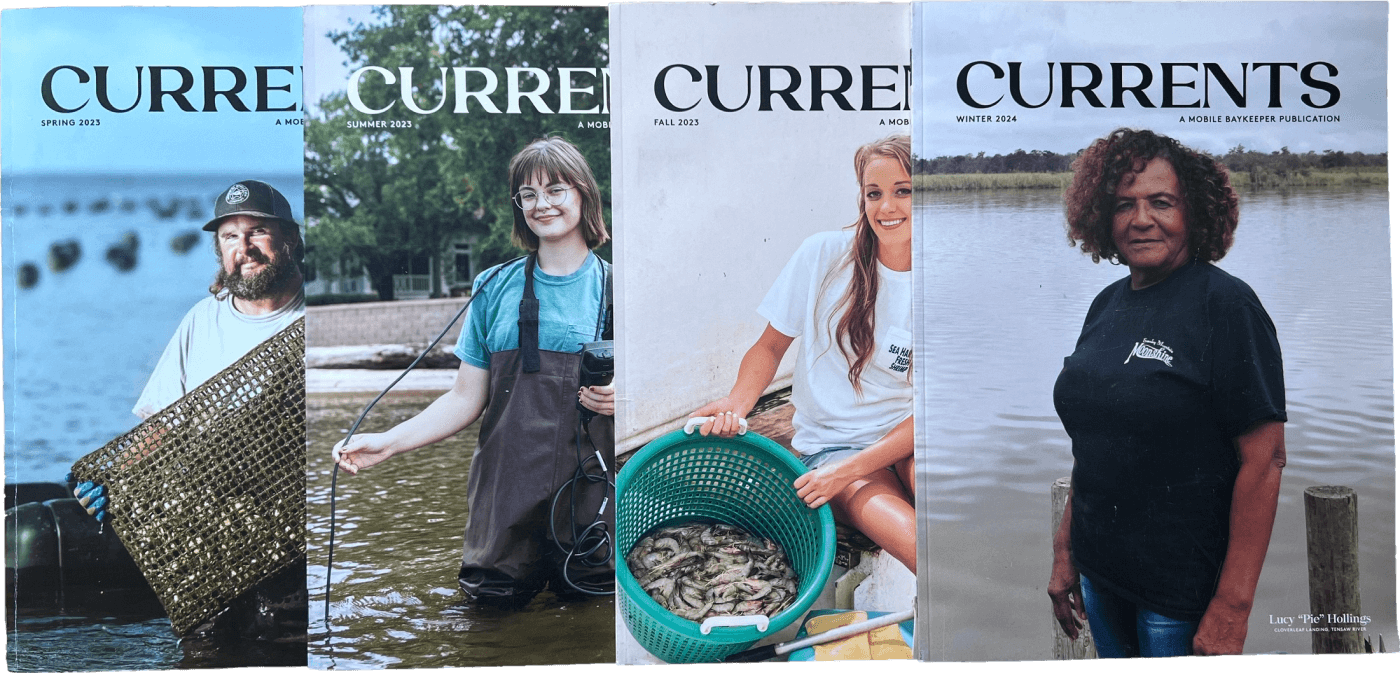
This article is from the spring 2026 edition of Mobile Baykeeper’s print quarterly, CURRENTS. The magazine is mailed to active members who have given more than $50 in the past year. To get on the magazine’s mailing list, donate here.
By Susan Rouillier
Few modes of transportation carry the same wistful nostalgia as the steam locomotive, so frequently celebrated in novels, films, song, and art. Yet one such locomotive, once vital to the heart and growth of South Mobile County, has nearly slipped from local memory: the Bayshore train. For 40 years it altered lives, advanced industry, opened remote coastal places to the world, and stitched together the story of communities along the Bay.
A Grand Beginning: The First Excursion
The inaugural excursion of the Mobile and Bayshore Railroad left Union Station on September 10, 1899, bound for Portersville and Bayou La Batre. The train was filled with young men from the Young Men’s Benevolent Association — today’s YMCA — and carried an astonishing two thousand passengers on its maiden run.
A round-trip cost 75 cents, and the promise was simple yet profound: access. Access to places once reachable only by water or grueling wagon journeys, access to recreation in Coden and Bayou La Batre, and access to fertile lands that would soon support thriving agricultural and seafood industries.
The early triumph of the Bayshore line fueled the development of vacation resorts in Coden, expanded seafood and canning enterprises, and opened new markets for farmers in the Fowl River and Mon Luis Island areas. This single line of rails helped define the future of South Mobile County.
The Line through Mobile County: Main Routes and Branch Lines
Depending on the year and map, Bayshore trains originated from Mertz, Prichard, or downtown Mobile, meandering southward until reaching Delchamps Station. Here the track diverged:
• Eastward, a spur crossed the narrows of Fowl River toward Alabama Port and Cedar Point, once imagined as a major future harbor
• Westward, the primary line extended through Coden and onward to Bayou La Batre


Flag Stops and Regular Stops
The line between Mobile and Bayou La Batre once stitched together 27 small worlds. Most weren’t stations in the grand sense — just flag stops, where a traveler stepped out of the woods or a sandy lane and waved down the engineer like hailing an old friend. The train would groan to a halt, gather its people, and push on.
South of Theodore, the tracks shadowed what we now call Bellingrath Road, slipping past Laurendine, Windsor, and Rebel Roads — names that still echo the communities the railroad once fed.
Among those humble flag stops were:
• Laurendine, first called Froshinn until WWI-era suspicion scrubbed its German name. It sat where Laurendine meets Lancaster today
• Kipling, where the Kipling Station subdivision stands now
• Parker, not far from the gates of what would become Bellingrath Gardens
The daily, dependable stops —
• Lloyd’s, at the corner of Bay Shore and Wooley roads
• South Orchard
• Fowl River
• Delchamps
All served as anchors in the rhythm of rural life. These weren’t just points on a timetable but lifelines: places where farmers shipped produce, families met visitors, and small industries hitched themselves to the wider world. The train didn’t merely pass through these communities — it stitched them into the story of Mobile County.

Industries on the Line: Canning, Bricks, and Produce
▸ The Canning Industry at Alabama Port
The John Boyle Canning Factory at Alabama Port once pulsed with life, its long one-mile pier stretching into the Bay like an arm welcoming the returning fishing boats. Bayshore trains whisked away barrels of oysters, shrimp, and fish to inland markets, making the factory a vital link between water and rail. But nature had other plans. Hurricane after hurricane battered the coast, and the great storm of 1906 delivered the final blow, tearing apart both the factory and its mighty pier. In the aftermath, with the Bay quiet and the tracks leading to nowhere, the railroad abandoned the Alabama Port spur altogether.
▸ The Brick Kilns of Jett Brothers
Just beyond Fowl River Station, the Bayshore line rumbled past one of the county’s largest industrial landmarks: the Jett Brothers Construction Company. Four enormous brick kilns — each a cavern of heat stretching 70 feet long and 25 feet wide — sat like red-fired giants beside the track. With clay-banks close at hand and clear, fresh water bubbling from nearby springs, the operation grew quickly, its smokestacks rising above the landscape like beacons of industry.
The Jett Brothers built their kiln faces so tight to the train spur that workers could slide bricks straight from the doors of the factory onto waiting railcars. For decades, these trains carried the bones of a growing city; legend says that one out of every two bricks laid in Mobile around the turn of the century came from this very yard.
But industry is often tied to the rails that feed it. By 1940 — barely a year after the Bayshore line fell silent — Corps of Engineers aerial photographs show nothing but open fields where the mighty kilns once smoked. The brick yard vanished almost as quickly as the trains that sustained it, leaving only stories and scattered shards in the soil.
▸ Farms and Orchards
South of Fowl River Station, travelers often spoke of riding through “beautiful orchards of fruit trees and rich farmlands.” The land rolled out in neat rows of citrus, figs, vegetables, and pecans — an agricultural tapestry glowing under the coastal sun.
South Orchard and Fowl River became essential shipping hubs. Farmers loaded their crates onto the Bayshore trains, sending coastal produce to markets far beyond the Bay. Without the rail- road’s steady rhythm, the short-lived citrus boom and the region’s lively produce trade could never have flourished.
The Bayshore line didn’t just pass through farmland — it carried its hopes, its harvests, and the livelihoods of the families who worked the soil.

Harriet Gould: A Life Shaped by the Bayshore
In 1970, the Press-Register interviewed Mrs. Harriet Gould — a bright, sharp 75-year-old whose life seemed stitched right into the rails of the old Bayshore line. She recalled an era when whistles echoed across orchards, neighbors gathered at flag stops, and the train was more than transportation — it was the daily heartbeat of her world.
▸ Her Childhood Journeys
Beginning at just 13, Harriet became a familiar sight on the Bayshore line — a determined young girl with her father’s bank deposits tucked safely in hand. From Coden she rode the morning train into bustling Mobile, then hopped a streetcar to People’s Bank, and later to First National. As soon as her errand was complete, she would race back through downtown to catch the afternoon train home. At Coden, her father waited faithfully with a horse and wagon, ready to take his daughter the last leg of the journey along the sandy road home. It was a routine that stitched her childhood into the very rhythm of the railroad.
She remembered the train seats vividly (“red and covered in a velvet-like fabric”) and how cinders from the smokestack blew in through the open windows, leaving her so dusty she needed a bath as soon as she got home. The journey from Coden or Alabama Port to Mobile took just over two hours to cover the 38 miles.
▸ The Hurricane of 1906
One of Harriet’s most unforgettable memories followed the devastating hurricane of 1906. Sent inland to stay with her aunt during the storm, she returned to Coden on the first Bayshore train allowed through. The cars were heavy with grief: 50 coffins rode with her, bound for families who had lost everything. When she reached home, she found her own house shoved off its foundation — wounded, yet miraculously still standing. “Many people lost their lives,” she said, recalling memories that had never quite released their hold.
▸ A Railway Romance
At 16, Harriet met the handsome young agent at the Coden Station. She later attended Montevallo but left before graduating — “I was so much in love.” She returned home and married Edwin Gould in 1915 at the age of 19. They would have four children, 12 grandchildren, and five great-grandchildren. “My entire life,” she said, “has been associated with trains.” She is buried beside her beloved husband in Oddfellows Cemetery in Bayou la Batre.
Crossing the Water to Dauphin Island
The Bayshore line brought travelers only part of the way to Dauphin Island. From Alabama Port or Coden, they transferred to a boat or
ferry for the crossing.
A 1920s photograph shows a large ferry unloading passengers — many in business attire, some carrying briefcases — onto a pier on Dauphin Island. Whether visiting family, reporting to work in the island’s bustling seafood industry, or seeking a day of sea breezes, the scene reflects a slower, more deliberate rhythm of life and travel.
Decline and Final Departure
The Bayshore Railroad thrived alongside the citrus groves of Fowl River and the tourist resorts of Coden. Each depended on the other. But unforeseen forces tore at its foundations.
• The hurricanes of 1906 and 1916 destroyed hotels, wharves, and tourist centers.
• The devastating freezes of 1926 and 1927 killed the citrus trees central to the area’s economy.
• Automobiles, buses, and improved roads reduced reliance on rails.
By the late 1930s, both freight and passenger traffic had dwindled. The Bayshore routes into South Mobile County were discontinued in 1938–39. What had once been a vital artery faded quietly into memory.
A Legacy in the Landscape
Today, although almost all traces of the Bayshore Railroad have been reclaimed by forest, farmland, and development, but one remnant remains — a brick masonry culvert made for its support is still visible under Old Bay Shore Road in the Lloyd’s Station subdivision.
It was more than a train. It was a lifeline, a witness to storms and seasons, and a thread that stitched the people of South Mobile County to one another. It carried farmers’ harvests, fueled industries, carried children to school, connected lovers, and opened remote stretches of coastline to the wider world. In remembering the Bayshore, we remember a chapter of local history shaped by steam, steel, and the enduring human need to connect.
Feed the Beast
A slumbering giant, muscles coiled,
the train crouches in the early light.
Firemen enter the hush,
feed it coal like sacrificial flesh.
Flames lick, then roar with certainty.
Water hisses, remembers its strength.
Pistons throb — the heartbeat quickens —
a roar of heat and iron erupts.
The beast lurches, hungry, alive.
— Susan Rouillier