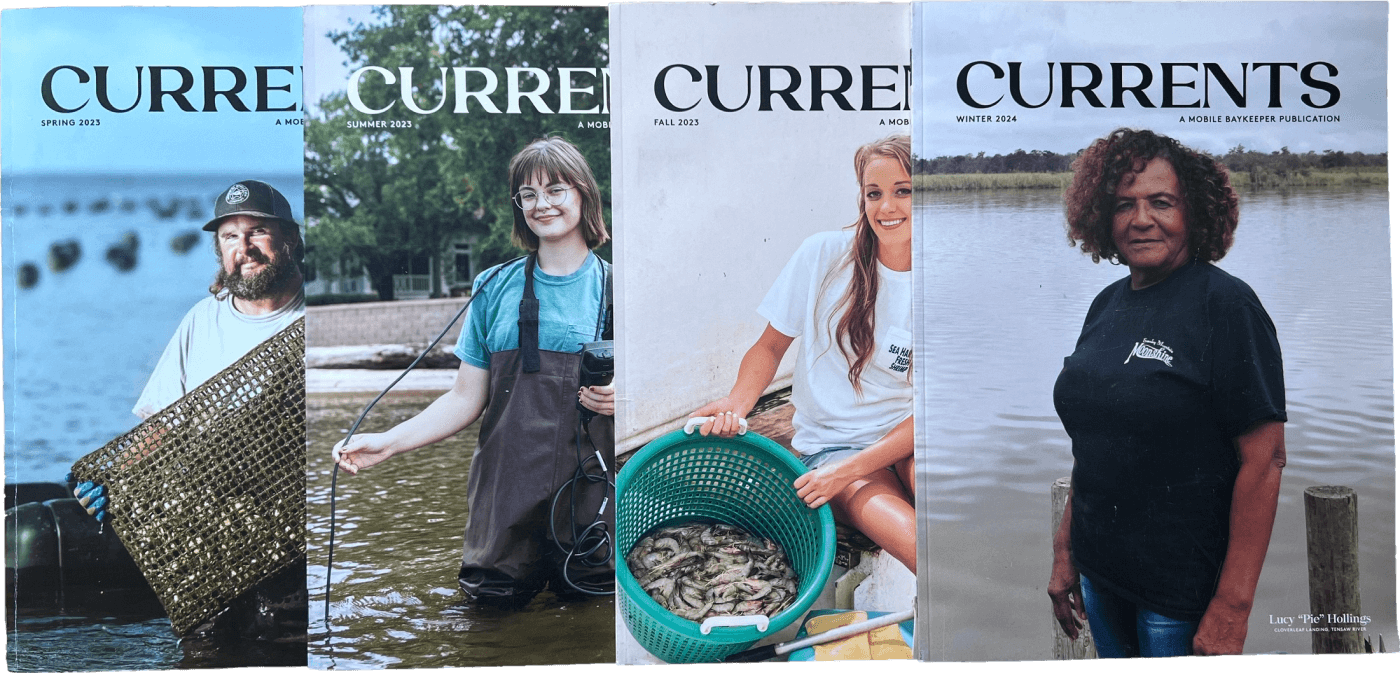
This article is from the spring 2026 edition of Mobile Baykeeper’s print quarterly, CURRENTS. The magazine is mailed to active members who have given more than $50 in the past year. To get on the magazine’s mailing list, donate here.
By Rachel Ball
The world seems quiet and still on this chilly Saturday morning in January. Few cars are on the road; it seems most have opted to stay warm and cozy in their homes. Yet, at Village Point Park in Daphne, there are more than a dozen people huddled under a gazebo. Some seem to know each other while others are standing by themselves, but everyone is here for the same reason: a guided nature walk.
One of the guides is Melissa Nichols, community herbalist and owner of Cedar & Moon Apothecary. Melissa leads the group, from the gazebo and, before they’ve even stepped onto the trail, she’s pointed out some crossvine. She shows the group how you can tell a plant is crossvine because it has finger-like tendrils that it uses to “climb” its way up trees. As she leads the group deeper into the for- est, she points out a host of native species: “Yaupon are the only native species that contain caffeine, and you can make green tea out of its leaves ... Magnolia flower petals are a wild food that are great pickled ... Bidens alba is more nutritious than kale, and you can grind it to a powder and put in a smoothie — it’s also great topically for mature, aging skin.”
Melissa’s lessons show that, even in winter, the forest is full of life, if you know where to look.
And Melissa has always known where to look.
“My family has always had such deep roots, and a deep connection to the plants, animals, and water that has sustained us for hundreds and hundreds of years. We are avid fishermen. The waters here know our names by heart, you know? It’s been connected to our way of life for as long as there have been people on this part of the continent.”
Melissa is an indigenous person belonging to the Mvskoke Nation and grew up deeply immersed in the natural world. “One thing that my mama always said is, ‘You’re never broke as long as you have fish in the freezer.’ And that’s the truth because we’ve always been very well cared for by the land — from fishing, hunting, gardening, and foraging wild, edible food. But some people don’t have that. Some people don’t have a garden, or they’ve never eaten a wild plant.”

During the tour Melissa shares the stories she grew up hearing from her Pawpaw, who used to talk to her about the seagrass and compare it to the plants above ground. He’d point out various plants on terra firma and say they used to be part of the bays and rivers.
Melissa has passed these lessons on to her daughter, who walks in step with her mother for most of the tour, occasionally darting ahead after spotting a wood ear mushroom or flowering Roselle plant.
While Melissa feels lucky for the abundance her coastal home provides, it is not lost on her that things have changed. Her grandparents and great-grandparents were shrimpers who also harvested clams, oysters, and fresh mussels. She can remember being with her Pawpaw in the Bay as a little girl and watching him throw out cast nets. “We still fish with cast nets,” she says, “but there’s a big difference in the amount of abundance there was back then compared to now. As indigenous people, we can tell you from generation to generation just how much things have changed. As somebody who has grown up fishing and hunting public lands for my whole life, I can tell you, season to season, year to year, that things are different.”
While there are many reasons why the fish from our waterways are becoming less safe to eat, and why the health of our Bay is being threatened, one thing remains true: “This is a densely indigenous populated area,” Melissa says. “There are so many Poarch Creek Indians and people belonging to the MOWA Choctaw Tribe who have this deep feeling and responsibility in our bones for the land, for the water, for the people. I wouldn’t say that we’ve reached a point of no return, but I do think that we’re at a very pivotal time in history. The things happening within our generation are going to set the path for whatever comes next, so it’s a time for everybody to be involved.”
Melissa makes the point that it is not just indigenous folks who feel a sense of responsibility to our wonderful environment — many people from all walks of life who have found themselves lucky enough to call our area home feel this same responsibility. But it is going to take everyone to make real, meaningful change in the health of our Bay.
As the forest turns into marsh, some of the walkers start feeling confident enough to identify the native plants themselves. It is Melissa’s hope that, above all else, she is able to awaken their innate curiosity during these trips.
“They see things with new eyes and they recognize how precious, how absolutely unbelievable, where we are is. And they will start feeling that responsibility toward it.”
Eventually the trail winds out of the forest and marsh and delivers the group to the shores of Mobile Bay. As the group heads back to the gazebo, almost two hours later than originally planned, the walkers start asking Melissa where they can find teas, tinctures, and salves made from these native plants. One place where they can find these natural, local products is from Melissa’s business, Cedar & Moon Apothecary.

“I feel super lucky to be able to do Cedar & Moon and offer things to the community,” she says. “People get an opportunity every time they buy a Cedar & Moon product to get a taste of nature. You’re not going to see ingredients that you have to question, or that you have to worry about, and I pride myself on that.”
As the group gathers around the gazebo it’s clear a sense of community has united them. Those that were standing alone earlier are now deep in conversation with people who were strangers hours ago. Some have brought things they have made with foraged food: pickled mushrooms, mushroom jerky, and mushroom candy. Everyone is sharing and enjoying the food while getting to know each other, inviting each other to events in the community, and sharing their own knowledge.
This scene reflects Melissa’s idea of personal empowerment through connection with the natural world: that everything we need is growing here and that we can ethically harvest and gather and cultivate for generations. And with that knowledge comes an enhanced sense of responsibility.
“And then maybe they’ll go, ‘Hmm, what’s all this about the coal ash in our Bay?” Melissa says. “What’s this alert I got on my phone telling me that I couldn’t eat the fish out of the creek?’ You know, they start putting it together that this affects them and makes people feel like, ‘Oh, well I’ve got to do something.’”
This group did something on a grey January morning, even if it was as simple as taking a walk by the waters they call home.