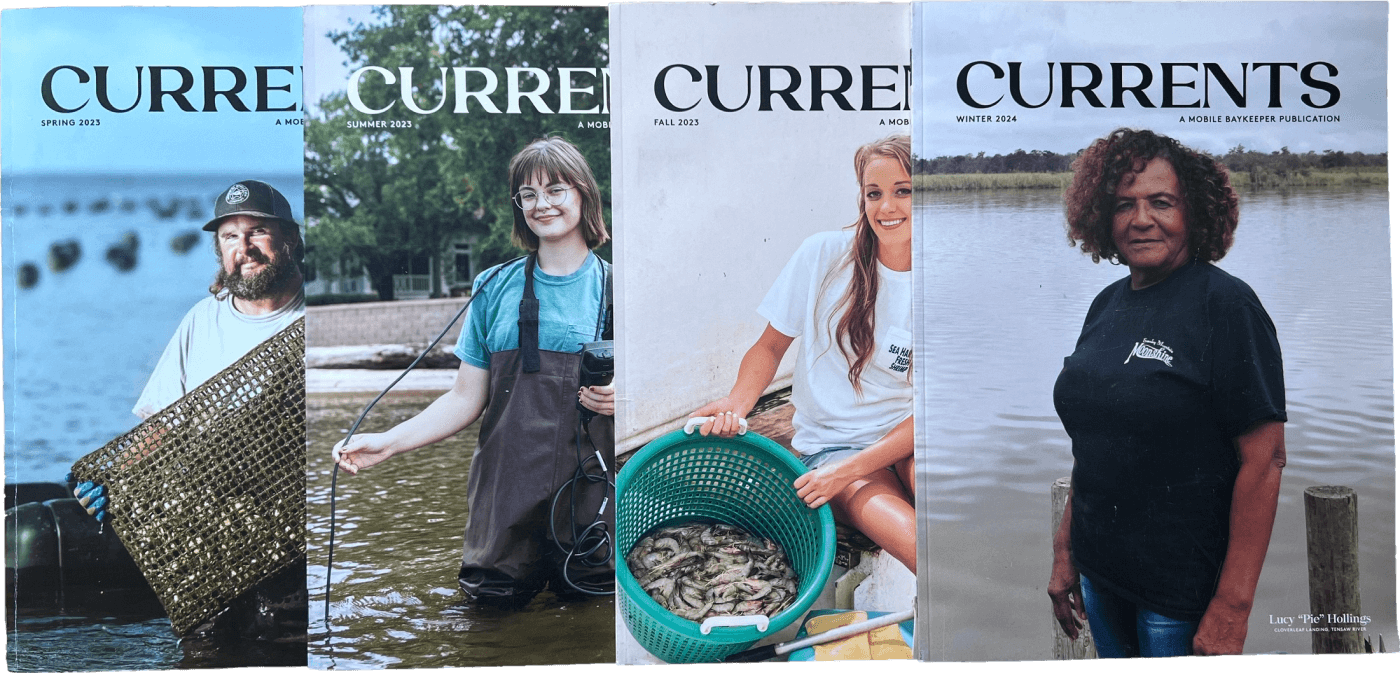
This article is from the 2026 summer edition of Mobile Baykeeper’s print quarterly, CURRENTS. The magazine is mailed to active members who have given more than $50 in the past year. To get on the magazine’s mailing list, donate here.
By Virginia Kinnier | Photos by Caine O'Rear
When Janice Greer looks out the front windows of her home overlooking Mobile Bay, she sees much more than brown waves and wooden wharves stretching out to the blue horizon.
At 97 years old, her eyesight may be dimming, but her memories are crystal clear, and she literally wears a timeline of them around her neck. A 70th wedding anniversary gift from her husband, Jack Greer, Sr., the necklace tells the story of their life together: where they met, where they got engaged and married, every detail permanently etched on a medal just as the memories are in her mind.
Today, as she looks out on the same scene that served as the backdrop of all those memories, she is surrounded by the living legacies of their marriage —their four children, Jan, Jackie, Tutta, and Moo — and her mind is never far from Jack.
“I see him everywhere here,” Janice says.
Here refers to their 90-acre bayfront property, more affectionately known as Sunny Cove by the now five generations of Greers who have shared it over the past 100 years. The property was originally purchased in 1926 by Jack’s parents, Mr. and Mrs. Joseph Barton Greer, as a summer home for the family. It has remained with the family ever since.
Theirs is a love story that spans seven decades, first rippling out with their four children followed by 12 grandchildren and now 25 great grandchildren. While the faces have multiplied over the years, the setting of their love story has remained the same: Sunny Cove, Mobile Bay.

Janice met Jack when she was 15 years old, nearby at the Alba Club on Dog River, and soon after she started spending all her time with Jack at Sunny Cove. “They were actually engaged on the bayfront in the original summer house, although it no longer exists because it was gobbled up by a hurricane,” Janice’s daughter, Tutta, explains.
While Sunny Cove has its fair share of hurricane scars, parts of the original house can still be found if you know where to look, as Jackie Greer, the only son of Janice and Jack, Sr., points out. “Where part of the original ceiling goes out that way, this was a screened-in porch that kind of went around both sides where we slept in the summer.”
When Jack’s parents owned the property, his father used to ride the now-defunct Bayshore Train every Monday morning into work at what would become a very successful family business, Autry Greer & Sons (now Greer’s Markets), and back again on Fridays to join his wife and four children for the weekend at the Bay. When his parents got older, they passed the Bay house down to their two sons, Jack and Bartee, who carried on the Greer family tradition of summers spent down the Bay with their own children.
“We would take our shoes off when school let out in May and put them back on after Labor Day,” Jackie laughs.
Regardless of shoes, days at the Bay were full speed.
“A typical day for me would be getting up before the sunrise, the birds would wake me up because we were sleeping on the screened-in porch,” Jackie recalls with a smile. “I’d slip out the door, walk out on the wharf, watch the sunrise, and come back to feed our horses that were right next door. After that it was fishing, crabbing, throwing out handsewn cast nets, skiing, and swimming. Even the horses would come out and swim with us. We ended each day with music, either singing out on the wharf or inside while the kids sat on top of the upright piano listening to our aunt play.”
Like most places on the water, the years are dictated by storms. When one of the worst ones took its aim at Mobile Bay, Jack Greer felt the loss and dug his heels in harder.
“When Hurricane Frederick hit in 1979, we lost 150 trees, and it tore up the front of the house,” Janice recalls. “Jack stood out there staring at the loss, and he said, ‘I’ll patch it up, and we’ll just go home.’ I looked at him and said, ‘You really want to go home?’ But I knew he was not wanting to leave. This was home.”
With that decision made, Jack and Janice renovated what was left of the summer house and moved down the Bay permanently. Up until then, for 53 years, it was just a summer house. But for Jack, it was always so much more.
“Dad always had a master plan,” recalls Moo Martindale, the youngest of Jack and Janice’s children. “He was going to build a lake, which he completed when I was in third grade. Then he built Mama the big house by the water, and then he added tennis courts. He was a big traveler, and he always wanted a family chapel, like the ones he saw in Europe, so he built one right here at Sunny Cove. He was a man of many projects, and over time the village he envisioned evolved into what it is today, with the chapel he relocated from Coden and reconstructed on the property, as well as a 100-year-old schoolhouse, the original Toulminville schoolhouse built in 1859, where his grandfather and six siblings attended elementary school.”
While Jack brought his vision to life at Sunny Cove, another vision was soon revealed by local businessmen and chemical companies to transform the western side of the Bay into an industrial park, one main goal being the construction of the world’s largest sewage outfall pipe that would empty directly into Mobile Bay. As word spread, local neighbors banded together to save their little corner of the world.
“Everyone who was for the development of this industrial complex down here told them they weren’t going to be able to stop what's going on,” Jackie remembers. “Well, for my dad, that was just sort of a challenge.”
Jack became the first Chairman of the Board of the newly formed West Bay Watch, and the group hired a lawyer who went to work with them fighting for the Bay, even when it meant they were fighting against friends and fellow Mobilians at powerful places like the Mobile Press Register and the Chamber of Commerce. The case made it all the way to the Alabama Supreme Court, and in an unprecedented victory at that time, the Bay won.
Ten years ago Jack shared a few words about his experience with his friends at Mobile Baykeeper, the descendant of Mobile Bay Watch and the organization he helped found following the success of their trial. “It wasn’t a popular decision at the time, but we knew it was what we had to do. None of us were really environmentalists; we were just normal people who cared about the Bay, our seafood, our property value, and our quality of life. After a while, I think the chemical companies decided this area was a tough one to fight. People here love their homes, and they love Mobile Bay.”
While it was an enormous victory, the trial did not end the environmental threats to Mobile Bay. Over 30 years later, the Greers are still carrying the weight of growing concerns regarding development of the area.
“I think right now we’re most concerned about the ongoing dredging to make the channel deeper to get all these bigger ships in,” Janice’s daughter, Jan, says. “They’re not thinking about what these ships do to the bayfront. When those waves come in, they are massive.”
Moo adds, “And it’s not just the size — there’s also so many more waves because of the bigger, heavier ships. So it's a real concern over here because the channel is closer to this side. It has really destroyed the bayfront.”
With the loss of the bayfront comes the loss of so many unseen treasures of the Bay. “I would hate for kids to miss what the Bay is really about: the shrimp, the crab, fishing, throwing your line out, skiing,” Jan says. “Now there are legitimate concerns about even putting a foot in the water, and with that you lose so much of what life down here is.”
When asked about any changes to the water itself, the answer is as clear as the water once was. “Back then it was all grass beds, and the water was beautiful,” Jackie remembers. “We could just walk along the wharf and see groups of mullet swimming in big schools. And then at night, when you were floundering, you were standing in grassbeds.”
Tutta recalls, “We used to have clay that we called blue mud. We made all kinds of little pots that we let dry in the sun. We don't have that anymore because the beach is just ... gone. We used to be able to walk all the way up the beach to Fowl River and back, picking up driftwood. It was just the joy of all the pieces and parts along the bayfront, the sand, the shells.”
Aside from a pretty view and artistic inspiration, the Bay provided real sustenance as well.
“So many people fed their families with flounder and shrimp and crab and whatever else they could catch from the Bay, but you don't see any of the fishing boats coming and going anymore,” Moo points out. “A lot of people think of it as just the sunrises and the sunsets, and they don’t understand the real value. Until you can see it every day, like Mom and Dad did, you can’t understand what’s at stake. Dad would write poems about each day on the Bay. One day it would be about walking out to the end of the wharf on the sandbars, and the next day it would be about the tide being up, splashing right against the bluff. And if you don't know the Bay and how dynamic it is, you don’t know what something like that outfall pipe could have done to our Bay.”
While Janice’s heart carries concern over the future of this area, it is also full of gratitude for the past.
“My life has been a love story from about the time I was 16 years old,” she says. “Everything Jack and I did was together. I see him everywhere I look. He’s here, every day. You can’t touch something without knowing he was here.”
The very walls of their beloved home pay homage to Jack’s family and how they spent their time here for generations. A grand fireplace made of cobblestones Jack’s father salvaged from the streets of downtown Mobile stands in the main living area, accompanied by a giant ship wheel that hangs like a chandelier, a souvenir from one of Jack’s father’s travels and a nod to his maritime service. Family photographs peek out from every surface, a tangible scrapbook that tells the story of the Greer family’s 100-year history here. Many of the frames hanging on the walls were handmade by Jack’s father from driftwood he collected on the shores right outside his home. Even the lamp that lights the main sitting room is more than meets the eye; the wooden base was handmade by Jack from driftwood found on the shore.

“Mom’s done a good job of carrying on Dad’s legacy,” Jackie says proudly. Not only has Janice remained staunchly committed to life down the Bay, she continues to welcome people with open arms to Sunny Cove, inviting church groups and children’s groups to explore the village or celebrate special occasions like weddings, baptisms, and reunions, and every December she hosts Christmas at the Village, an annual Christmas celebration at Sunny Cove Village for friends, neighbors, and the community filled with lights, music, and cheer.
“Her health has been a blessing, but her eyes are our main problem. I tell everybody she can’t see well, but she doesn’t miss much,” Jackie laughs.
And she is paying close attention to what is happening right outside her door.
“We’re on a precipice,” Janice admits. “If we don’t save it now, the Bay will be gone. Every year is a little worse than the last. They dredge all the time; the water is muddy all the time.”
When asked what her husband would say now if he could see the changes to his Bay, she says with a laugh, “He wouldn’t say it quietly, I can tell you that.” When Jack was in the hospital in the final days of his life, all he wanted was to go home to the Bay. “Roll me out to the Bay,” he said. He just wanted to see it one last time.
“We were able to do that for him, give him one last day on his Bay,” Tutta says with a smile.
As Janice begins another summer down the Bay, the sun will shine bright on Sunny Cove and the memories that line its walls will continue to keep her company, even in the absence of her beloved companion, who will forever live on through the humble devotion of a self-proclaimed “normal person who cared about the Bay.”
For Mobile Bay, Jack and Janice Greer will always be much more than that.