This article is from the 2026 summer edition of Mobile Baykeeper’s print quarterly, CURRENTS. The magazine is mailed to active members who have given more than $50 in the past year. To get on the magazine’s mailing list, donate here.
By Grant Blackburn | Illustration by Courtney Spencer
Before Baldwin County developed the South Alabama Mega Site, before the world’s largest aluminum recycler built a multi-bil- lion-dollar plant there, and long before I ever considered what ethical hunting might be, I would get home from school, hop on my bike, and ride the mile or so from my house to a place we called Catawba, a thousand-acre block of young pine plantation north of Bay Minette that almost nobody used. There were a couple of guys who lived near the gate and hunted Catawba, but they knew me, and so long as I asked permission they would allow me to come and go as I pleased.
Catawba had everything I dreamed of as a young man: miles of logging road, creek bottoms, a dirt pit for shooting, a beaver pond for catching bass, and occasional poachers who made the woods feel lawless and wild. Before I could drive I would ride my bike through Catawba for hours with no agenda, no plan, and no phone. All I had to do was get home before dark. Catawba was where I first walked alone with a shotgun, where I first spoke to a turkey, and where I learned to hunt deer. My family moved to Montrose when I was in high school, but I would regularly make the drive to Bay Minette for an afternoon of hunting or wandering or bass fishing. That continued until I graduated and moved away.
Even after that, while I lived in Birmingham during college, I would routinely cook up excuses to come home and spend time at Catawba. My then-girlfriend (who is now my wife) killed her first deer there while we were home one winter. That taught us that my wife is not a deer hunter. When my college friends learned of Catawba’s proliferating whitetails, they’d come to Baldwin County over holiday breaks from Birmingham and Demopolis and Ponte Vedra, Florida, to set up deer camp and hunt for days. More than one of my friends took his first deer there, and one of my most reliable fishing buddies, who now lives in Atlanta, still has a Catawba buck on his wall that he took almost twenty years ago.
As a college-aged deer hunter, my conservation ethic was suboptimal and my goal was often to see how much meat I could put in the freezer. I didn’t waste what I killed, but it is fair to say that my friends and I were motivated by immature bloodlust and the false belief that the number of deer we killed was directly proportional to our abilities as “outdoorsmen.” I can thank Catawba for correcting those deficiencies in my character, and unlike other philosophical gains in my life, this one did not happen gradually. Catawba straightened me out all at once in the cold sunrise of a January morning.
Several college friends were visiting Baldwin County during winter break in what was probably 2007 or 2008, and the hunting was excellent. By that time I knew how the deer moved through Catawba, and, for some reason attributable to juvenile overzealousness, I became determined to kill a deer at extremely close range. My thought process was the closer I could get to a deer, the better a hunter I’d prove myself to be. My plan was to strut proudly into camp, and to tell my friends that I had to lean back to make room for the shot.
I made my way to a reliable creek bottom an hour before first light, camouflaged myself against a tree, and waited. The air was still and cold, but also humid and damp, and the creek bottom smelled like pine needles and tannic water. Time passed slowly and the necessity of my absolute stillness meant that all I could do was think. I do not remember what I thought during the hour that I waited for the sun, but I do remember that when I heard the crack of straw over my shoulder, I doubled down on my plan, readied my gun, and waited for my shot.
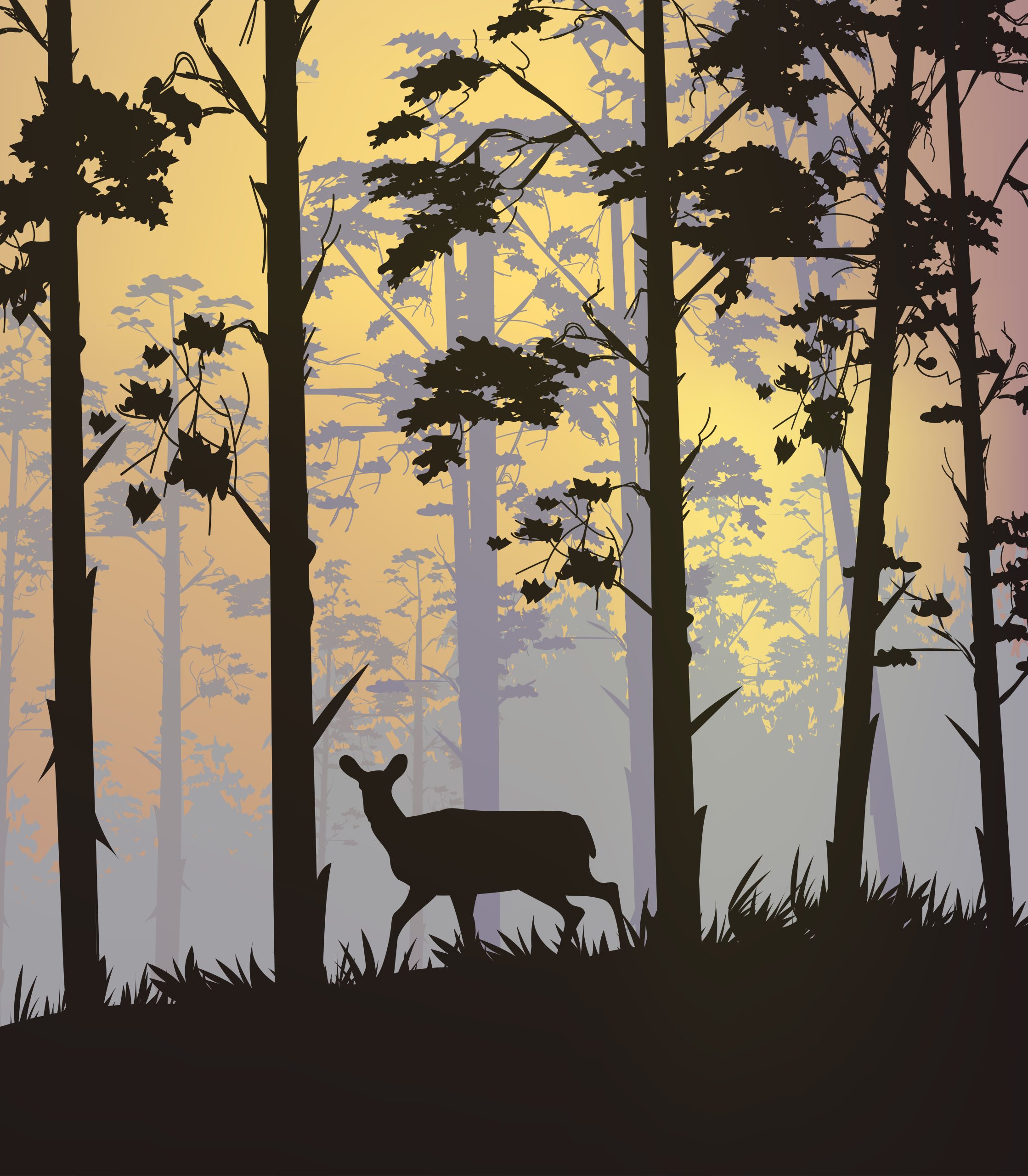
An old doe was approaching cautiously from my left on a track to pass about five yards in front of me. I remember having no doubt about my intentions until the deer stopped broadside directly in front of me. At that precise moment the first rays of morning sun broke through the hardwoods behind her. She was suddenly cast in the golden light of a winter morning, and her details were instantly burned into memory. All these years later, I remember the scene with great clarity, right down to the angle of the shadows made by the light on her face. I saw dew on her whiskers and the heat of her breath fogging the morning air. I could see the individual hairs on her nose and the hesitant glances in her eyes. Her leg muscles rippled beneath a winter coat, and in that instant my plan fell apart. I watched her for as long as I could, and as she walked away I sat, stupefied, wondering what had happened to me.
That brief encounter taught me that hunting involves an exchange, and that harvesting a game animal is not simply an act that precedes meat going in the freezer. It is a transaction involving mutual give and take. The deer gives its life and a hunter takes it, but what does the hunter give in return?
Until that morning at Catawba my answer to that question, had I thought to ask it, would have been, “nothing.” I’m not sure that we as hunters can give anything to balance those scales when the measure of success is death, but now, if nothing else, I consciously give my respect each time I hunt. This goes beyond philosophical lip service. Pragmatically it means having a commitment to marksmanship and taking ethical shots. But, I think more fundamentally, it means entering the woods with some degree of reverence, and an appreciation for everything that lives there. These demonstrations of respect may nevertheless be inadequate, but they are the best way I have found to balance the ledger of the hunter’s exchange.
It wasn’t until I had a son and daughter of my own, and Catawba was long gone, that I understood how I had taken the place for granted. Today Catawba is part of the South Alabama Mega Site. The bass pond is beneath a rail spur and the logging roads accommodate commercial traffic. Although I miss the wild pine woods of my youth, I am grateful for the benefits Catawba will bring to north Baldwin County in its new form. The place where I let that old doe walk sits in an undisturbed corner of the site where the creek still flows, and where, I am sure, the deer still come and go every day.
Remembering Catawba
CURRENTS
To receive your copy of CURRENTS every quarter, become a Baykeeper today. Members who give $50 or more are automatically subscribed to our magazine.