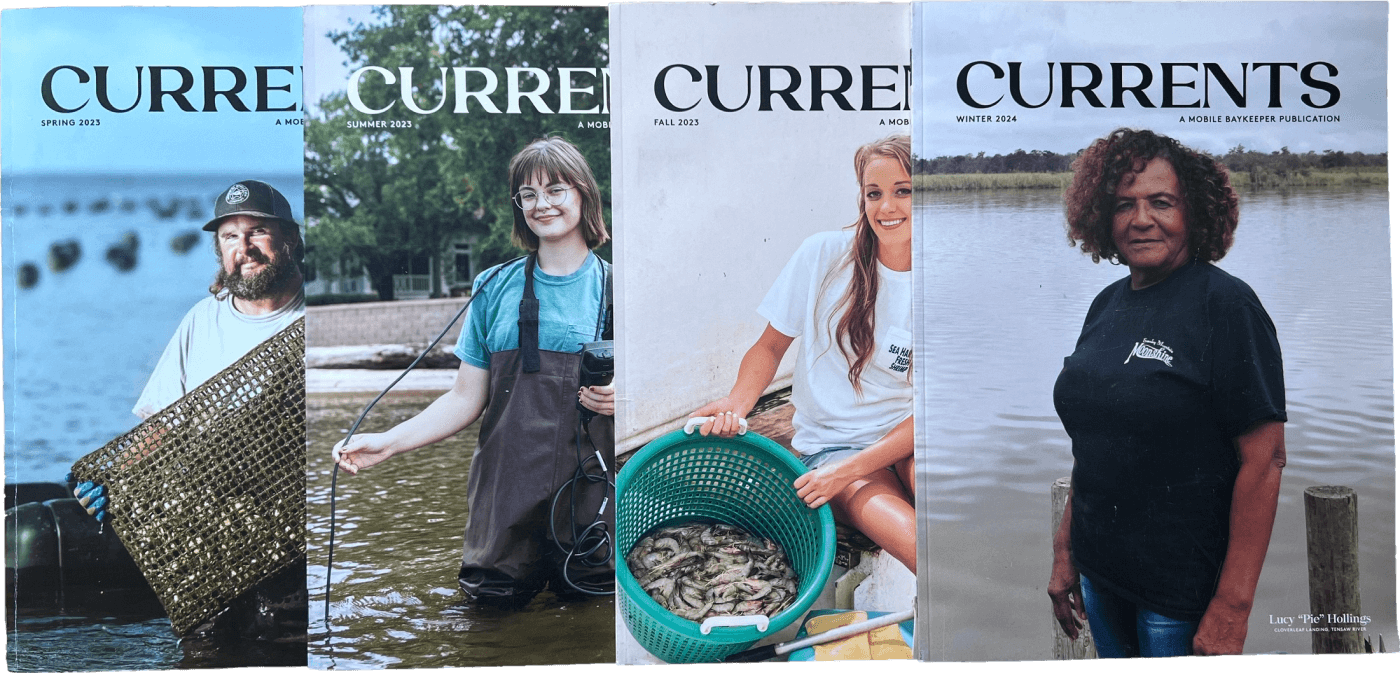
This article is from the 2026 summer edition of Mobile Baykeeper’s print quarterly, CURRENTS. The magazine is mailed to active members who have given more than $50 in the past year. To get on the magazine’s mailing list, donate here.
By Nick Williams
Darren Shirah has spent more than fifty years fishing the Mobile-Tensaw Delta, first as a boy riding with his uncle, and now as a retired angler who spends as much time on the water as he can. He’s known to many through his YouTube channel, Reel Time Outdoors with Darren, where he shares the kind of knowledge that can only be earned over decades of paying attention.
What follows is a conversation about how that knowledge was built, what he’s seen change, and why he keeps going back.
What are your earliest memories of fishing in the Delta?
My earliest memory … I was probably eight years old, and it was my Uncle Eugene who carried me. I’d spend the night with him and we’d get up early and go. Steele Creek, Little Bayou John, Franklin’s Creek … We went a long way from where we started, and that’s what I remember as a kid.
We fished with worms and crickets. He raised his own worms, and we’d buy crickets at Northside Bait and Tackle. It’s reopened now, as Steele Creek Marina, under Josh Gunter.
Were there any lessons from your Uncle Eugene that stuck with you?
He showed me how to tie a knot. I don’t even know what it’s called, but I suppose it’s some variation of a clinch knot. It was all I used for years until I learned to tie a Palomar knot, and I still use it today on small hooks.
He taught me to use a quill, too. I use a porcupine quill float to this day. And if I can’t find them, I’ll buy the quills online and make them into floats. The reason why he used the quill is that it is much more sensitive. The fish doesn't feel the drag when he pulls on it, and you can get away with a lot less weight. It’ll stand up when your bait’s off the bottom, and it lays flat when it’s on the bottom. It gives you more information about what’s going on with your bait.
You fish for a little bit of everything, but bluegill (bream) seems to be a really big part of what you do. What is it about them that’s kept your interest all these years?
I never thought about that. That was my first love, you know? There’s just nothing like a good bluegill bite. They’re so aggressive, and they’re plentiful. Ninety percent of the time, if you spend long enough out there — he may not be a giant — but he’s going to stretch your string. Bream are willing to bite.
There’s just nothing like that quill going down. Sometimes it’s fast, sometimes it bobs a little and turns. Sometimes it’ll just lay flat. It’s just exciting. Then you pop it and he goes circling. Bream circle when they fight. I guess that would be the reason. I don’t know. I just love them. I love catching them. I love to eat them.
Do you use a depth finder?
I never had one for most of my life. Even today, I don’t really use one. I did get one on a boat recently, but I don’t need it. I know where I’m at. I know how deep the water is where I’m at. I don’t need a screen to know if it’s twenty-foot deep because I already know it’s twenty-foot deep. That might sound arrogant, but I’ve been doing this for fifty years.
I learned it by trial and error. You throw a worm out there and give it a countdown. You find out how deep it is. There are places in the Delta I’m not as familiar with, but most of it I’ve been in. I know. So that’s my depth finder.
When you think back over the years, what are the biggest changes you’ve seen in the Delta?
The most noticeable changes are the creeks that I used to go in, the sloughs that I used to go in, you can’t get in them anymore. There’s no water. It’s filled in, silted in.
The fish population is not as good. The size of the fish is not as good. And there’s less grass in the Delta, although recently it seems to be coming back a little. That is the biggest reason I think that the fish population has gone down in number and size because there’s no habitat or no food source.
Grass brings grass shrimp. There’s hardly any grass shrimp … crustaceans, snails, which the shell crackers eat. Bream eat snails and grass shrimp. They live off the grass. Not the grass itself, but what grows in the grass and lives in the grass. And when there ain’t no grass, there ain’t no food.
There is still some grass, but it’s not as much. So your sizes went down for that reason, and your numbers went down for that reason. That’s my opinion. So that’s the big change. It hurts my heart to want to go to spots that I used to fish and catch fish in three to six feet of water, and there is six inches of water. Or the grass is gone.
Do you have any sense of what’s causing those changes?
I don’t know for sure. I’m no scientist. But there’s something wrong in the Delta. My theory is it’s a combination of things. I think some of it is coming from upstream. We’re the end of the drain, so everything ends up here. Industry, runoff, whatever it is, it’s all coming down into the Delta. I can’t prove that. That’s just my opinion from being out there all these years. I just know it’s different. Something’s off.
You’ve started sharing your knowledge through your YouTube channel, "Reel Time Outdoors with Darren." What made you decide to do that?
My son-in-law is the one who pushed me to do it. He said I ought to start a YouTube channel and share what I know. I never thought of myself as having any kind of knowledge to share, but I do have a lot of years out there. I’ve learned a lot. I’m going fishing anyway, so I figured I might as well video it and show people.
It’s grown more than I expected. People recognize me, come up and talk to me, ask questions. That’s been surprising, but it’s also been good.
When you think about the future of the Delta, what gives you hope? What concerns you? What gives me hope is seeing young people getting into fishing. I see more of that, especially with bass fishing. That’s encouraging. I’d like to see more kids out there fishing, just for fun. Not everything has to be about tournaments or big fish. Just go catch some bream. Catch something. Enjoy it.
What concerns me is the health of the Delta. The changes we talked about. The water, the grass, the fish. That worries me. Access is another issue. It’s hard for people to get into the Delta without a boat, and that makes it harder to get new people involved.
For Darren, the Delta is a place you have to learn by being out there. Books and even videos cannot do the place justice. He knows it is not the same place it once was, but he has also seen enough to believe that there is still something worth passing along. — N.W.

Quills, Bream, and Grass
CURRENTS
To receive your copy of CURRENTS every quarter, become a Baykeeper today. Members who give $50 or more are automatically subscribed to our magazine.