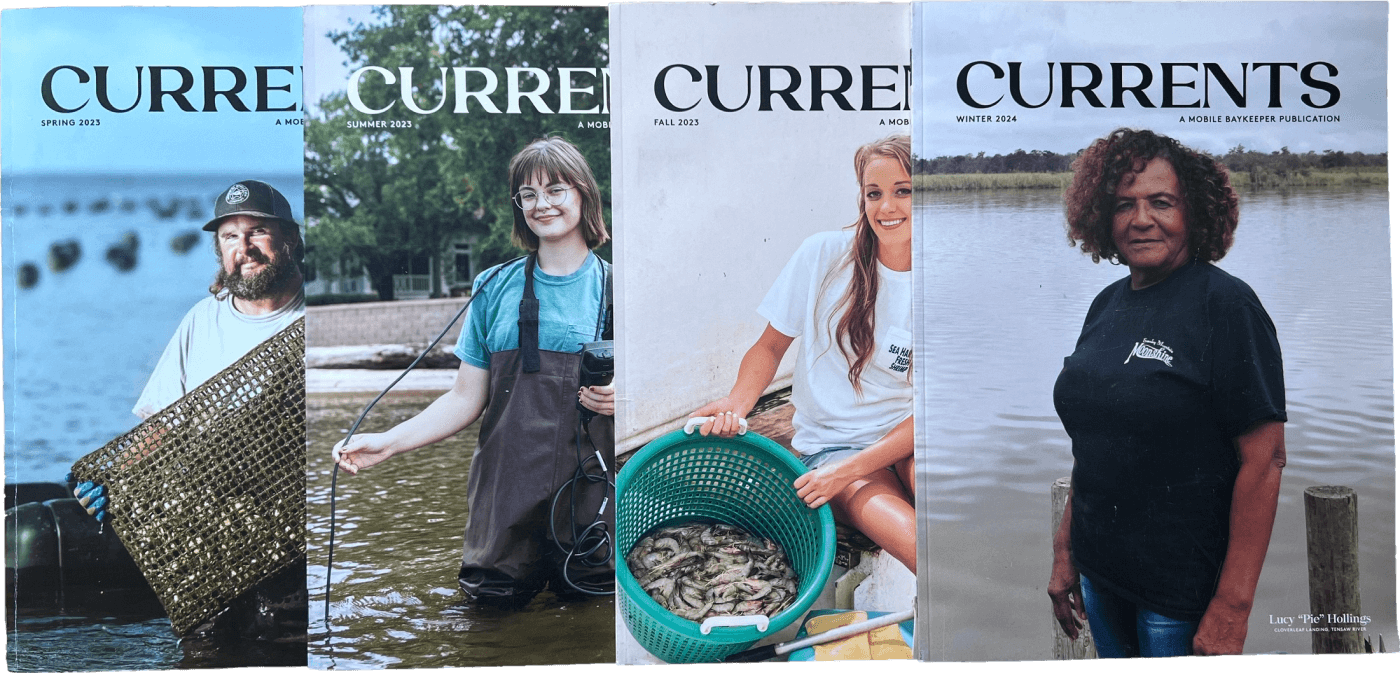
This article is from the 2026 summer edition of Mobile Baykeeper’s print quarterly, CURRENTS. The magazine is mailed to active members who have given more than $50 in the past year. To get on the magazine’s mailing list, donate here.
By Rachel Ball | Photos by Courtney Mason
I’m driving through lush piney woods until I find a small clearing in the trees. If I hadn’t been looking for it, I would have missed it. The clearing is the start of a driveway. I turn into it and bump and twist along until I come to a slow stop in front of Captain Tom Yeager’s home, nestled in the treetops. Tom saunters out, barefoot and brandishing a lilac bandana around his neck. His deep, honey-coated voice calls out, asking if I want to come inside for tea. We start climbing the stairs over his boathouse until we reach the top deck overlooking Fly Creek. Tom opens the door and subtle notes of pine and cypress greet my nose as he leads me into the living area that seems to be bursting with stories of Tom’s life as a captain and Port of Mobile harbor pilot.
I soon pass under a small staircase that reminds me of one you would find in a boat and that leads to Tom’s studio bedroom and then into a rustic kitchen with an iron stove and open shelves spilling with ceramic dishes. As I sit at the kitchen counter, Tom puts a kettle on the stove. He has snacks laid out in front of me in little dishes shaped like canoes. He wanders over to the fireplace and begins starting a fire. I’m admiring the ironstone fireplace creating the perfect contrast to the knotty cypress walls, and Tom tells me he found every stone in the fireplace. In fact, everything in this living room was made from things he found. The windows are all reclaimed. The sleek rocking chair and cozy couch are made from cypress logs found on the beach. The coffee table is made out of a piece of cypress so big the sawmill wouldn’t cut it.


Tom recalls, “Well, I had just bought a new chainsaw, why don’t we quarter it? We started on one end and popped a line and sawed it all the way across and inside. Anyway, that tree was over 1,000 years old, based on the rings.”
The floors are made out of long-leaf, yellow pine, a 200-year-old tree that had been in the water since the turn of the century — back when they were pulling the trees out with mules and trying to float or pull them down the shallow creek, which wasn’t dredged until the ’40s.
When Tom was putting his pilings in, his crane guy would bump up and pull out these 30-foot-long sinker logs and Tom turned them into the stunning living room floors I’m standing on now. Tom says he learned woodworking through osmosis from boat-builders. Herbert Foster, who lived at the foot of Pier Street, built boats there at the turn of the century — from shrimp boats to the prams Tom sailed as a kid.
Early Times
Tom grew up at his mom’s house on Pier Street. Her name was Dorothy, but everyone called her Dot. Everyone came to Dot’s house on Sundays to hang out and admire the Bay, but Tom likes to say, “I slept on my mama’s porch, but I lived in the Bay.”
He and his dog Boo-Boo, an Irish Setter and Black Lab mix, would get up at daylight and not return until dark. They’d hit the beach and Boo-Boo would wade up to her chest in the water, pointing at schools of fish. Mr. Lee, the butcher, would call out to them, “What are you and Boo-Boo doing this morning?” “Oh, we’re catching mullet,” was Tom’s usual reply, knowing Mr. Lee wanted to throw a net with them.
When Tom swam, he’d try to stay on the top of the water and not disturb the seagrass beds. He wore these little goggles because “the seagrass beds were like a coral reef. There would be a stingray or crab or flounder. Everything lived in it, you just can’t believe it. That ribbon grass was over a foot tall so it just flowed around. It was unbelievable, really. You just never dreamed it would disappear, you know.”


The Houseboat
I spot an old photograph of a houseboat on the wall and Tom starts telling me the story behind it. Tom’s father was good friends with Levine Berglin. The Berglins were one of the founding families in Fairhope and owned Azalea Creamery, making ice cream and milk in downtown Fairhope.
One day when Tom was five, Tom’s father and Levine came into Fly Creek with a barge and a paddle wheel and tied it up at the yacht club. The next day, they put picnic tables and umbrellas on it and took off to Fish River. They brought a couple of ski boats so everyone was out skiing and running around and they had a grill and food and coolers on the barge. Herbert Foster designed and built a house on the barge, turning it into a houseboat.
Tom smiles as he says, “Levine, my father, and all these men I grew up with, they fought in World War II. So when they came home, they didn’t have the word for PTSD, but what they did do? They partied every weekend.”
For years, they’d take the houseboat up to the Delta to hunt and fish. To a 6-year-old Tom, the 65-foot houseboat felt 1,000-feet long. They named the houseboat “Pleasure Bay” and when Levine passed away, he left it to Tom.
The houseboat is what Tom lived in when he was building his boathouse on the creek.
The Bungalow
After visiting the houseboat, Tom takes me across a deck as he leads me to a little bungalow sitting in the trees, and I feel like I’m walking amongst the clouds. Rachel Ball and Tom Yeager
Right now, he has an Argentinian photographer, Matias, staying in the bungalow while Fairhope Yacht Club is hosting the US Optimist Team Trials. The bungalow has also inspired some of Tom’s artist friends, like musicians Molly Thomas and Ken Rose, who together wrote much of Molly’s latest album, Tumble Home, while visiting Tom’s magical place.
As we meander back to the main house, I’m thinking about the idyllic way Tom grew up and can’t help but wonder if the magic of that childhood is still alive. Was he able to impart those kind of experiences to his daughters, Jessica and Catie? Tom tried to give them a childhood like his. “We were in the Bay every day,” he says. “There was nothing we weren’t doing on the water. If we weren’t sailing or traveling on the sailboat, we had a motorboat and we were off to Sand Island or Petit Bois. I would set Jessica down and she would crawl right to the Bay — one with the turtles.”

The Little Pink Boat
Back at the house, Tom points to a photo of two little girls in a tiny, pink wooden boat. “That little pink boat we built for them when Jessica was four,” he says. “This is them on Christmas morning with it. We made those little oars there too. They were little and small, so we made everything small so they could handle them. We’d pull this little boat behind our sailboat when we’d travel. I grew up on the Bay and I am just a complete boat lover, you know. We sailed everywhere. They loved it. The only time I ever heard them cry or get upset is when I told them we were going back home.”
Clearly, Tom passed down the boat-lover gene to his daughters: Jessica is a waterwoman and Catie sails in regattas, most recently winning the 2025 RS Aero Women’s North American Championship held at the Fairhope Yacht Club.
Tom can’t overstate how important nature is in childhood, saying, “I think it’s the most important education you will ever get. Connecting with nature is everything. It’s true love. We’re one with it all. It gives every day to us. It doesn’t stop. Even though we mow it down and destroy it, it keeps on giving. It’s a beautiful place here, I’ll tell ya. It’s a sacred place.” I’m not surprised to hear Tom say this, seeing as he graduated from the Marietta Johnson School of Organic Education.
Turtles All The Way Down
Tom and I head back downstairs and under the boathouse. It’s time to feed the turtles as they’re sitting on a huge cypress log. Tom tells me that log has been tied there for more than 20 years. He found it on the beach, back when Scott Paper was logging with a helicopter up in the Delta, and dragged the log home, just as he did with the logs he turned into furniture upstairs. Tom left this particular log tied up, and the next day, “Turtles were up on it, then this alligator gets out and is sitting with the turtles. They were nose to nose. I was like, well, okay, that’s going to be y’all’s log.”
We settle down to feed the turtles and I notice the little pink boat from the photograph Tom showed me. It’s sitting next to a wooden rowboat that Tom tells me is a replica of a Magnolia rowing skiff. It’s made of juniper and heart pine, the same pine as the living room floors I was standing on upstairs. Tom rows that boat every evening at sunset.
While the turtles enjoy their meal, Tom fills the easy silence with more stories: of the ospreys who hang out here every day; of the man- atees who came up here one time and hung out right under the boat- house; of the beavers and otters who come out every night; of the sound of mullet jumping at night; and of the time he met a married couple, Rick and JoAn, in St. Petersburg and figured out they were both sailing back to Alabama. Rick and JoAn opened Anchor Down Boatworks in Josephine and have been friends with Tom ever since.

The Cypress Trail
Now that the turtles are fed, Tom wants to take me around what he calls the “Cypress Trail.” Tom started clearing trails on his land for his four-year-old grandson, Jack. We leave the turtles and start on our walk in the woods. As we’re walking, Tom points out all the little cypress trees he’s planted. They have wire fences around them to keep the beavers away. We’re walking along the creek, towards the artesian well that flows behind the boathouse, with just the sounds of the birds singing and Tom’s melodic voice. Tom intermittently stops to smell the Cherokee Roses that are blooming along the trail. He points out a 50-year-old pine tree that got struck by lightning during Hurricane Sally and tells me how he’s going to turn it into a bridge to go over the slough where we’re standing.
We get to the artesian well and I feel like I’m somewhere far away from Fairhope, deeply surrounded by nature until Tom points in the direction of the road that took me here. Tom groans as he says, “When they built that four-lane, they clear cut that forest and that’s when everything started changing here. This was an amazon when I grew up.” He says this area started flooding after the forest was clear cut, but adds that the cypress trees he’s been planting will grow to act as a natural bulkhead. Tom stays optimistic, saying, “I think in some ways it’s got to be better now. They’re testing water. I never heard of anybody testing water when I grew up. We didn’t have the amount of people here, either.”
The trail starts looping back towards the boathouse when we come across the old wooden sailboat Tom and his friend Rick, the one he met in St. Petersberg, have been restoring. It’s the very same sailboat Tom’s daughters grew up on, and the one he now hopes to sail as he creates new memories with his grandson, Jack. Tom built the boat in 1983. It’s made of juniper. He gives me a piece to smell as he tells me how juniper is a good wood to build a boat out of because it doesn’t take up water. He goes on about how when he was building the boat, he was working with a third-generation moonshiner on the tugboat, so they’d drink moonshine while they were working on the wooden boat. He points out how the stem of the boat is made from mulberry.
I’m imagining all of the places Tom has been in this little wooden sailboat when I ask, “Out of all the places you’ve been, what is your favorite place?” Tom replies, “All of them. Favorite is a hard word because I love everywhere I’ve been. I tell you what, I love everywhere I am. How about that?”
As I prepare to leave and as Tom gets ready to go out in his Magnolia rowing-skiff replica, I think of how lucky we are that out of all the favorite places Tom has been, he always tumbles home to Mobile Bay.