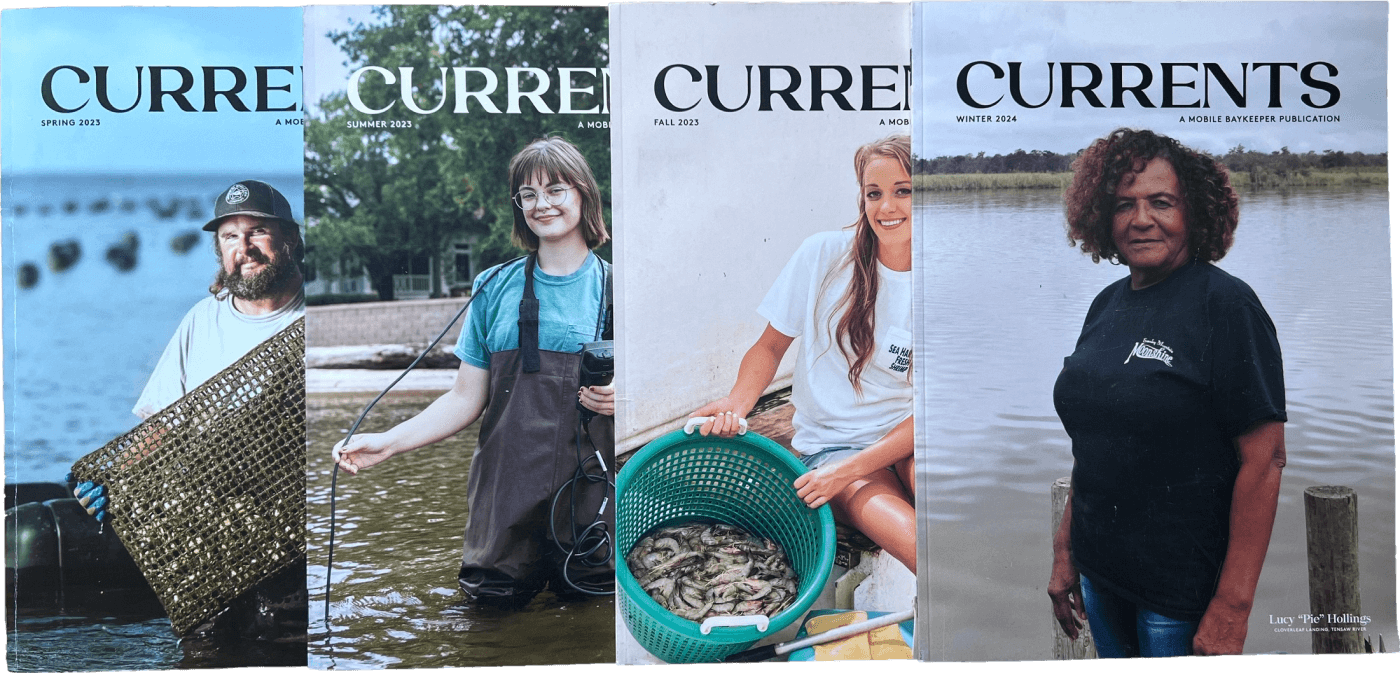
This article is from the 2026 fall issue of Mobile Baykeeper’s print quarterly, CURRENTS. The magazine is mailed to active members who have given more than $50 in the past year. To get on the magazine’s mailing list, donate here.
By Sam K. Wilkes | Illustration by Courtney Spencer
Hard to name another world-renowned artist more synonymous with Mobile Bay and the Gulf Coast. But how do you memorialize the legacy of a man who lived over a thousand lives? The answer seems to depend on who you ask. Some knew Jimmy Buffett the musician. Dylan called him one of our greatest songwriters, citing “He Went to Paris” as a personal favorite. Which might be unexpected to those who only think of Buffett as the frozen concoction reveler. And they would likely be even more surprised after spending time with his whole discography. To hear a tongue-in-cheek poet, similar to John Prine but with a salty rim. A sentimentalist wringing his heart out on the back of a cock- tail napkin. A stargazing philosopher defying gravity. A Hemingway mixed with an ounce of Hunter S. Thompson for spice.
Great storytellers immerse their listeners within their domain. I personally can’t think of a comparable singer-songwriter who managed to create his own world—or island— and transport so many devoted people there with him. Doesn’t matter where I am, when I hear his songs, I still think of my dad wearing out old tapes on our family trips to the Gulf in the late ’80s, immediately immersed in the salt air, with the smell of driftwood and boiled shrimp. And to bring it full circle, my own young boys teared up when the sad news broke that Labor Day weekend in 2023. And that's just the music. Some knew the adventurer, the sailor, the pilot, the fisherman, the savvy businessman, the author, the unassuming philanthropist, or the family man. And some knew the honorary Mobile Baykeeper board member. But the folks on the Gulf Coast understand this dynamic collage. Which is why they created an exhibit.
“Shortly after Jimmy passed in 2023, Mayor Stimpson got a group of creative minds from the City and asked, ‘What can we do to keep Jimmy as a part of Mobile?’” says Karen Poth, executive director of the National Maritime Museum. “We started with a statue, which will be installed in front of the museum. But then we said what about an exhibit? Honestly, at that time I was thinking of a small room with a couple of cases, showcasing that he grew up here. But in the past two years we’ve received such a great response from his family, friends, and even fishing buddies who were excited about it being located here in Mobile. And with their help we are now up to a 6,000 sq ft exhibit with over 200 artifacts. We will have the most comprehensive Buffett exhibit in the world.”
The exhibit is located inside the National Maritime Museum of the Gulf, on the waterfront by the Mobile Convention Center and Cooper Riverside Park. And the location was intentional. James William Buffett was born in Pascagoula on Christmas day but moved to Mobile at 18 months old, where he lived until college. Raised in a Catholic household, Jimmy served as an altar boy until he was 17 years old and attended St. Ignatius and the McGill Institute (now McGill-Toolen Catholic High School), where he even served on the cheerleading squad one year. His grandfather, James Delaney Buffett, was a schooner captain traveling the globe, while his father, James Delaney Buffett, Jr., was a marine engineer and worked at the shipyard. His mother, Mary Loraine ‘Peets’ Buffett, worked at the Alabama Dry Dock and Shipbuilding Co. as well and held many positions including the first ever Equal Employment Coordinator. Jimmy spent his summers on Mobile Bay and along the Gulf Coast, developing a lifelong love for saltwater and sailing.

“Mobile played such a huge role for his family and who he was. His parents worked here and all Jimmy’s first jobs were here in Mobile,” says Karen. “We have a lot of family photos and memorabilia from those early times. Several pages of handwritten lyrics, one from the ‘Captain and Kid’ written after his grandfather’s passing. And his first recording, here in Mobile with Milton Brown. And the museum is located right across the river from where his parents worked at the docks. This waterfront was very much a part of his life. His grandfather sailed ships into this port from all over the world, hence the title ‘Son of a Son of a Sailor.’ The exhibit will even have a full ship log from all the vessels Captain Buffett sailed. His famous 4-mast schooner, The Chiquimula, sailed routinely from the West Indies to the port of Mobile with lumber and railroad ties. After Captain Buffett no longer owned the schooner, it was towed into the Blakeley River where some investors had plans for converting it into a restaurant until it caught fire and burned. However, Jimbo Meador says the wreckage of the hull and masts can still be seen during a low tide with a north wind, peeking above the water line north of the Causeway near Spanish Fort.”
Jimmy graduated high school in 1964, and his parents envisioned him becoming a US Naval officer or fine southern lawyer. As we all know, Jimmy charted his own course. He played some drums and trombone in school but never seriously picked up a guitar until his brief stint at Auburn University. He learned three chords, enough to attract the attention of the ladies. That decision changed the man and musical landscape for decades.
Milton Brown, a local Mobilian, had never heard of the young man until around 1969 when he walked into his little studio located at the Loop. Situated over a dentist’s office, Product Sound Studio had been built from junk parts by Travis Turk, a local radio disc jockey. Travis along with local radio/TV meteorologist, John Edd Thompson, and Nick Panayiotou, the son of the owner of Mobile's finest restaurant, Constantine’s, had recruited Milton at his doorstep to help operate the studio.
“We rented the little space for about $50 a month and converted into a studio,” says Milton. “Travis built the board out of parts from the junkyard. With rotary pots, not the slider pots of today. And we opened the doors and put the word out. We pretty much tried to help record anyone who came in the door.”
Jimmy had recently returned from gigging around the French Quarter in New Orleans and took a job as an electrical assistant at the shipyard on Mobile Bay, gigging at night along Royal Street. Fortunately, Milton was there when Miss USS Alabama, Margie Washichek, came in and asked if she could make a recording appointment for her boyfriend. Milton said he put her on the schedule, and the boyfriend came a few days later to record. Milton had never met the young man, thirteen years his junior, but recalls to this day “that Buffett smile that just lit up the room.”
Jimmy recorded “Don’t Bring Me Candy” and “Abandoned on a Tuesday” with Travis Turk at the helm in that Mobile studio. Those were the first two songs Jimmy Buffett ever wrote and recorded in a real studio. A two-sided 45 rpm record paid with his own money. Buffett later admitted on his Buried Treasure: Volume 1 album that there was a lot of Gordon Lightfoot influence shining through those early recordings. Milton had more of a country and bluegrass background, but he took a liking to Jimmy and his folk sound. Unfortunately, though, they could not get it played on the radio in Mobile. “This was still during the protest-song era. He wasn’t doing his Caribbean Cowboy music yet,” says Milton. “But I would take his stuff around to the various local radio stations, and universally I would get the response: ‘It’s not country, it’s not pop, so we don’t have a genre for it.’” (See Jimmy’s song “Saxophones” for his musical take.) Milton chuckled recalling how “Jimmy later would say, ‘They didn’t have a genre for me and now I am a genre.’ And, of course, he was right.”

Milton saw something in Jimmy early on and knew he was made of the right stuff. “One time he had a gig in Atlanta at some bar and I was in town,” says Milton. “Jimmy said when you finish come see me. I went in and there’s Jimmy on stage playing his heart out to an audience of one. And that one guy had obviously had too much to drink with his head on the table. Jimmy played for that stoned guy as though it was an auditorium full of people. And I thought to myself, ‘This is a guy that knows what it’s about and does things right.’”
In those days, they would record ten songs in a three-hour session for a rough demo and then shop it around to record labels in Nashville. One of these sessions, Milton was getting ready to record in Nashville since they had three-track studios at the time. Milton only had seven songs ready to record. “So I asked Jimmy if he'd like to record three of his,” Milton recalls. “He lit up and said ‘Oh boy, yes I would!’”
Milton and Jimmy flew to Nashville, recorded some demos, and shopped the songs to the CBS Records Division. Milton recalls them recording “Abandoned on a Tuesday,” “Don’t Bring Me Candy,” and “Ain’t He a Genius” in the Nashville studio, which had more advanced gear than Mobile at the time. Jimmy had to be back in Mobile for his standing gig at the Admiral’s Corner Lounge in the Admiral Semmes Hotel, for which he received nominal pay and free drinks. Milton called him that night and told him CBS had made an offer, contingent on the corporate approval. Milton recalls hearing the cheers over the phone, knowing Jimmy needed this deal so he could marry his devoted girlfriend, Margie, and start a career. However, the next day CBS said the offer to sign stands but they would have to cut the amount in half from about $50 a week to $25. The wind immediately dropped from the sails, as Jimmy could not start a career and family on the reduced amount.
But soon the winds picked back up. “When I got back to my motel there was a message left for me to call Buzz,” says Milton. “Turned out Buzz Cason was building a studio and Travis Turk was helping him. Buzz and his business partner had just sold their catalogue to Lawrence Welk and so they were flush with money. Buzz said, ‘If you meet me, we’ll hammer out the details of Jimmy’s contract.’ So, we met at Lum’s restaurant and agreed on terms that were written on the back of a napkin. I always say, ‘I don’t know who has that napkin now, but I sure wish I had it.’ Anyway, that contract allowed Jimmy to get married and move to Nashville. The rest is kind of history.”
On his Buried Treasure: Volume 1 album, Jimmy recalled his time back in the Mobile studio, saying, “Going back home was one of the best and luckiest moves I ever made. Though I didn’t know it at the time, Milton provided the launch pad from which my rocket blasted off to where no Mobilian had ever gone before. So, as they say in nautical terms, Product Sound Studio was the port from which I embarked on this musical journey.”
Yet before he could set off to make history, there was a lingering obstacle. “Shortly after Jimmy went to work with Buzz in Nashville, I get a call from him frantic and almost weeping,” says Milton. “He said, ‘Buzz isn’t going to sign me unless you tear up our contract.’ I told him not to get upset, and consider our contract torn up. Now, I didn’t tear it up, I don’t know why I saved it, but my word was still good that contract didn’t exist anymore as far as I was concerned,” says Milton. Milton still has the contract to this day and it will be available for the museum. “Years later, after he’d become a success, I was sitting at a birthday dinner at LuLu’s with Jimmy’s mother, Peets, and I told her that I had found that old agency contract and it says that I’m entitled to 10 percent of what he’s made. So, I figured if he’s made $800 million by now, then I’m owed $80 million. She said, ‘Don’t tell Jimmy that, it’ll give him a heart attack.’ I was, of course, teasing her, but the next time Jimmy was in town he called me up from the Grand Hotel for lunch. I told him that same joke and his mother’s reaction. Jimmy just gave me that classic Buffett smile and said, ‘I wouldn’t have had a heart attack, but my lawyers might.’”
Milton was clearly teasing and the contract only had a term for three years, so there was no great loss. But it still makes for a good story and a testament to Milton’s word. “There was no question ever—in my mind it was torn up,” he says. “My word was good. I was just happy to have been a part.”

Photo courtesy Florida Keys Public Libraries, Ida Woodward Barron Collection / CC BY 2.0
On his first album, Down to Earth, Jimmy recorded a song co-written with Milton called “The Christian?” Milton recalls with delight that Jimmy had come up with the idea about fake Christians and had the standout lyric: “Could you really call yourself a Christian/ If charity cost half as much as beer.”
Milton and Jimmy’s careers took different paths over the years once Jimmy discovered his signature tropical sound in the Keys. Milton stayed in the country genre, writing music for several Clint Eastwood movies, along with songs for Glen Campbell, Merle Haggard, Charlie Rich, Menudo, Blake Shelton, Kenny Rogers, Smokey Robinson, Loretta Lynn, and the Nitty Gritty Dirt Band, among many others—a list too long to include in this article.
The two stayed in touch over the years along with their extended families. “The last time I saw him, he had called and said, ‘How about a visit?’ and I said, ‘Great when?’ He said, ‘I’m at the airport.’ So, he took an Uber to our house in Mobile and we visited. We talked about old times. We had our daughter Margaret’s wire-haired red dachshund, Max Pickle, over at the house and that dog loved Jimmy from the outset. Jimmy kept a picture of Max Pickle on his phone and when he was doing one of his last music videos, for the song ‘Like My Dog,’ he sent me a text that said, ‘Your daughter’s dog made the cut!’” Jimmy made the video in partnership with the ASPCA to encourage pet adoption. Unfortunately, he passed before its official release in November 2023. But it is good to see another Mobile connection in the expansive legacy.
Still residing in Mobile, Milton Brown is beyond thrilled for the exhibit to be opening here. He says that Mobile and the Bay meant a lot to Jimmy. “I think it’s past time that we honor him. I think it’ll memorialize somebody that certainly changed a lot of lives. And I think it’ll be really good for the city, too. Parrot Heads from all over the world will want to come and see it. An exhibit that’s never been available to them before.”
Surprisingly, Jimmy Buffett’s only top ten hit was “Margaritaville,” peaking at No. 8 in 1977. If he had followed the typical course of a “one-hit wonder” from the ’70s, he might have been playing the legacy act at local jamborees and relegated to a footnote on “Where Are They Now?” programs. But as Milton noted, Buffett went on to create his own genre, making new music up until the end. But not only his own genre, the man created his own aura, his own brand, his own resorts, his own fleet of vessels, and was still filling venues across the world with a festival flair. Much like the Grateful Dead, Buffett amassed a devoted fan base of Parrot Heads that grew over time and followed him into the sunset. Today you can’t have a drink anywhere on the Gulf Coast without some Buffett influence in the air, maybe on the stage or on the walls or behind the bar. Jimmy’s Coral Reefer Band continues touring his music to “keep the party going,” per his final wishes. And now there are young bands taking his legacy in new directions. Jammy Buffet (one “t”) started in Colorado and now tour the country, blending Buffett’s catalogue with songs from the Grateful Dead, Allman Brothers Band, and other similar styles.
That’s partly why the exhibit will be what the museum is calling a living tribute. There is too much to distill into a few cutouts and placards. The exhibit will have many never-before-seen artifacts from Buffett’s life, photographs, and rare concert footage. But due to the number of stories and content, it will update with new material periodically—a living and vibrant testament. It’s built across two levels and tells the story of him from Mobile to worldwide troubadour. The exhibit will even have the phone booth from his famous Coconut Telegraph album cover, shot on a pier in Point Clear near the Grand Hotel. The phone booth was once owned by Elvis Presley, which is a whole other story—but it’s on loan, so it will only be on display at the museum for the first six months.

Another item the fishermen are especially excited about is a replica of Jimmy’s “Last Mango,” a 42' Freeman with quad Yamaha 300-hp engines and its custom-built pilothouse. Yamaha and Garmin teamed up to build the replica of the helm for the exhibit. It’s a unique vessel with combined features that did not exist until Jimmy drew out his vision and made a request. “This is one of the boats of his fleet that folks from Mobile are most interested in,” says Karen. “Excited for all the fishermen in Mobile to come check out.”
Jimmy stayed on the cutting edge when it came to improving his fishing game. Jimbo Meador, local living legend of the fishing world among other renowned attributes, recalls Jimmy pushing the envelope and trying new techniques up until his final days when the two would take trips to the Bahamas to bonefish. “We started going on those stand-up paddle boards to get in really skinny water that the guides couldn’t go,” Jimbo says, laughing to himself while choking up a little. “Did that right up to when he died. He loved bonefishing. I fished with him a lot. We used my design with the Ultimate Native kayak first. Because we wanted to get in that really skinny water, or back in those creeks. But anyway, I sure miss him, he was a helluva good friend and you know he never did forget me. I knew him before he got famous. That’s what most people don’t realize, he was down to earth. But anyway, that’s all I got to say about that.”
Some other highlights from the collection on display will include: Buffett’s 2023 Rock & Roll Hall of Fame statue; his personal 12-string Martin guitar that was used to write and perform “Son of a Son of a Sailor”; handwritten lyrics and other personal papers from throughout his career; never-before-released concert and recording footage; personal photographs, scrapbooks, and memorabilia offering an intimate look at his life; as well as a recreation of Shrimp Boat Sound, Buffett’s Key West recording studio.


Jimmy had moved on from Mobile when Will Kimbrough was coming up at Mary B. Austin Elementary and Murphy High School, but his music made an impact at an early age. “I think my dad did some legal work for one of Jimmy’s sisters. Otherwise, I was just a kid who knew all the Buffett songs. How could you not?” says Kimbrough. “I remember seeing Buffett and John Prine on TV when I was 10 or 11. It made an impression on me. Around that same time, I became absolutely fascinated by music, songs, bands, guitars, so I begged my parents for an electric guitar and an amplifier, and they gave me one for my 12th birthday.”
The young Kimbrough, watching his television set, probably never dreamed he would one day work extensively with both Prine and Buffett. Kimbrough formed a band after high school that opened for an up-and-coming band, REM, at the Saenger Theatre in Mobile about a month before they recorded their debut LP, Murmur. “That made a big impression on me as well. I felt like I could pursue music if those guys could. Not because I thought I was as good or better than them, but because I felt like I had a lot in common with them. I was very inspired by the concert.”
Kimbrough later moved to Nashville and immersed himself within the music scene, which at the time included Webb Wilder, John Hiatt, Rodney Crowell, Steve Earle, Emmylou Harris, and so many others. After several albums with his own band, Will and the Bushmen, he joined Todd Snider’s band. Touring with Snider’s band, around 1995, is when he met Jimmy and the Mobile natives connected. “We were playing Tipitina’s in New Orleans. Jimmy showed up with Jerry Jeff Walker. It was a big ol’ NOLA night. A few years later, Jimmy asked me to send him songs, and he cut ‘Piece Of Work’ on his License to Chill album.”
After that point, Kimbrough wrote songs on every Jimmy Buffett record, even penning what has become in some ways Buffett’s swan song. “Writing ‘Bubbles Up’ in December of 2022 was a real highlight for me. It’s a song that makes his biggest fans, Parrot Heads from all over creation, cry. But my memory is that Jimmy was excited about the song, and very happy when it was finished. He sang the hell out of it in the album, which would be his last.”
Kimbrough still tours with the Coral Reefer Band all over the country, having recently played in Orange Beach this past July. Kimbrough has nothing but love for the new exhibit, especially its location. “Jimmy and the Coral Reefer Band became like family to me and my family,” says Kimbrough. “I loved and admired Jimmy. We were a good team. And I am delighted the exhibit is in my beautiful hometown. Mobile has always been a great music town, from Jabbo Starks with James Brown to Wet Willie to Jimmy Buffett to the Red Clay Strays, not to mention the lesser-known greats who taught all those Hall of Famers how it was done. It’s a great community, and people all over the world have gotten to enjoy it. The Buffett exhibit carries that legacy into the future for generations to come.”

U.S. Navy photo by Mass Communication Specialist Seaman Kevin T. Murray. Public domain
Jimmy Buffett died from a rare type of skin cancer in September 2023 at the age of 76. When Karen Poth took on this project, she knew him only through her love of his music and seeing him in concert, but was not prepared for the wake he left behind. “The number of people that knew and loved Jimmy is just staggering,” says Karen. "We have talked with band members to managers to fishing buddies to family to a couple of astronauts to Kenny Chesney to the first and only interview of Sunshine Smith, who started Margaritaville resorts with Jimmy. Researching Jimmy is probably the hardest thing I’ve ever done because everybody has their own version of Jimmy. So, every time we do more research, we find more stories to tell. And I think that’s going to be the fun of this— updating it fairly often with new exhibits and stories.”
One especially difficult area for Karen to research dealt with his philanthropy. “One of the most humbling pieces of researching this exhibit is all the things he was involved with that nobody knew about, as he didn’t want the acclaim,” says Karen. “One thing very near to his heart was getting kids out on the water. So, he’s donated so many boats. He would send kids every year to a ‘Seacamp’ for around 40 years. It was extremely hard to research this stuff because he wasn’t doing it to get the acclaim, mostly under the radar.”
To celebrate the opening weekend of the exhibit, Mac McAnally and Scotty Emerick will perform a “Margaritas and Memories” concert at the Saenger Theatre in downtown Mobile on September 11. The next day, for the grand opening, they will unveil the new larger-than-life bronze Jimmy Buffett sculpture, along with live music and nautical-inspired murals along Cooper Riverside Park.
CBS News once asked Buffett what secret he knew that the world had not quite absorbed. He smiled that wide grin, saying, “It’s not taking this stuff very seriously. There are hills and valleys for sure, but it’s not all that serious. I guess it had come from the early days in my childhood. I was exposed to a lot of really whimsical behavior by my family who were a bunch of seafaring people. So, I was sort of raised in a sort of devil-may-care, sort of laid-back attitude of people. But hard workers, but also knew how to work and knew how to play.”
Whimsical, seafaring people is a great way to describe folks that line the streets to watch Folly chase Death with a golden pig bladder every winter, then skim the saltwater in the summers and wade the shores before sunrise to catch jubilees. The City of Mobile rightfully honors the man, properly celebrating the whimsical mentality. “I am especially thrilled that it’s here in Alabama, this is something to bring attention to the waterfront and Mobile Bay. It’s a lot of stuff that people may not know about,” says Karen. “Being here on the Gulf Coast. It’s kind of the soundtrack of our summer. Of our lives, really. But this has been the honor of my career. I never met him, but I’ve gotten to get to know him through all of this.”
Fortunately for the fans and the Mobile Bay area, the living exhibit will be rooted here and continue to grow over time, endeavoring to capture the essence of a local troubadour that could not be pinned down, but at the same time taught the world how to take a breath and flow with the rhythm of the tides.