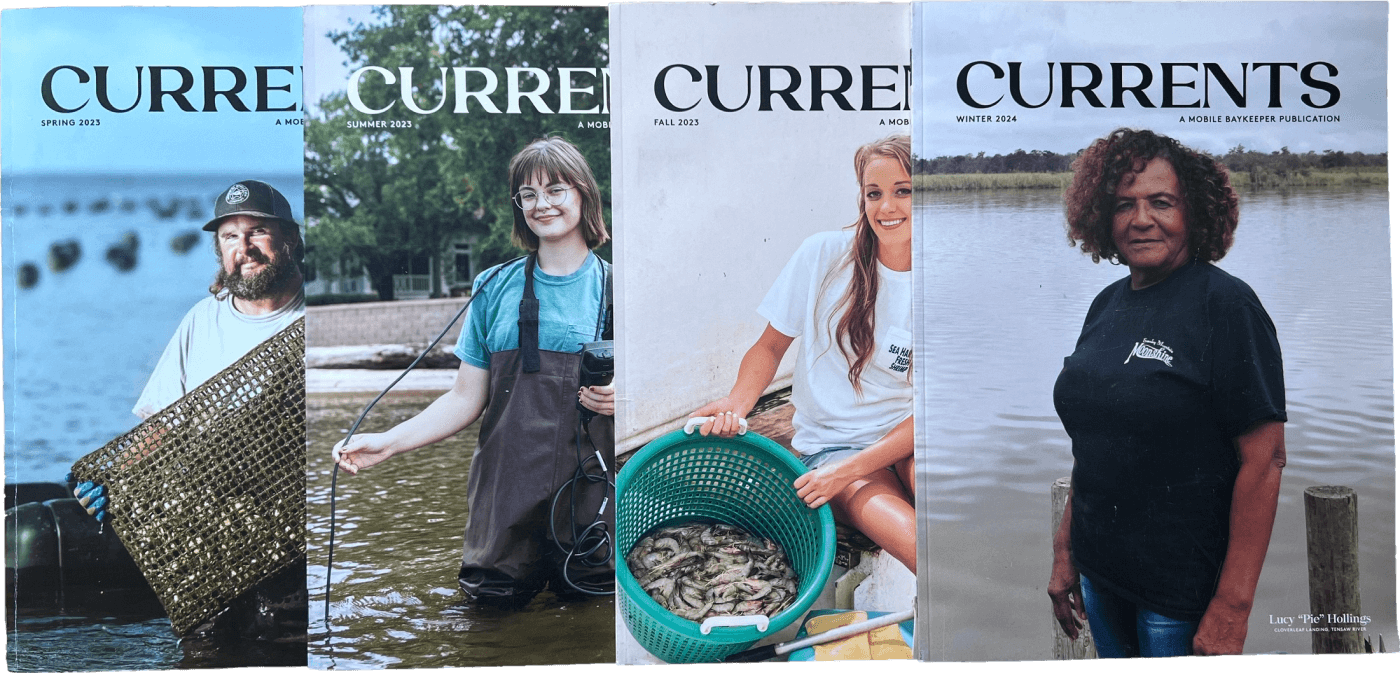
This article is from the 2026 summer edition of Mobile Baykeeper’s print quarterly, CURRENTS. The magazine is mailed to active members who have given more than $50 in the past year. To get on the magazine’s mailing list, donate here.
By Sam K. Wilkes | Photos by Courtney Mason
There is only one town in the United States that receives its mail year-round by boat. So, it’s easy to grasp the appreciation the Magnolia Springs community has for its waterway. The postal practice dates back to 1916 and is still going strong more than a 100 years later, except now it’s done with a tiller outboard on an aluminum Jon boat loaded with crates of stamped mail, idling along the mailboxes perched on the docks.
But it’s not just the mail route that connects the people of Magnolia Springs to the water. The first families settled around the Magnolia River because of its spring-fed nature. Rich in biodiversity, the Magnolia River is one of the chief sources of fresh water in Weeks Bay, flushing and replenishing itself regularly. The river has held a reputation for some of the nation’s purest waters, from the days of the early settlers until recently in 2010, when it received the state’s designation as an “Outstanding Alabama Water.” This label recognizes the waterway’s exceptional ecological significance and requires the state’s highest protection status. The surrounding Town of Magnolia Springs, with roughly one thousand residents, has managed to maintain most of its quaint charm over the decades, hidden from the encroaching sprawl under its veil of Spanish moss and tunnel of live oaks. Yet neither the town, nor the waters, are immune from all the effects of the outside world, especially those flowing downstream.

In 2025, a favorite swimming site, “Cold Hole,” started showing signs of record-high bacteria levels. This historic part of the Magnolia River sits near the heart of the town, with a deep underwater cold spring that keeps it consistently cool and has provided relief to many locals for centuries during the sweltering summer heat. Mobile Baykeeper had contracted to test the waters at this site weekly. The Baykeeper SWIM report tested for Enterococcus and E. coli. Test results typically varied week to week, depending on rainfall amounts and other factors; however, the Cold Hole report had showed bacteria readings above 4,000 most prob- able number (“MPN”). (In April, Mobile Baykeeper paused its SWIM water-quality monitoring program due to a lack of dedicated funding. We plan to resume the program once funding is secured. )
The EPA considers water safe for swimming when the bacteria count is below 104 MPN per 100 mL of water. “While Enterococcus and E. coli in and of themselves are not necessarily dangerous, they are indicators that other more dangerous pathogens may be present,” says Baykeeper staff scientist Cassie Bates. “If you swim in water with high levels of these bacteria, it could potentially cause some serious health issues.”
Robert Turner has been residing in Magnolia Springs for more than 32 years. He’s served on the town council for the past five years. Turner had seen the Baykeeper SWIM reports and had attended a neighboring Wolf Bay Water Watch meeting. “Baykeeper drew my attention to the testing aspect,” he says, “and I knew of other water-watch groups, so I decided I wanted to get involved and keep an eye on our own watershed.”
That decision led Turner to resurrect the “Magnolia River Alabama Water Watch” organization, a group that had not been in operation for roughly 15 years. Turner now serves as the director of the organization. And even though he has a double major in Biology and Chemistry, he had never used those degrees with his career. “I have no work experience related to this, just a passion for the watershed,” he says. And Turner quickly learned he was not the only one. When Turner rekindled the organization in 2025, they started with only four volunteers, a group that has grown to 14 volunteer certified testers as of March 2026.


However, this is not simply townspeople signing up to stare at the water occasionally. The organization is affiliated with the Alabama Water Watch corporate group and requires all testers to go through several hours of rigorous training and classes. “The testing procedure is strict and controlled, which is why training is needed,” says Turner. “But you do not necessarily have to have a science background to test. Anyone willing to be trained can be a tester. We just need concerned citizens.”
The Town clerk, Hannah Driskell, was one of those concerned citizens and an initial volunteer with Turner. “I have lived in Magnolia Springs my whole life,” says Hannah. “I went to school to be a paramedic right out of high school. I have an associate’s degree in applied science, but no background in water testing.”
Hannah and other locals, Lisa Mason-Sanders and Bill McFadden, started on the initial team with Turner in the spring of 2025. In addition to testing, Hannah helps coordinate the meetings and ensures the testing supplies are stocked. “Before becoming a certified tester, I had to complete a 4-hour online course and a 4-hour in-person course. We also have to be recertified by the Alabama Water Watch every two years,” says Hannah.
Volunteer Lisa Mason-Sanders had a background as a laboratory technician. After attending a presentation by Ashley Campbell of the Baldwin County Environmental Protection Agency and Johanna Gertsch of the Weeks Bay National Estuarine Research Reserve, Lisa decided to apply her skills to help preserve the health of their unique waterway.
The Town of Magnolia Springs and state organizations quickly welcomed the small startup and have been very supportive. The organization receives some funding from the Town as well as the Mobile Bay National Estuary Program, but it relies heavily on its volunteers and donations. The team tests the waterway once a month at 14 certified locations from near the head of the Magnolia River to the mouth, covering a span of roughly four miles. Each team member has their own assigned test location. “My spot is upriver at The Commons,” says Hannah. “I don’t have to use a boat to access my location, but some other team members do.”


Baykeeper’s SWIM program tested weekly in two spots along the Magnolia River, yet it only focused on bacteria levels, while the Magnolia River Water Watch team tests for bacteria as well as salinity levels, pH, oxygen levels, turbidity, and the overall chemical health of their waterway.
“Cassie Bates with Mobile Baykeeper has been a great help for us interpreting the data and tracking on maps,” says Turner. The health of the water is not readily visible with the naked eye. “So, data is strength. All our test results are sent to Alabama Water Watch headquarters, and that data is posted on their website monthly for the public.”
Through Hannah’s work on the team, she has learned firsthand how important data collection is to preservation. “The data we gather and submit can be used to identify unusual shifts in water quality or bacteria counts, help justify restoration projects, evaluate impacts of development or land-use changes, support zoning or conservation decisions, and help identify problem areas needing attention such as runoff, erosion, or septic issues,” says Hannah. “Sharing the results with the community is very important to me. Because I know everyone in Magnolia Springs loves the Magnolia River. So, we encourage members of the community to be active in the health of our river, whether that is through volunteering with the team or being an advocate.”
Some team members drive their boats and sample from the middle of the river, while others collect from areas closer to shore. Some do both. They each have their tackle box of professional-grade water-testing tools and perform the chemical tests on site, which include measuring the oxygen, pH, turbidity, and salinity levels. The team uses salinity refractometers that look like rifle scopes to measure the salt, as salinity levels can dictate the growth rates of certain bacteria and provide other water health indicators. The Magnolia River typically contains mostly freshwater due to its spring- fed nature. However, sometimes with the right current or winds, the brackish waters of Mobile Bay and Weeks Bay will push up into the river.
After testing and recording the salinity, oxygen, pH, and turbidity levels, each team member lowers into the river a latched container that holds inside two uncontaminated glass bottles in order to collect a final water sample with no exposure to the air or human touch. The containers securing the two bottles are then taken to Town Hall, where the team extracts a sample with a sterilized pipette and tests it on a Roth Biochemical card. Three Roth cards are used for each testing site. Finally, they place the test cards into a pre-heated incubator for 24 hours and wait for the results. If blue spots appear, then E. coli is present. The amount is then measured against the EPA’s recommended guidelines for human safety of below 104 MPN per 100 mL of water. Recent bacteria results near the head of the river have shocked some of the team members, which only fuels their continued efforts to educate the public.
In addition to the monthly tests, the group meets every two months and then conferences quarterly with a Task Force Team which includes ADEM, the Mobile Bay NEP, the state’s Department of Agriculture, and Foley’s Environmental Department. The initial goal of the Magnolia River Alabama Water Watch was to obtain a year’s worth of data on the river to provide a baseline and overall picture of the health of the waterway. However, this data has also assisted with source tracking pollutants for ADEM and Foley’s Environmental Department. “We sourced three dirt pits causing issues at the head of the Magnolia River,” says Turner, “and have been able to close those recently which has helped the river a great deal.”


However, Turner stresses that this organization was not developed to be a punitive organization. “We're not playing sheriff, but we do want to help open the public’s eyes to problems,” says Turner. “We believe if we find pollutant sources and document them clearly, then most people will work to resolve the problem. As an analogy, if your neighbor’s septic tank is leaking and causing problems in the neighborhood, your goal is not to call the sheriff and punish them, rather you want to inform your neighbor so the problem can be remedied for the good of both properties and the community.” As the old sayings go, we know what rolls downhill and what flows downstream. As Baldwin County grows rapidly, the downstream flow only becomes more complex for this historically pristine waterway and productive estuary. Turner and team are dedicated to protecting the river’s “Outstanding Alabama Water” designation. The state designation aids in those protection efforts, but it often takes community members and grassroots movements to sustain real action. That aspect gives Turner hope for the future of the organization.
“The community has accepted the cause and we’re getting more and more volunteers weekly. We’d like to add more test sites and explore multiple grant opportunities,” says Turner. “But most importantly, our voice is now being heard statewide. The river is the main artery to the heart of this town, so we have no choice but to keep it alive and well.”