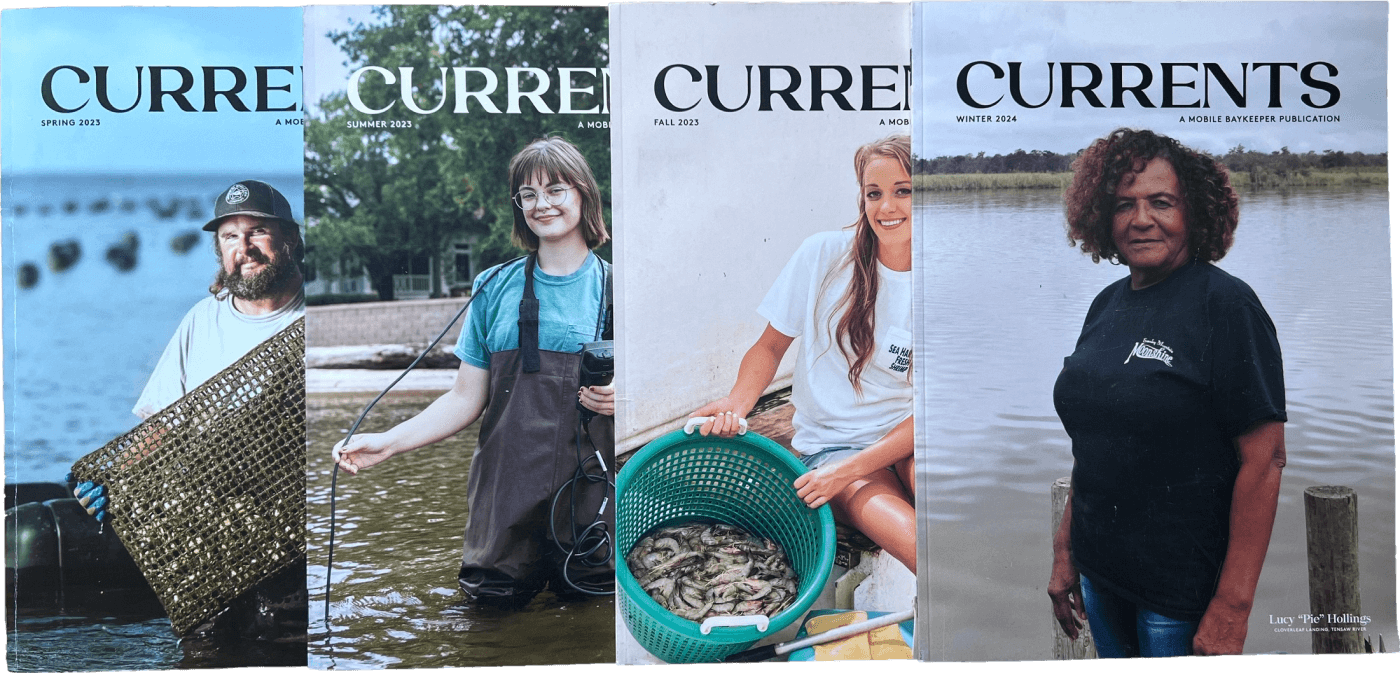
This article is from the spring 2026 edition of Mobile Baykeeper’s print quarterly, CURRENTS. The magazine is mailed to active members who have given more than $50 in the past year. To get on the magazine’s mailing list, donate here.
By Nick Williams
Justin Dunnam has spent his entire life on the waters around Mobile Bay and the Mobile-Tensaw Delta. He’s a well-known kayak tournament angler in the area, the creator of the Eight Mile Drifter YouTube channel, and a regular voice on the Alabama Freshwater Fishing Report podcast. Off the water, he holds a Bachelor of Science in Biology from the University of South Alabama (Go Jags!) and teaches high school science at Government Street Christian School.
That mix of hands-on fishing experience and scientific training is what shapes Dunnam’s views on local fish-consumption advisories. A calm, thoughtful, and patient man, he approaches the issue not as an alarmist, but as someone who genuinely loves fishing, enjoys eating fish, and wants clear, honest information so people can make informed choices. The problem, as he sees it, is that those clear answers are often missing.
Justin traces his fishing roots back to growing up near a small, unnamed creek off Old Citronelle Highway, where he and his neighborhood friends fished almost daily throughout summer break. That creek, he says, was clearly polluted even back then.
"There was a little creek my friends and I fished as kids where people would throw roadkill and dump trash. I’m sure that the creek, if you tested for anything in it, would probably be almost irradiated with all the contaminants and stuff.” Even as kids, they understood something wasn’t right. “We’d dig a few worms, and break them in half, and take them down to the creek in the summer. And we used to catch a lot of fish there, but we never would eat them. We joked that one day we’d catch one with three eyes!”

As Justin grew older and started fishing more seriously, especially after getting his first kayak, those early experiences stayed with him. Chickasaw Creek, a place he fished from childhood through adulthood, became a focal point of his frustration. “The whole time that I would go to Chickasaw Creek, from childhood on up until just a few years ago, there was always a sign that said, ‘Do not eat the largemouth bass from this water,’” he says. What bothered him wasn’t just the warning, but the lack of explanation. “There wasn’t any additional information with it. If you asked anyone, they would just tell you that they were mercury-poisoned and that was the end of it.” There was no clarity on where the risk started or stopped. “Is it safe to eat the fish way up the creek, or is it safe to eat them farther down? There was never any explanation.”
After earning a biology degree, Justin began to better understand what mercury contamination actually means. “I learned a little bit more about methylmercury and how it can impact fish, and how it accumulates up the food chain and ultimately in your body,” he says. What surprised him most was how few contaminated filets it takes. “The portions they tell you to eat of fish, in places where there’s contamination and they recommend reduced consumption, it’s pretty low. So it doesn’t take long to get to that level.”
Once that clicked, he started digging for more information, and that’s where he really hit a wall. “I just couldn’t really find any good sources of current information about where testing was done, when it was done, or how it was done. There really was a lack of data. I could find pretty regular swimming advisories, like if there’s bacteria in the water, that sort of thing,” he says. “But as far as when it’s safe to eat fish from a creek, I just can’t find that much information."

Maps might show a creek in red, with a note to limit consumption, but the details are missing. “I can’t look at when fish were tested and what fish were tested. How far up the creek they sampled, how big the fish were, there’s just not much information. Why are some creeks safe and other creeks are not?” That lack of transparency, especially when neighboring creeks have different advisories, doesn’t sit right with him.
He’s also keenly aware that people respond to advisories very differently. “There are people with more and less trust in the government,” he says. Some anglers dismiss the warnings entirely. “I know a few people who think that banning the consumption of largemouth bass is just for the benefit of big bass tournament organizations, so they don’t even pay it any attention.” Others assume clear water means clean fish. “People think that because the water looks clean, it must be clean, so the fish in it must be clean.” On the opposite end, he sees people who won’t eat anything local at all. “They won’t keep any seafood that comes out of the local waters and would prefer farm-raised fish.”
Justin’s own approach lives somewhere in the middle, guided by what he calls common sense rather than hard data, because hard data is so hard to find. “Where it’s heavily industrialized around there, I really won’t keep anything — bass, bluegill, catfish — from that area anymore.” Instead, he’s more comfortable farther upstream. “I would prefer to keep fish from way up the creek, where I know that there shouldn’t be anything directly polluting the water.” Still, he’s quick to add that conditions matter. “If we have a heavy rain and they say there’s sewage in the water, I don’t think anybody in their right mind would start keeping fish from a specific spot!”
At the heart of Justin’s perspective is a simple warning paired with a deeper wish. “Be vigilant. You know, when you consume fish that may have the potential to be contaminated, you're exposing yourself to that. So do your research.” His advice is practical but cautious. “Because it seems like there’s just not enough information out there to make a solid decision in every circumstance, you really have to just use your common sense.” What he really wants, though, is better information so people don’t have to guess. “It is very rewarding to know that you can go out and catch your dinner, or feed your family, feed your neighbors,” he says. “I think people should take advantage of that and not have to worry about whether or not the fish are contaminated.”
Despite what he knows about fish consumption advisories, Justin still fishes. He still eats fish. But he does so with an awareness shaped by experience, education, and some frustration with how little clear information is available. “I would like for there to be more information out there,” he says, plainly. Until then, he believes anglers are left doing the best they can with common sense and incomplete answers.