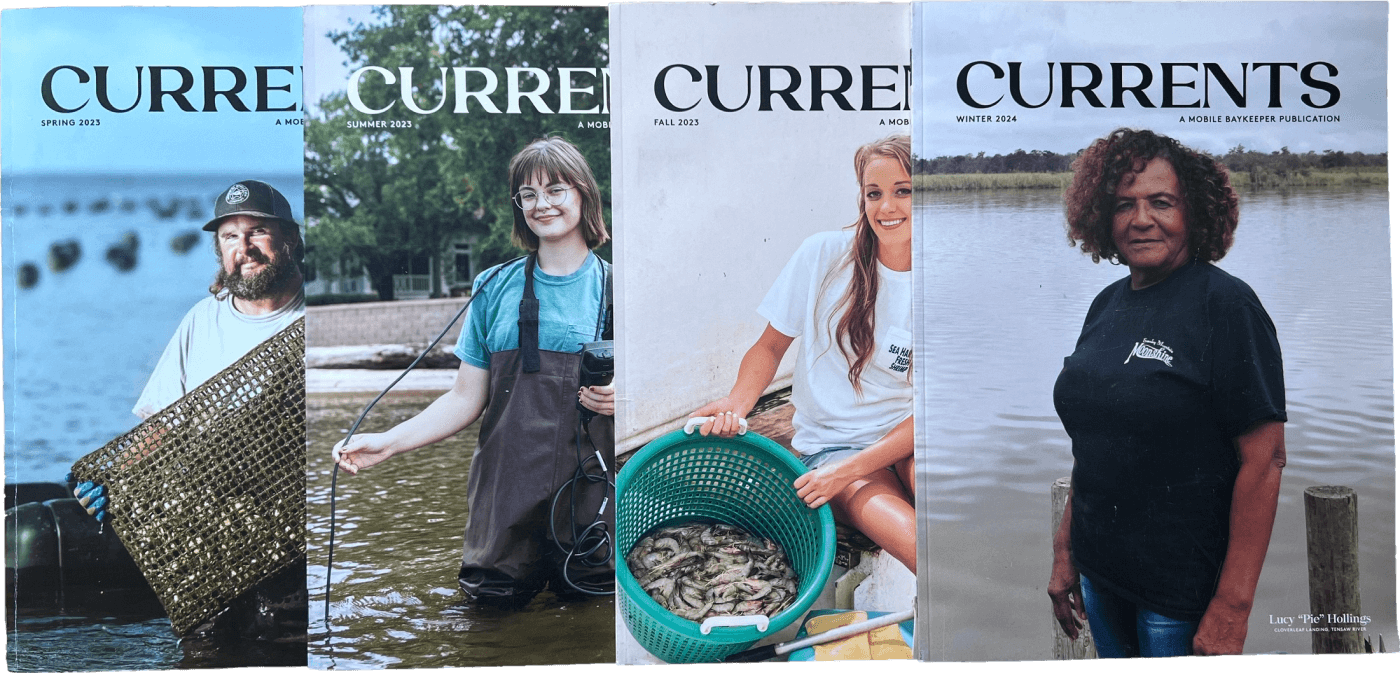
This article is from the 2026 fall issue of Mobile Baykeeper’s print quarterly, CURRENTS. The magazine is mailed to active members who have given more than $50 in the past year. To get on the magazine’s mailing list, donate here.
By Susan Rouillier | Image Painting of Choctaw woman in Mobile by S. Philip Romer, 1850 (courtesy of Museums at Washington and Lee). MOWA Cultural Center and Museum
During a conversation with historian Peter Rivers in Mount Vernon, Dauphin Island came into focus, not as a solitary island, but as one thread in a vast Indigenous homeland, woven together by seasonal movement, ancestral memory, and a deep knowledge of the land and sea. Rivers, a historian with the MOWA Band of Choctaw Indians, described a people who identify themselves as Choctaw and as direct descendants of the Native Americans who used Dauphin Island. In his telling, the island was not merely visited a few times, but formed part of a living network of fishing camps, seasonal harvests, and village connections stretching between the coast and the river bluffs inland. For these families, Dauphin Island was a place they often returned to for food and work.
From the River Bluffs to the Island
In our conversation, Peter Rivers explained that his ancestors traveled to Dauphin Island from inland settlements near McIntosh Bluff and Twenty-One Mile Bluff. To make the journey, they cut trees at McIntosh Bluff, lashed them into rafts, placed themselves and their goods on it, and floated downriver, allowing the current to carry them downstream toward Mobile and Dauphin Island. After selling their goods near the French settlements, they returned home overland on foot, suggesting that these were practical, one-way trading rafts rather than permanent boats used for regular upstream travel.
From Mobile, they continued by canoe to Dauphin Island, where they gathered fish and oysters and maintained camps or village sites. They would stay for periods of harvesting, then return inland again.
This memory of regular movement between river and island suggests not separation but continuity: the bluffs, the Bay, the island, and the fisheries all belonged to one seasonal round of life. Rivers recalled his great-grandfather speaking of oysters on Dauphin Island that were bigger than his hand—a detail both intimate and astonishing, and one that conveys the abundance the island once offered.
Fishing Camps and the Wealth of the Water
In Rivers’s account, the people who came to Dauphin Island were skilled fishers who knew how to take from the water with care and precision. They made fish traps from wood and reeds, constructing them like crates or funnels that allowed fish to swim in but not back out. These traps worked with the habits of the fish rather than against them, drawing on observation and patience instead of wasteful force.
They also made fishhooks from bone, shaping tools from the remains of animals already used for food. Nothing was discarded carelessly. Along the rivers they planted corn, beans, and squash— known as the traditional Three Sisters—and fertilized these crops with fish intestines, returning the richness of the catch to the soil. The method reveals an economy of deep intelligence: the river fed the people, and the people fed the ground.
Fishing, then, was not an isolated activity. It was tied to agriculture, toolmaking, travel, and seasonal settlement. Dauphin Island’s waters supplied fish and oysters but also sustained a wider food system reaching back inland to Choctaw communities along the Mobile and Tombigbee waterways.

Foodways: Using the Whole of Creation
Rivers emphasized that his ancestors wasted little. Their foodways were bound to practicality, reverence, and close ecological knowledge.
The turtle was especially important. All parts were used. Its intestines were dried and used for stitching tools and clothing. The shell could become a teething ring for babies. Turtles were not only a source of nourishment and materials, but also of ceremony: there were turtle songs and a turtle dance, evidence that the animal lived not only in daily life but in the spiritual and cultural imagination of the people.
Other foods also formed part of this richly adapted diet. Families raised the Three Sisters and gathered wild foods such as poke salad. They ate hominy, prepared jelly from native persimmons, and enjoyed a traditional corn dumpling called “bonaha.” Rivers also described a Choctaw dish called “lalahoo,” a kind of gumbo made with vegetables and seasoned with sassafras, a plant that had many uses. Sassafras was enjoyed as a tea, used in seasoning, and associated with smoking and curing meat. He also noted that roots from fruit-bearing trees were used to flavor dishes such as pork stew.
Their hunting practices also reflected practical knowledge. Small animals such as squirrels, rabbits, and raccoons were avoided in summer because of the risk of disease. Instead, people turned more often to birds, while also hunting deer, pigs, and turkeys. The pattern suggests a highly observant food tradition, one that responded not only to availability but to season, health, and inherited wisdom.


Basketry, River Materials, and Everyday Skill
Along the river, families made baskets from honeysuckle vine or kunsha vine, using the natural materials that grew around them. These baskets would have been essential to gathering, carrying, storing, and processing food. Such work belongs beside fishing and planting, for it shows how thoroughly daily life depends on knowledge of local materials.
What emerges from these practices is not a list of separate crafts, but a complete system of living. The vines became baskets. The bones became hooks. The turtle shell became a tool for a child. Fish nourished both people and crops. Food, labor, ceremony, and environment were interwoven.
Dauphin Island in the Larger Indigenous World
Archaeology supports the idea that Dauphin Island belongs to a much older Indigenous landscape. The shell rings and mounds on its north shore testify to thousands of years of occupation, harvesting, and return. North of the Bay, at Bottle Creek, one of the great mound centers of the northern Gulf Coast rose as a ceremonial and political center, linking the coast, Delta, and inland waterways into a larger world of exchange and movement.
By the time the French arrived in the early 1700s, their records began naming Native groups more specifically. In those colonial documents, the Choctaw appear clearly as a major interior people with whom the French traded, negotiated, and formed alliances. What the written record does not provide is a neat, uninterrupted paper trail connecting every Native family on Dauphin Island directly to today’s Choctaw descendants.
But oral history, archaeology, and regional continuity together tell a deeper story. They suggest a coastal and inland Indigenous world connected by waterways, kinship, trade, and seasonal migration—a world in which Dauphin Island fits naturally as a place of repeated Choctaw use and memory.
The MOWA Band of Choctaw Indians
Today, the MOWA Band of Choctaw Indians is based primarily in southern Washington County and northern Mobile County in southwest Alabama, in communities such as McIntosh, Mount Vernon, and Citronelle. Their name, MOWA, combines Mobile and Washington counties. They identify as descendants of Choctaw people who remained in Alabama rather than being removed west during the forced removals of the 1830s.
The MOWA Band received state recognition from Alabama in 1979, though they continue to lack federal recognition. Over generations, many families were misclassified in census and government records, often recorded simply as “people of color,” or under other racial categories rather than recognized as Indian communities. That bureaucratic erasure complicated later efforts to establish formal recognition, even as cultural continuity endured.
Despite those obstacles, the MOWA community has continued to preserve and teach its heritage. Rivers noted that the Choctaw language, which he referred to as “Achafa,” is taught in schools. Cultural celebrations and powwows continue, including the Green Corn Dance, Rabbit Dance, and Turtle Dance, along with traditional-style dress and games such as stickball. Choctaw stickball sticks, called “kapucha,” are typically made of hickory wood. Each player carries two sticks, one in each hand, the larger one for catching, the smaller one for throwing a tightly wrapped leather ball. The community also maintains cultural institutions and educational programs that keep these traditions alive.

Memory, Continuity, and the Island
Rivers’s testimony is valuable not because it supplies modern bureaucratic proof, but because it preserves something older and more human: lived continuity. In his account, Dauphin Island remains part of a remembered Indigenous geography—reachable by raft and canoe, rich with oysters and fish, tied to inland bluffs and villages, and sustained by practices that honored the full use of every plant and animal taken.
The story of Dauphin Island’s Native past is therefore not only a story of archaeology or colonial documents. It is also a story carried in families: of giant oysters, turtle songs, reed fish traps, bone hooks, sassafras tea, baskets made on the riverbank, and journeys from bluff to Bay. Through such memories, the island remains what it long was—an Indigenous place of harvest, return, and belonging.
This article is adapted from Susan Rouillier's forthcoming book, “Dauphin Island: 1699–2027,” which chronicles the island's history from its Native American heritage through the modern era.