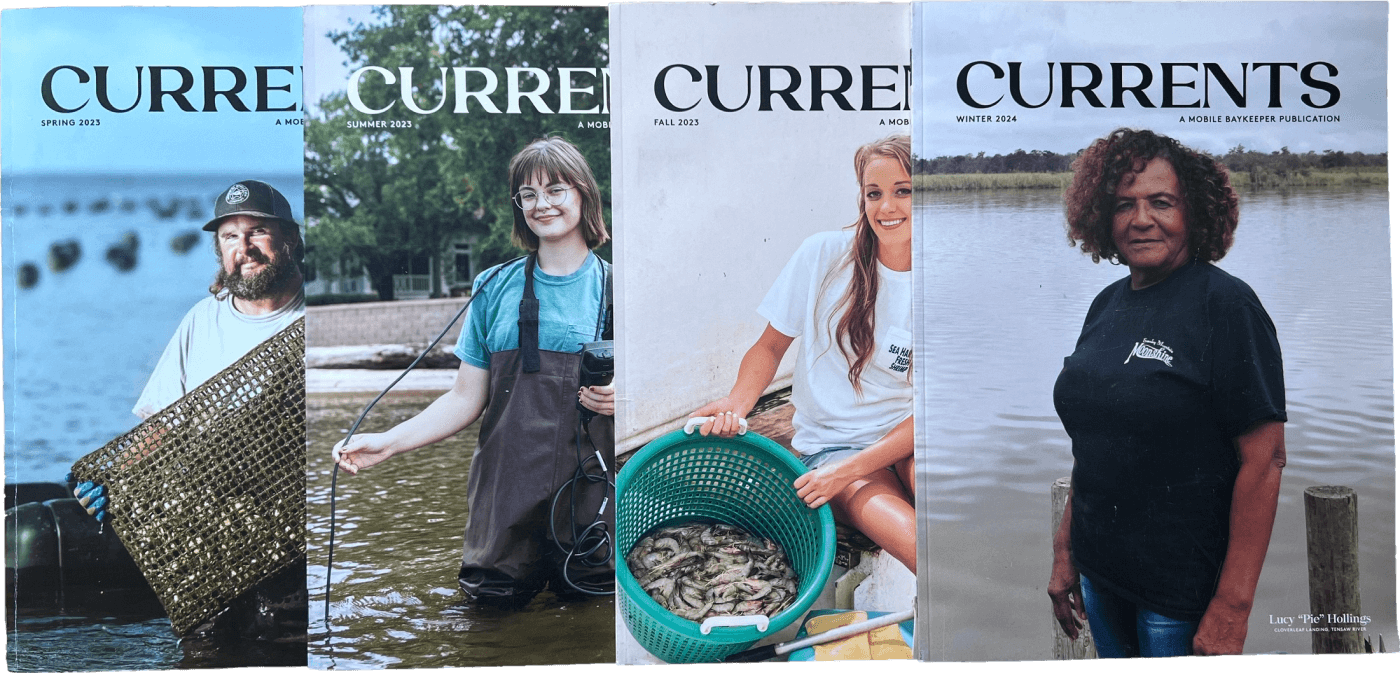
This article is from the spring 2026 edition of Mobile Baykeeper’s print quarterly, CURRENTS. The magazine is mailed to active members who have given more than $50 in the past year. To get on the magazine’s mailing list, donate here.
By Grant Blackburn
My road to vice is always paved with stress. When demands start grinding against the limits of my ability, you might find me having an extra nightcap, or a bowl of ice cream with a cookie stuck in it. Usually, I find a reserve of willpower and conduct myself in a way that wouldn’t disappoint my mother. But at other times fallibility and minor vice win the battles in my mind. When that happens, if I can get away with it, I drive to north Baldwin County and disappear into the Tensaw Delta for as long as I can.
Timber therapy was necessary last December, and my nine-year-old son, JB, wanted to go with me. We left Orange Beach on a Friday morning and drove to Red Hill Spring, in Latham, to fill up on water before launching the boat. Rain had not fallen there for weeks, but the spring was reliable. Cool, sweet water flowed from the side of the hill, just as it had done for “unknown generations” of people, mentioned on a plaque at the spring, who came to this place before we did.
JB filled our water jug, and locked up for a moment as he turned away from the spring. “What a cataswamp!” he said.
“A what?” I asked.
“Cataswamp.”
“What does that mean?”
“It’s that.” JB said, pointing toward Red Hill Creek.
“That, son, is a creek and a bog. And there’s probably a beaver dam somewhere we can’t see.”
“Well, it’s a swamp,” JB said, “so that’s the last part. And the first part of the word is like a cat, and it looks like cats are in there.”
“Okay …” I watched as JB worked his jaw, trying to finish his thought.
“It also means a guy who doesn’t know what he’s doing.”
I told JB to formulate a consistent definition, and to put our jug of spring water on ice. But I kept thinking … cataswamp. It was a fine way to describe the stress-induced cognitive bog that had sent us running for the woods in the first place. It called to mind a rudderless version of myself that could emerge if I lost focus — a guy whose course through life was set by the magnetism of the day’s most pressing demands. I stopped thinking like that and told JB, on second thought, that the word was excellent and his definition was perfectly consistent. He shot me a satisfied grin and we made for the launch.
You need a vessel to explore the Delta, preferably something with a shallow draft and a deep tolerance for abuse. JB and I use a Gheenoe called The Hard Way. Imagine a canoe, a bit wider than normal amidships, with a push pole, a flat transom, and a few rod holders. No electronics, no battery, no intricate systems to break and disappoint us. Just a simple boat filled to the gunwales with tackle, gear, and spring water. It was fortunate that the Gheenoe could float off in high humidity, because the water at Rice Creek Landing was remarkably low. After backing all the way down the ramp, we still had to shove The Hard Way off its bunks. We poled our skiff away from the crumbling gravel ramp a few moments later, and were free.
We pushed into Baldwin County’s riverine wilderness and entered the realm of technologically plausible deniability. By that, I mean cell coverage is wonderfully sporadic, and you feel like you are back in the 1990s. You cannot be expected to communicate with anybody who isn’t with you when you come to the Delta, and you can’t rely on a phone to show where you are. Nor can you promise someone that you’ll be in touch. Jimmy Buffett called it going incommunicado, and for those of us who suffer from overconnectivity, it is a wonderful gift.
We poled The Hard Way through the tannic, glassy water of Rice Creek toward the place where JB and I wanted to spend the night. Alabama State Lands maintains a dozen or more shelters on the Bartram Canoe Trail. Some float, others are built on pilings, and a few sit on land. We were headed for the Jug Lake platform, which floats alone at the end of Bayou Jessamine beneath a canopy of bald cypress and water tupelo.
Low water revealed parts of trees that we had never seen, their buttressed foundations rising from the water more prominently than usual. Spiky cypress knees broke the surface, encircling ancient trunks like sunken crowns of living timber. The water was so low that we had to get out and drag the boat over several submerged logs. She’s named The Hard Way for a reason, and by the time we reached our campsite the skiff was covered in mud and we had earned a sense of accomplishment.


JB and I had hours until dark and nothing to do, so we talked. We “hunted deer,” (which means I watched my son thrash the undergrowth with the audible signature of several boars and we saw no deer). We made up games, shot JB’s Red Rider, and hooted with the owls, who hooted back. The woods grew quiet after sunset, and the creeping darkness seemed to bring the whole Delta with it, drawing the sights and sounds and smells in close. At dusk the woods still felt alive, but subdued, like they were following a rhythm and preparing to rest. We found the Pleiades through the cypress canopy, and traded stories until JB fell asleep.
I was almost asleep in my hammock when I realized, for the first time in a while, that the vices were silent. Not just quiet, but absent. At the risk of saying too much, that was a bit unusual. But lying there, I wanted for nothing. We hadn’t eaten much for dinner, but I wasn’t hungry. I did not want a bowl of ice cream, or my phone, or anything else. JB also seemed content, for his part. I saw him as I remembered myself as a kid, before the words ‘phone’ and ‘tablet’ invoked thoughts of parental restrictions and charging blocks. JB had lived that afternoon in the moment, with a kid’s mind, soaking up whatever new things the Delta had to show him. I fell asleep looking at the Seven Sisters without a trace of cataswamp in my head, wondering why that was so.
We awoke to thundering gunfire in a dim, predawn light. Dew covered everything, and the air was cool, but so thick with humidity that it almost tasted sweet. Ducks flew for cover and shotgun blasts filled the timber in all directions. JB and I loaded the Gheenoe but waited to pole out until the shooting was over, lest we ruin the morning of some guy who had rolled out of bed in the wee hours to get in his duck blind. On the way out we met two hunters who let JB hold his first duck, and swore him to secrecy before sharing a reliable hole where we might find a couple of our own. Before long we were making our way back toward Rice Creek. A belted kingfisher and several lucky wood ducks flew upriver ahead of us, skimming the smooth water and clearing the way.
Had you asked me at the start of our trip why timber therapy works, I would have said that it all comes down to elimination. That it removes the everyday distractions and stressors. And while I still think that is true, our trip broadened my perspective. Floating through the Delta for a couple of days allows for a clarity of mind that is mutually exclusive with good cell service. It is not escapism, but the promise of an opportunity for quiet, unbroken thought that will draw me back to the Delta next time.
Sometimes, when I haven’t been to the woods in a while, I get worked up. I will tell anybody within earshot that I am going to move off the grid and throw my phone in a barrel fire. But that isn’t true. I don’t want to disappear, and I don’t need to, so long as the Delta is here with a bit of therapy when I need it.
For information about the Bartram Canoe Trails in the upper and lower Delta, including campsite reservations and an interactive map, visit alabamacanoetrails.com/bartram