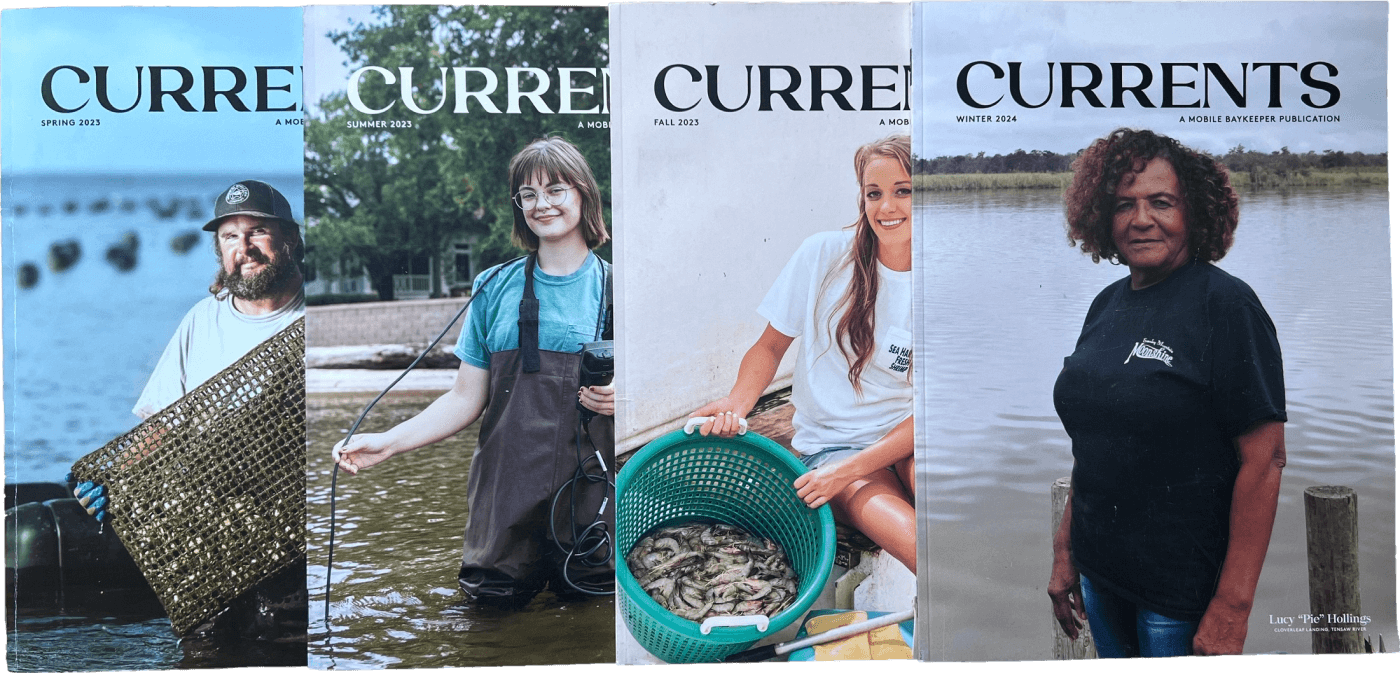
This article is from the 2026 summer edition of Mobile Baykeeper’s print quarterly, CURRENTS. The magazine is mailed to active members who have given more than $50 in the past year. To get on the magazine’s mailing list, donate here.
By Susan Rouiller | Photo: Peter Alba, 1910. Courtesy Ala. Dept. of Archives and History
When we think about the deep roots of south Mobile County — the bayous, the oysters, the salt-kissed winds that shape lives — we should think also about the figures whose lives helped shape it, too. One such man was Peter Francis Alba (1833–1915), a name that may be familiar to many around Bayou La Batre, Coden, and Dauphin Island, but whose story deserves to be told with the full weight of its humanity: a life of service, struggle, and generosity that rippled across generations.
The Early Years
Peter was born in Pensacola, Florida, in 1833, but his family moved to Mobile when he was still a child. Growing up in Mobile, young Peter was steeped in the culture of the Gulf Coast — its creeks and marshes, its rhythms of tide and trade, its people forged by sea and soil.
From an early age he showed the courage and resilience that would mark every chapter of his life. He was drawn westward in the mid-1800s, becoming what was then termed an “Indian fighter,” serving on the frontier alongside officers who would later be famous in Civil War annals — among them Robert E. Lee. In those years Peter encountered hardship, danger, and the brutal realities of frontier conflict.
The Civil War
But his fight did not end there. When the Civil War came, he answered the call — not as a boy, but as a seasoned man. He served as a Confederate cavalryman, riding with determination born of unwavering loyalty to the community he called home. The war, with all its devastation, marked him deeply, as it did so many of his generation.
What is remarkable about Peter Alba is that his story does not stop with the battlefield. In many ways, that was only the beginning.
A Life of Care
After the war, he returned to civilian life in Mobile and evolved into a popular and prosperous businessman. He was famous for his ability to handle horses and studied veterinary medicine. He also ran a livery stable and “Alba’s Pasture” for the care and boarding of horses near downtown Mobile. He traveled the world and shipped exotic horses from overseas home to Mobile.
He became what some today might call an undertaker — a profession that in the late nineteenth century was not just about burial services, but about care, ritual, and compassion at life’s most tender threshold. In a city still healing its scars from conflict, his work offered respect and dignity to those passing through sorrow. As if all this is not enough, he became a cabinet maker and served as the City Sexton for Mobile in 1890 and 1891. He established Mobile Transfer Company (a baggage handling company), was king of the Mobile Carnival festival in 1875, and was instrumental in forming the Mobile Humane Society.

The Coden Villa
But Peter’s heart was not only invested in solemn duties. He prospered enough to build and own handsome properties, including his villa in Coden, an area that in the late 1800s and early 1900s was gaining a reputation as a seaside haven. His villa wasn’t just a place of comfort — it became a part of the cultural fabric of the community, a landmark where stories were shared and connections made.
A Commitment to Education
Peter had a deep belief in the power of community and education — not just for some, but for all children of this coast. In 1919, several years after his death, that belief bore fruit in a very visible, very meaningful way. Land that Peter had owned was donated for the construction of a Rosenwald school — the Grand Bay Elementary School for Colored — a school built to provide educational opportunities to African American children in an era when segregation and inequality made such opportunities very scarce. Today a historical marker stands at the site where the original Rosenwald School once stood, 11610 HW 90, a quiet witness to the hopes of a community that believed deeply in the power of learning.
His donation of that parcel of land was not just a gesture; it was a commitment to the future of a community that deserved dignity and hope. The school, built with funds from the Julius Rosenwald Fund in partnership with local citizens, stood as the eleventh Rosenwald school in Alabama, a testament to local investment in education and racial uplift. The Grand Bay School, built on Alba's property, consisted of five large rooms, three of which were used for primary through seventh-grade classes. The other two rooms served as living quarters for the teachers.
At a time when few white landowners were willing to take such a step, Peter Alba’s decision was a quiet but powerful act of generosity. It acknowledged the worth of every child’s education and helped provide a foundation for generations to grow, learn, and aspire beyond the restrictions of their circumstances.

The Places That Bear His Name
His contributions to education did not stop there. Across south Mobile County today, the name “Alba” lives on in schools such as Peter F. Alba Middle School in Bayou La Batre, a thriving institution that educates and nurtures young minds, drawing on the heritage of a man who believed in building up community through thoughtful investment in young people. The Alba name is also woven into the history of Alba High School, which served this region for decades before consolidations and renaming eventually became part of the evolving landscape of Mobile County education.
But beyond land donations and school names, Peter’s legacy extends into the very land we touch here on the coast. In the decades after his passing, Peter’s heirs and family holdings helped catalyze community growth in places like Alba Beach, a stretch of shoreline on Mobile’s western shore, named in recognition of the family’s presence and contributions to the region.
His influence also spread into land given for churches, civic gatherings, and other community uses in the area around Coden and Bayou La Batre — lands that helped sustain community cohesion through the twentieth century and into today.
In many ways, Peter Alba was an embodiment of the contradictions and aspirations of his era: a soldier of a fractured nation, a businessman, a caregiver, a landowner, and a benefactor who believed in education and community. He lived through war and peace, through reconstruction and modernization, and in every chapter found a way to anchor himself to this coast, to its people, and to the promise of what lay ahead.
A Dignified Tribute
Captain Alba passed away in 1915, two days before Christmas. His funeral was conducted in the Cathedral-Basilica of the Immaculate Conception by the Bishop of the Mobile diocese, Rev. Edward P. Allen. Graveside services were conducted by Rev. Father Gerow. Prayers were said by Father Kennedy, Pastor of his church in Bayou La Batre. A Confederate Flag was draped over his coffin. Joseph Hermann Jr., bugler for the Raphael Semmes camp, played “Taps” and camp drummer Louis Rafield sounded the last tattoo. Members of the camp led the riderless horse-drawn muffled-drum procession for two miles, from the Cathedral to Magnolia Cemetery, where he was buried beside three of his children who died before him.

His Legacy on the Coast
One can imagine him riding the trails as a young cavalryman, the calm breeze of Mobile Bay on his face; later, standing beside a schoolyard where children played; later still, sitting on the porch of his Coden villa watching the slow arc of Gulf sunsets. In every scene there is continuity: a man rooted here, committed to the land and its people.
Today, when educators at Peter F. Alba Middle School speak of their school’s mission, when students walk the hallways in Bayou La Batre, when families enjoy a morning at Alba Beach or drive past Alba Road and the sites that bear his name, they are touching facets of a legacy that began with one man’s conviction that investments in land and in children have the power to shape a community’s destiny.
His life reminds us that the courage of heroes can be found in the choices they make after wars have ended. Peter Alba’s courage was in his commitment to a future that valued learning, dignity, and shared space. And for that, south Mobile County still carries his name with respect and affection.