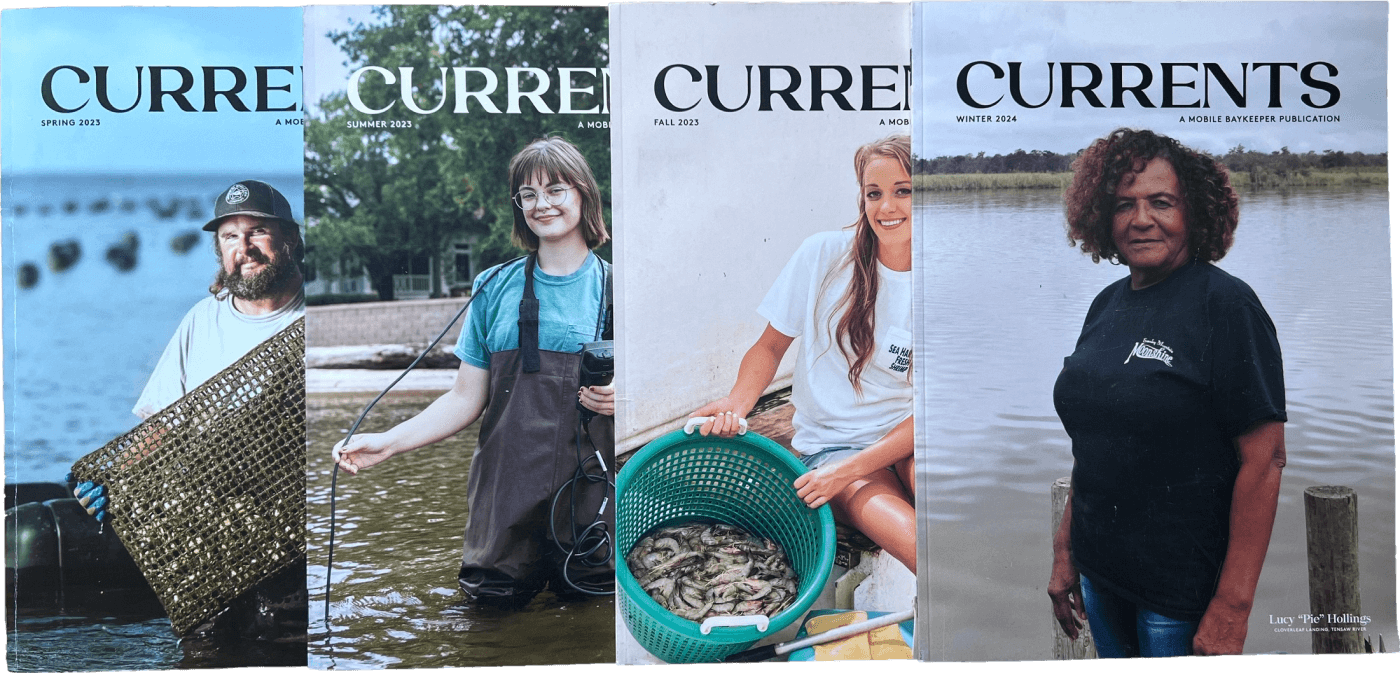
This article is from the 2026 summer edition of Mobile Baykeeper’s print quarterly, CURRENTS. The magazine is mailed to active members who have given more than $50 in the past year. To get on the magazine’s mailing list, donate here.
By Caine O'Rear | Photos by Courtney Mason and Caine O'Rear
"We’re out here looking for old, ancient Indian reefs. Indians lived in them woods, come out here with pirogues. It’s how they fed their families. You’ll find pottery here, mixed in with this stuff, when you get in on these little oyster reefs. You’ll find all kinds of old Indian pottery. And if you want to go fishing, this is the place.”
That’s Michael Williams talking — or better yet, evangelizing — in his characteristically sandpaper rasp. He’s a local oysterman and shrimper of more than thirty years who, along with his wife Kerry Mitchell, make up Salty Pirates Seafood. The pair also spearhead the Alabama Commercial Fishermen Association and have long been advocates for seafood sustainability and reef restoration.
It’s a mild day in the middle of April, and we’re on Heron Bay in Michael’s motorized flatboat, navigating through the marshes and tidal creeks, which today are brimming with shrimp and redfish. Michael proudly calls this his “backyard,” as you can see his house on the Bay from where we sit. Heron Bay lies just west of the Dauphin Island causeway, near Cedar Point, right before you hit the bridge that takes you to the island. The area is a pristine stretch of coastal marsh and maritime forest that runs just shy of 500 acres. On a tranquil morning like this, one imagines it doesn’t look too different from the prehistoric days when indigenous tribes populated the waters and drew their sustenance from it. Or like it did centuries later, when Union troops bivouacked along the Bay in the summer of 1864 and feasted on the seemingly endless beds of oysters while mosquitoes — Rebel bugs love Yankee blood — feasted on them. And yet still, even today, Heron Bay feels like a sanctuary from the threats that plague so much of the watershed, and one can’t help but think that more of our waters should look like this, if only the effort was made. “This is what the rest of our waters could look like if we took care of it,” Michael says.
Today’s mission involves depositing hundreds of pounds of shell as part of a large-scale initiative to build new reefs. The shell that’s being deposited on existing reefs will serve as the foundation to develop more substrate, upon which Baykeeper will add more shell to allow baby oysters — or larvae — to form and flourish. This is known as recruitment, or attracting “spat on shell.”


It’s just one day in the life of Mobile Baykeeper’s Holistic Oyster Restoration project, run by Baykeeper’s own Dr. Kayla Boyd — her “dream job,” she says — who is frequently out in the field with project partners and oystermen like Michael. A Wisconsin native, Kayla earned her PhD from Auburn University in Fisheries, Aquaculture, and Aquatic Sciences, studying how the environment impacted oyster health in the Gulf of Mexico through lab and field work. Boyd says it was the resiliency of oysters that drew her to the bivalves in the first place. “They’re a complicated animal,” she says. “They are simultaneously very tolerant to environmental changes, but also sensitive to certain stress combinations at the same time.”
That resiliency is a good metaphor for the Oyster Restoration Project itself.
“I’ve come to understand that perseverance in the face of adversity is what is needed to see a massive project like this move forward.” Boyd explains. “I don’t mean just myself, but, much like the resiliency of the oyster, the tenacity of the oyster community is something I’ve always respected, and to see it enacted through this project, and through the Alabama Commercial Fishermen Association’s work, has been awe-inspiring and encourages me to reach for grander goals.”
For 2026, Baykeeper plans to plant 500,000 oysters for restoration, as well as permit 50 oyster restoration plots across coastal Alabama. The goal is to accrue additional larvae to support the growth and rebound of the public reef.
“Today was the first day we put shell out here to build the foundations for new oyster reefs up in Heron Bay,” Boyd says. “The shell we put out here will serve as the foundation that we can continue to put baby oysters on top of, so they won’t sink.”
Since the 1950s, it is estimated that Mobile Bay has lost roughly 85 percent of its oyster population — a staggering decline brought on by predation by drills (small predatory marine snails), historically unsustainable harvesting practices, shell-dredging for construction materials, and ship channel dredging.
Yet this spring saw progress in restoring the Bay’s oyster population, as part of Baykeeper’s collaboration with the Alabama Commercial Fishermen Association, Fish Tec, and other groups. Together, the collective has built 13 oyster reefs out of its planned 28 for the year. Locations for planting were prioritized based on several factors, including natural shoreline, salinity regimes, proximity to publicly harvested reefs, historic oyster presence, land ownership, and public interest. Other than Heron Bay, locations include nearby Portersville Bay, Bayou la Batre, Mon Luis Island, and Dauphin Island, among others.
To kick off the initial planting, Isle Dauphine Oyster Company donated hundreds of pounds of shell (the program also uses shell from Alabama Coastal Foundation’s recycling program), while Fairhope Roasting Company donated the burlap sacks that volunteers tirelessly filled. And special thanks goes to the Alabama Department of Conservation and Natural Resources, who greenlit the project and made it all possible. “This project shows what can happen when the community comes together to take responsibility for the health of our waters,” Boyd says.

Oyster restoration in coastal Alabama will not be easy; its current obstacles include a lack of permitted oyster restoration locations, a lack of industry involvement in the restoration process, and a lack of commercially available spat-on-shell to be used for restoration.
“There are many bottlenecks, including a lack of a long-term vision for oyster restoration outcomes,” Boyd says. “There have been many unforeseen roadblocks when it comes to permitting, which has been the biggest challenge. When I run up against a wall that prevents an initiative from moving forward, it can delay oysters going in the water for months. However, as I’m working on this project with different agencies, navigating these processes is getting easier. I thank the Alabama Department of Conservation and Natural Resources and the Alabama Department of Public Health for helping this project clear those obstacles to move forward.”
Challenges aside, today is a fun day to be out on the water — the kind of life-affirming spring day we often get before the tropical heat arrives. Michael’s boat sprung a leak earlier in the morning, but he’s assured us he patched it. It’s an old boat that he’s had for five years, and he says it’s the first time he’s had any trouble with it.
“I work it a lot, and with a wooden boat, when you work it a lot, it’s gonna leak,” he says. “It’s a pirogue, man. I told you I’m like an Indian. How long since the Indians was in here? 200 years?”
The Troubles
Alabama’s 2025-2026 wild harvesting season was a short one. It closed in late December 2025, marking one of the worst harvesting seasons in a decade. The Marine Resources Division of the Alabama Department of Conservation and Natural Resources reported that approximately 5,000 sacks of oysters were harvested, totaling 425,000 pounds with an estimated dockside value of roughly $170,000. Compare that to 2020-2021, which saw more than 22,000 sacks harvested, making that season one of the best in recent memory.
At the time of this season’s closing, Kevin Anson, director of MRD, said low salinity and low dissolved oxygen levels, brought on by higher-than-normal water temperatures, were to blame. “These events negatively affect young oysters more than adult oysters and appear to have significantly reduced survival rates for very young oysters,” he said. “Since it takes a minimum of 18 months for an oyster to reach harvestable size, we anticipate a lower number of adult oysters on Alabama's reefs in 2026.”
Back in September 2025, the MRD hosted its annual meeting in Bayou La Batre, where it discussed the state of the oystery and guidelines for this year’s harvesting season. Prior to the get-together (which usually involves a fair amount of tension and even some shouting from the crowd), rumors circulated that the season would be shut down entirely.
“Even though we’ve had several years of better harvest, we’re not where we want to be, we’re not where we were,” Jason Herrmann, a biologist with MRD, told the crowd. He stressed that the most concerning part of the 2024 preliminary data concerned the drop in spat. “Gotta have the babies to have the reef thrive,” he said.
Whether there will be a season in 2026-2027 remains to be seen.
Living Reefs
Laura Solinger-Phillips is a fish biologist for NOAA. While her professional duties with the agency mostly concern entanglement mortality for the North Atlantic right whale, her doctoral studies at the University of Southern Mississippi dealt with oyster restoration, and she has been a staunch advocate for Baykeeper’s holistic oyster restoration project.
‘There are so many factors that are potentially catastrophic to oysters,” she says. “If it’s a hurricane, dredging in the Bay, or it’s really hot — you’ve got diseases down here. It’s a really difficult situation. I’m not envious of our fishermen or managers and the decisions they’re faced with. Our stock is not in great shape, and it hasn’t been in a while.”
Solinger notes that you have to support the calcium content of the reefs, but also create a living system of oysters that can continue to contribute shell and calcium back to the habitat for future shell to live on — an effort that is being undertaken by Baykeeper and one she is duly impressed with.
“You can spend millions of dollars planting, and maybe you get one or two years of good spat development. But if you haven’t supported the environment enough to create a living oyster reef, that effort is quickly eroded.”

Oyster Keepers
In addition to its holistic restoration efforts, Mobile Baykeeper runs the Oyster Keepers Program, a hands-on reef restoration initiative that engages the community by activating waterfront property owners’ docks and piers to host an adult reef. The oysters are suspended in cages year-round and produce the larvae that seed new reefs. Each cage has the potential to produce 100,000,000 oyster larvae per year and filter 2,000 gallons of water per day.
Baykeeper has secured all the piers needed for 2026, but anyone wanting to be part of Oyster Keepers in the years ahead can sign up for our newsletter at Baykeeper Newsletter to stay connected. We are working toward a goal of planting five million oysters by 2028, and it’s the community that helps move that goal within reach.
Coda
Recent research suggests the ancient reefs were not only a food source for the Native Americans that populated the southern coasts, but also the linchpin of ecological balance, with harvesting practices that sustained reefs and oyster populations for millennia.
In a 2020 paper published in the journal Science Advances,[“Eco- system stability and Native American oyster harvesting along the Atlantic Coast of the United States”], the authors noted that “despite intensive harvesting of these fishes [by Native Americans along the Georgia and South Carolina coasts], for the most part, such practices were sustainable over long periods, indicating ... that some form of social control and management of resources occurred along the coast. Adaptive controls, such as common pool management and proprietorship over beds, likely emerged with the onset of village formation along the coast as populations moved into productive new areas where resources could be procured.”
The study clearly suggests that Native Americans worked together and were highly organized when it came to oyster harvesting — something we’ve failed to achieve in the modern era.
Centuries later, accounts of Union soldiers stationed in coastal Alabama during the Civil War testify to the bounty of reefs that existed in Heron Bay and Cedar Point, an interesting slice of history documented in historian Paul Brueske’s book The Last Siege: The Mobile Campaign, Alabama 1865. “[We’d] wade for oysters in the shallow pond above the cove, and forget our baked heads and cut and bruised feet, in the tantalizing prospect of fried oysters for supper ... but the novelty would not last forever,” wrote Andrew F. Sperry of the 33rd Iowa Volunteer Infantry.

Sperry’s experience sounds like something worth returning to. Mobile Baykeeper's mission is to defend and revive the health of the waters of coastal Alabama, and one of our markers of success is seeing the community take responsibility for the health of its waters.
“One of the encouraging aspects of the Oyster Restoration Project is that it is community-driven and led by a variety of stakeholders,” Boyd says. “This project is not only restoring ecosystem functionality, but it also provides support for the commercial oyster fishery. Industry and environmental balance is the unique feature to this project. The language of oysters is universal, regardless of industry or state-line boundaries. Having the support of various stakeholders, and to see groups working together to make every shell that goes in the water have the maximum potential for success, is worth more than anything.”